Not
everything worth reading is hot off the press. In this section, we recommend "something old" that is still well worth
reading. "Something old" can mean anything from a venerable and antique
classic to a good book first published four or more years ago.
“MAJOR BARBARA” by George Bernard Shaw (first
performed 1905; first published 1907)
 Like
most people who bother to think of him, I have a very mixed attitude towards
George Bernard Shaw (1856-1950). Once
upon a time, and especially in his old age when he had become the “Ancient of
Days”, the Anglo-Irish playwright (and Nobel Prize-winner of 1925) was regarded
as a colossus of literature. But his stock began to fall almost as soon as he
died. Does he now feature in many university courses of literature? I do not
know – though I do remember that when I was an undergraduate forty years ago,
we were pulled unwillingly through one of his more obtuse plays, Man and Superman, in Stage Two English.
Presumably even in the 1970s he was still regarded as a giant of theatre to
whom undergraduates had to be introduced.
Like
most people who bother to think of him, I have a very mixed attitude towards
George Bernard Shaw (1856-1950). Once
upon a time, and especially in his old age when he had become the “Ancient of
Days”, the Anglo-Irish playwright (and Nobel Prize-winner of 1925) was regarded
as a colossus of literature. But his stock began to fall almost as soon as he
died. Does he now feature in many university courses of literature? I do not
know – though I do remember that when I was an undergraduate forty years ago,
we were pulled unwillingly through one of his more obtuse plays, Man and Superman, in Stage Two English.
Presumably even in the 1970s he was still regarded as a giant of theatre to
whom undergraduates had to be introduced.
In the late
1980s and early 1990s, Michael Holroyd was still trying to make this case in
his three-volume biography of Shaw. I read Holroyd’s triple-decker with
pleasure as a compendium of political, social and literary history, but I was
not convinced. Holroyd seemed to be trying to revive a corpse.
 Of course GBS
can’t be dismissed with a one-liner, even if GBS himself dismissed many complex
problems with one-liners. Pygmalion
and some others of his plays still hold the stage and please audiences, which
is the only true measure of a playwright’s durability. Even people who haven’t
read him or seen his plays performed have at least heard of him (which is true
of most authors of any fame, I guess) and some of his one-liners are still
quoted.
Of course GBS
can’t be dismissed with a one-liner, even if GBS himself dismissed many complex
problems with one-liners. Pygmalion
and some others of his plays still hold the stage and please audiences, which
is the only true measure of a playwright’s durability. Even people who haven’t
read him or seen his plays performed have at least heard of him (which is true
of most authors of any fame, I guess) and some of his one-liners are still
quoted.
I have to admit,
too, that I’ve had quite a few encounters with him in my life.
In my days as a high-school English teacher, I
at various times got classes to study Saint
Joan (a success with the kids – especially the girls) and The Devil’s Disciple (bad choice and not
a success). I directed a production of Arms
and the Man at one school, and a production of the one-act-er The Shewing Up of Blanco Posnet at
another. I remember spending many hours, about thirty years ago, following the
whole text of Shaw’s flatulent (and very long) late effort Back to Methuselah, when it was given a radio broadcast. I also
remember being in Dublin fifteen years ago with my wife and one of our sons,
when the fiftieth anniversary of Shaw’s death was being commemorated with a
revival of some of his plays. We took the tour of Shaw’s birthplace, saw a very
jolly production of Arms and the Man
at the Gate Theatre and a surprisingly gutsy production of his early play about
prostitution Mrs Warren’s Profession
at the Abbey Theatre. To this I could add seeing stage, TV and film productions
of many other Shaw plays – from an unexpected revival of Shaw’s heavy-handed
comedy You Never Can Tell at
Auckland’s late Mercury Theatre to a doleful TV production of Heartbreak House to Dirk Bogarde suffering
prettily in a film version of The
Doctor’s Dilemma.
I tell you all
this just to reassure you that when I make big generalisations about Shaw, I am
not speaking from complete ignorance.
But I am still
left with the question – why has his stock (with intellectuals, critics,
cultural “gatekeepers” – and the general public) fallen so low in the 65 years
since he died?
Here are a few
of my suggestions.
First, there is
the fact that even if he believed he was a disciple of Ibsen, and was breaking
away from the old “well-made play”, his plays still have a very old-fashioned
style and structure (usually a neat three acts hiding behind the proscenium
arch). Exposition. Crisis. Resolution. This was already becoming mouldy decades
before he died. He might have lived to 1950, but his dramaturgy was stuck in
about 1910.
Second, there is
too often a glibness to his plays. Problems are solved with neat one-liners or
with set-piece speeches. Shaw can produce interesting and complex characters
(Liza Doolittle, with her desire to be a lady, but with her growing realization
that Henry Higgins fails to treat her even as a human being). But then he
solves their problems with rhetoric rather than character development (Liza
Doolittle in the last act neatly tells Higgins where he’s gone wrong and how
she wishes to assert herself – it’s not like the ending of the musical version My Fair Lady, folks.). Instead of
watching a drama, we often feel we’ve wandered into a debating society where
ideas are bandied about rather than human beings explored. And, of course, the
best speeches are always given to the characters who are Shaw’s mouthpieces.
Finally, and
perhaps most uncomfortably, there are Shaw’s limited and dated ideas. There’s
nothing wrong with being a Fabian socialist, but it does become very dodgy when
mingled with Nietzschean “Superman” worship. Just as he often wraps up his
plots with rhetoric, so does Shaw look to the Big Men, the Napoleons (The Man of Destiny) the Caesars (Caesar and Cleopatra) and the Ubermensch himself (Man and Superman) to solve society’s problems. He has, in effect,
swallowed the nonsense about the enlightened despot, the benevolent dictator,
and this adds up to a naïve worship of bullies and of raw power itself. (See
his play The Apple Cart). Small wonder
that in his old age he was one of those who propagandised for Stalin. Add to
this his eugenics, and the witticisms seem to be heading down a very dark path
indeed.
Yet, forsooth,
he was a wit and did have
things to say and could be engaging in his work.
Which – to sighs
of impatience from you for having to wait so long – at last brings me to Major Barbara. This was another of those
plays that I once taught, with some profit, to high-school kids. It is also a
play I have seen a number of times in performance – again, a good production at
Auckland’s long-gone Mercury Theatre and a number of viewings of Gabriel
Pascal’s old film version.
Why do I pick Major Barbara?
 Because for me
it is the epitome of the best and the worst of Shaw. I do not think that, for
polemical wit, Shaw ever wrote a better scene than Act Two of Major Barbara (the Salvation Army
Shelter scene). And I do not think that a Shaw play ever ended with such a
deadly clunk as Act Three of Major
Barbara. In this one play, Shaw shows his strengths as a dramatist, and
then kills it all with debating society cleverness.
Because for me
it is the epitome of the best and the worst of Shaw. I do not think that, for
polemical wit, Shaw ever wrote a better scene than Act Two of Major Barbara (the Salvation Army
Shelter scene). And I do not think that a Shaw play ever ended with such a
deadly clunk as Act Three of Major
Barbara. In this one play, Shaw shows his strengths as a dramatist, and
then kills it all with debating society cleverness.
To orient you.
Act
One is a bland piece of exposition. In her drawing room Lady Britomart
Undershaft, long estranged from her husband the millionaire arms manufacturer
Andrew Undershaft, explains to her son Stephen the family fortunes. She needs
money to marry off her two daughters and she can get it only by asking the
husband whom she has not seen for years. Of one of her daughters, Sarah, and
her inane fiancé Charles, I shall say nothing more. They are basically in the
play to provide comic relief with their inanities, just as the pompous Stephen
is. However the other daughter, Barbara, is the heart of the piece. Barbara has
taken it into her head to join the Salvation Army and is engaged to an
improvident young Professor of Greek, Adolphus Cusins. (A big laugh for the
London audience of 1905 – Cusins was very obviously modelled on Shaw’s friend
the classicist Gilbert Murray, who offered Shaw suggestions on how the play
should develop. The joke is quite a dead one now.) After the preliminaries, the
play gets going only when Andrew Undershaft enters. He at once forms a strong
bond with Barbara. They have the same hearty wit and strong will and firmness
of opinions, even if their opinions differ. Undershaft listens respectfully to
what Barbara has to say about the Salvation Army, but suggests he, as an
industrialist millionaire, has a better way to save men’s souls. So the play’s
central debate is set up. Will money and power do more than religion and
charity for the good of humanity? Undershaft agrees to visit Barbara’s place of
work so long as she will visit his place of work. We breathe a sigh of relief
as the act ends. It has all been somewhat mechanical, as such lengthy expositions
always are, but it has been necessary and at least we know we are going
somewhere.
So to Act Two,
which I persist in believing is the best piece of theatre Shaw ever wrote. It
is a horrible, cold winter morning at the West Ham Salvation Army Shelter. The
scene opens with two Cockney wretches, Snobby Price and Rummy Mitchens. They
are discussing how (in order to get a feed) they have only pretended to be
great sinners, so that the Salvation lasses can have the pleasant illusion that
they have “saved” them. Shaw is at once suggesting that charity given by
religious organizations is always a sham for the recipient. An enthusiastic,
young Salvation Army lass, Jenny Hill, enters with a poor, broken-down old
workman, Peter Shirley, who is miserable about having to accept charity. So,
says Shaw, people are degraded by receiving charity.
So far, so
amusing. But it hots up when a young Cockney thug called Bill Walker comes
bursting in. He wants to claim back his girlfriend and give her the thrashing
of her life because she has dared to run away from him and hide out with the
Salvation Army. In his anger, he punches and hurts the first Salvationist he
sees – Jenny Hill. Enter, calmly and imperiously, Major Barbara. The way she
handles Bill Walker is Shaw at his best. By dealing with Bill Walker in a
brisk, professional fashion, Barbara totally deflates him. Better still, she
starts his conscience nagging at him by making him realise that he has done
wrong in his violence. We admire Barbara. She has great psychological insight.
She has a great way with words. She is an impressive figure. In this encounter,
she is a role any real actress would crave to act. Yet there is a subtle irony
undercutting Barbara’s handling of Bill Walker. In a way, we are aware there is
something immensely unfair about it. After all, Barbara is a very well-bred,
well-educated and articulate young woman, protected by her status as an earl’s
grand-daughter, while Bill is a poor, inarticulate thug. This is a contest of
unequals. As Barbara packs off Bill to find his girlfriend in another Salvation
Army shelter, we almost feel sorry for him.
Andrew
Undershaft and Adolphus Cusins have entered while Barbara is dealing with Bill,
and Undershaft has had the opportunity to see her at work. Cusins is in Salvation
Army uniform. In an amusing aside Undershaft exposes Cusins’ Salvationism as a
sham. Cusins has joined up only because he is in love with Barbara and has a
vague idea of the Salvation Army as a joyful, Dionysian religion, unlike the
gloomy evangelical churches. More to the point, Undershaft begins a serious
debate with Barbara. Says Undershaft, the Salvation Army is all very well, but
it merely produces the type of dependent, submissive people whom factory owners
such as he like to direct and exploit. Besides, it works by bribing people with
charity and the promise of heaven. Says Barbara, the Salvation Army works
selflessly to help the poor and it does save souls. Says Undershaft, the
Salvation Army can be bought by powerful people with money. Says Barbara, the
Salvation Army is not for sale.
Whereupon two
things happen.
A crestfallen
Bill Walker comes back, having been thumped and defeated by his former
girlfriend’s new man. Bill offers to pay a few pence for the damage he has
done. Barbara virtuously rejects his money. The Salvation Army is not to be
bought, she says. Besides, she wants his soul, not his money.
Enter a
Salvation Army commissioner, Mrs Baines. For lack of funds, there had been the
threat that Salvation Army shelters will have to close down. But, rejoices Mrs
Baines, a millionaire has generously offered a large cheque on the proviso that
somebody else matches it. Barbara is horrified to discover that the millionaire
in question is a whisky distiller – in her view, exactly the type of person who
causes many of the social ills that the Salvation Army has to clean up. At once
Andrew Undershaft, the armaments millionaire, sits down and writes the matching
cheque. Mrs Baines accepts it thankfully and she marches off (with Cusins in
tow beating a big drum) to a great Salvation Army meeting to celebrate.
Now Barbara is
devastated. The Salvation Army can be bought after all. Worse, it can be bought
by those who promote drink and war. In the play’s climax Barbara, in tears,
takes off her Salvationist badge and pins it to her father, saying that he has,
after all, paid for it. Remembering how his modest offering was refused, while
the millionaire’s money was gratefully accepted, Bill Walker sneers
sarcastically “What price salvation now?”
With these words ringing in Barbara’s ear, the curtain falls.
This is an
invigorating act. Of course it is polemical. Neatly, Shaw has argued that
charities run by religious organizations are at best the fabled
ambulance-at-the-bottom-of-the-cliff. They might help some individuals but they
don’t, he says, really deal with the essential problem of why there is poverty
in the first place. Worse, by doling out charity while accepting donations from
the rich and powerful, they really help to perpetuate the injustices of
society, even if this is not their intention. Implicitly, they are part of the status quo. For those who share such
views, this is the whole point of the play – a diatribe against both religion
and charity. (It is no accident that Major
Barbara was much admired by a Marxist like Bertolt Brecht and seems to have
been part of the inspiration for Brecht’s own Salvation Army lass play, Saint Joan of the Stockyards).
I can swallow
these simplifications, however, because they are put across with such wit and real
dramatic flair in Act Two. The act does have some of the verbal jousting of a
debate (Barbara and Undershaft; Undershaft and Cusins), but it is also buoyed
by its real and raucous humour, its contrasts of colourful wretches, even if
they are Shavian personifications of ideas, and especially by its conclusion,
which leaves its protagonist with a real problem.
So we sit up
expectantly wondering how it will all end.
At which point
Act Three begins and it all goes horribly wrong.
I will not try
your patience with a detailed synopsis. Suffice it to say that the first half
of Act Three has the whole Undershaft family gathered together in the drawing
room we saw in the opening act. The matter of the Undershaft inheritance (which
I haven’t discussed here) is worked out, with Shaw finding a very silly
contrivance – dependent on a very dated joke – to make Adolphus Cusins eligible
to inherit Andrew Undershaft’s business. In this act, Andrew Undershaft takes
to lecturing on his philosophy of life. The manufacture of advanced armaments
is acceptable because the more horrible war becomes, the more people will
strive to abolish it. (Over a century later, we may insert a hollow laugh at
this point.) Heavy industry provides jobs, and therefore does more than charity
does to help the poor. Cusins, who has given away the pretence of being a
Salvationist, accepts all this enthusiastically. So to the concluding scene
where the ensemble visit Undershaft’s armaments factory, with model workers’
village attached. Running about looking at it (with us having to suspend our
disbelief that Barbara has never considered her father’s place of work before),
Barbara and Cusins are both overwhelmed by the truth of Andrew Undershaft’s
philosophy. Here is the embodiment of Undershaft’s ideas. Happy workers,
regular work, the dignity of labour, a model for the rational organisation of
society and hence no need for doled-out charity. Barbara has been downcast
since her confidence in the Salvation Army was shattered. But now her spirits
rise. She will “re-join the colours”, and see how many souls she can save in an
environment where people are not degraded by being dependent on charity. She
will join Cusins in running Undershaft’s factory. “I have got rid of the bribe of charity. I have got rid of the bribe of
heaven,” she says. “Let God’s work be
done for its own sake.”
What is so bad
about Act Three? For one thing, it is so unconvincing in terms of
characterisation. Having been a strong-willed, intelligent, witty and
forthright young woman in the first two acts, Barbara suddenly becomes a mere
puppet waiting to submit to her father’s superior reasoning, and with nary a
solid argument to oppose him. This gives us time to reflect on how shallow her
earlier enthusiasm must have been in the first place. For another, it is all
conveyed in talk, talk, talk – or rather lecture, lecture, lecture from Andrew
Undershaft, especially when he presents his “gospel” to his family. At one
point, Shaw attempts to counter this obvious criticism with a weak joke where
Lady Britomart rebukes her husband for his speechmaking. But this doesn’t
cancel the objection. The dreaded Shavian debating-society rhetoric goes to
work and the play falls down dead as mutton. And so much is simply unresolved –
at least in terms of the clash of ideas that we were promised. As a whole, Major Barbara is a great build-up to a
big let-down.
Quite apart from
the dull thud it all makes as drama, let’s also note the stupidity of so many
of Shaw’s ideas. The perverse defence of the armaments business is sheer
impertinence. Once again, Shaw’s supposed plan to dignify labour and raise the
proletariat from the degradation of charity depends upon the largesse of a Big
Man – Undershaft. It is not democracy that Shaw is really promoting. It is
paternalism. So once again roll on Nietszche and the Superman.
Above all,
though, the attack on charity is based on the assumption that somehow society
can be organised in such a way that charity will become unnecessary. This might
have seemed a reasonable assumption in 1905 when the “welfare state” was just
beginning to be organised. But over a century later, with the vagaries of
economic organisation in the Western world, and especially with the rise of
neo-liberalism in the last forty years, it rings as hollow as Shaw’s witticisms
about the armaments trade. I am left with the impression of a play, which gives
ammunition only to supercilious people who mock charity because they wish to
belittle those who actually get their hands dirty in helping the poor. “We’re not like those silly religious people
who give out piecemeal charity. We’ve got a far better plan to improve the
world. Meanwhile we can sit on our hands and do nothing as we await the
revolution…. Or the Big Man who will solve all our problems….”
So, having told
you what I verily believe is the best scene Shaw ever wrote, I say farewell to
GBS. What a witty man. What a great talent for farce and one-liners. What
engaging caricatures. And what tedious speechmaking. What facetious debating
society rhetoric. What inability to resolve the big issues he deals with. And
what a congeries of foolish, half-baked ideas.
Major Barbara gives you
the essence of Shaw.
 Cinematic
Footnote: Though I have read this play many times,
and though I have seen a good stage production of it, whenever I think of Major Barbara, I think of Wendy Hiller
in the eponymous role in Gabriel Pascal’s 1941 film version. Pascal was the
Hungarian chap whose whole film career was based on the fact that he had
managed to persuade old GBS to let him have the film rights to his plays. Pascal
scored a palpable hit with his excellent production, directed by Anthony
Asquith, of Pygmalion in 1938 (Wendy
Hiller as Liza Doolittle; Leslie Howard as Henry Higgins). He did pretty well
with his film of Major Barbara three
years later. But the rest of his film-producing career was a bit of a train
wreck, including the disastrously expensive flop Caesar and Cleopatra in 1945 and a silly and amateurish film of Androcles and the Lion a few years
later.
Cinematic
Footnote: Though I have read this play many times,
and though I have seen a good stage production of it, whenever I think of Major Barbara, I think of Wendy Hiller
in the eponymous role in Gabriel Pascal’s 1941 film version. Pascal was the
Hungarian chap whose whole film career was based on the fact that he had
managed to persuade old GBS to let him have the film rights to his plays. Pascal
scored a palpable hit with his excellent production, directed by Anthony
Asquith, of Pygmalion in 1938 (Wendy
Hiller as Liza Doolittle; Leslie Howard as Henry Higgins). He did pretty well
with his film of Major Barbara three
years later. But the rest of his film-producing career was a bit of a train
wreck, including the disastrously expensive flop Caesar and Cleopatra in 1945 and a silly and amateurish film of Androcles and the Lion a few years
later.
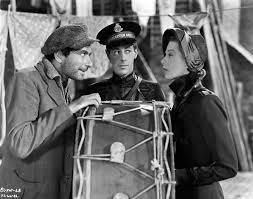 I
watched Major Barbara once again (on
Youtube) ahead of writing this notice. Wendy Hiller is beautiful in her brisk,
hearty English way and in her tearful despair at the end of the Salvation Army
shelter scene. Rex Harrison does a pretty good turn as the ironic Adolphus
Cusins (very similar to Leslie Howard’s playing of Henry Higgins in Pygmalion). Robert Newton rolls his eyes
and chews the scenery as the thuggish Bill Walker. And there is interesting
casting in the minor roles – a particularly greasy and sardonic Emlyn Williams
as Snobby Price; a very young Deborah Kerr as Jenny Hill; a bossy Sybil
Thorndike as Mrs Baines. Most surprising casting is Robert Morley as Andrew
Undershaft. He was already Mr Pomposity. But he was only 32 when the film was
made, so he had to be hidden under bushy grey beard and hair to appear
convincingly as the father of an actress who was only three years younger then
he was.
I
watched Major Barbara once again (on
Youtube) ahead of writing this notice. Wendy Hiller is beautiful in her brisk,
hearty English way and in her tearful despair at the end of the Salvation Army
shelter scene. Rex Harrison does a pretty good turn as the ironic Adolphus
Cusins (very similar to Leslie Howard’s playing of Henry Higgins in Pygmalion). Robert Newton rolls his eyes
and chews the scenery as the thuggish Bill Walker. And there is interesting
casting in the minor roles – a particularly greasy and sardonic Emlyn Williams
as Snobby Price; a very young Deborah Kerr as Jenny Hill; a bossy Sybil
Thorndike as Mrs Baines. Most surprising casting is Robert Morley as Andrew
Undershaft. He was already Mr Pomposity. But he was only 32 when the film was
made, so he had to be hidden under bushy grey beard and hair to appear
convincingly as the father of an actress who was only three years younger then
he was.
 The
film wisely “opens things up” a bit. There’s a long opening section (not in the
play) where Cusins first meets and courts Barbara. We actually see Bill Walker
being beaten up by his rival in love rather than merely hearing about it. There’s
a big Salvation Army celebration staged in the Albert Hall. Just as wisely,
most of Undershaft’s speechifying is cut from Act Three. What is substituted,
however, is just as bad – a long, long sequence of Barbara and Cusins gawking
enthusiastically at Undershaft’s factory and model town, which must have seemed
ultra-modern in 1941 but now looks positively primitive (apart from being
obviously models and painted glass shots). For all the cinematisation, the last
part of the film is just as much of a let-down as the last third of the play,
leaving us with unresolved questions and with the impression that Barbara and
Cusins are merely opportunistic children after all.
The
film wisely “opens things up” a bit. There’s a long opening section (not in the
play) where Cusins first meets and courts Barbara. We actually see Bill Walker
being beaten up by his rival in love rather than merely hearing about it. There’s
a big Salvation Army celebration staged in the Albert Hall. Just as wisely,
most of Undershaft’s speechifying is cut from Act Three. What is substituted,
however, is just as bad – a long, long sequence of Barbara and Cusins gawking
enthusiastically at Undershaft’s factory and model town, which must have seemed
ultra-modern in 1941 but now looks positively primitive (apart from being
obviously models and painted glass shots). For all the cinematisation, the last
part of the film is just as much of a let-down as the last third of the play,
leaving us with unresolved questions and with the impression that Barbara and
Cusins are merely opportunistic children after all.
That
most of Act Two is left just as Shaw wrote it is testimony to the fact that
this is the only part of the play that’s worth a damn.


