-->

Monday, June 20, 2022

Something Old

Not everything worth reading is hot off the press. In this section, we recommend "something old" that is still well worth reading. "Something Old" can mean anything from a venerable and antique classic to a good book first published four or more years ago.      

 “DOMINION – The Making of the Western Mind” by Tom Holland (first published 2019)


In reviewing Tom Holland’s Dominion – The Making of the Western Mind I am breaking my own code. This “Something Old” section of my blog is supposed to concern itself with books first published four or more years ago, and here I am reviewing a book first published a mere three years ago. Oh well!


Tom Holland’s long and compendious book has received much attention and – given that it has a very Christian message -  has gained praise from many unexpected quarters. Be it noted that, while first released as Dominion – The Making of the Western Mind, it was also published under the title Dominion – How the Christian Revolution Remade the World.


Holland’s central thesis is essentially a very simple one – the Western mind (meaning the mind of people living in Europe and in countries that have been influenced by Europe, or dominantly settled by Europeans) has been largely shaped by Christian thought. For most of approximately 1700 years – since Constantine legalised Christianity in the Roman Empire – the Christian faith dominated Europe, and despite all the persecutions, wars of religion, pogroms and other gross injustices that were perpetrated in Europe when it became known as Christendom, the essential teachings of the New Testament still endured and guided thinkers and philosophers. This was true even of those who were at odds with the ecclesiastical order. Indeed many who attacked the church were acting on Christian precepts. Until very, very recently, few people would have disputed this claim. Christianity made Europe what it is. But in an age of “secularism” (a very ambiguous word), it is often claimed that Christianity is so much in decline that it no longer influences the way Westerners think. And this is what Holland refutes. As he interprets it, underlying even movements that regard themselves as secular, agnostic or even atheist, there is still a large residue of Christian thought, assumptions and attitudes. In many respects, those in the West who decry or belittle Christianity are still acting on precepts which grew out of Christianity.


To orient you, let me explain that Tom Holland divides his lengthy treatise in three.

Part One he calls “Antiquity” taking us through pre-Christian Athens and Jerusalem, the origins of Christianity and its spread (with an emphasis on Saint Paul), the establishment of an orthodox creed, how heaven was conceived, how far early Christian missionaries went, the doctrine of charity and then, in the early 7th century, the barrier that was raised with the advent of Islam. I confess that I found this part – the first 180 pages of Dominion – to be the hardest to read, not because it was difficult to read, but [I beg your pardon for saying so] because it was all familiar to me from my own time taking a degree in, and then lecturing in, early Christian history. So we are taken through the development of a monotheistic belief among Athenian philosophers and the gradual development of God among the Jews. The Jewish religion was the first to favour the poor as opposed to the powerful. With Christianity there came a proclamation in universal terms of favour of the poor and weak over the rich and powerful. It is in the hard development of Christian orthodoxy that one has to wrestle with thinkers like Origen and Arius and the extremely puritan Donatists before we reach the Nicene Creed. There is the matter of charity, and the conflict between Pelagius who says human beings are perfectible by their own will; and Augustine who says human beings are inherently flawed. There is the influence of Manicheanism  with its dualistic ideas. Holland also notes the primal split in early Christianity between those who see faith having to work in the world and those who believe faith can be practised only by withdrawing from this world – the hermit or monastical impulse that will appear again and again in Christian history. “Throughout Christian history, the yearning to reject a corrupt and contaminated world, to refuse any compromise with it, to aspire to a condition of untainted purity, would repeatedly manifest itself.” (Chapter 4)

 But in all this, Holland emphasises the universality of Christianity’s claims and the message that all human beings are equal – breaking with Classical pre-Christian societies

Part Two Holland calls “Christendom” from the early Middle Ages on, when the Christian faith dominated Europe, with missionaries like Boniface converting the pagan Saxons, but with the threat of an expanding Islam conquering Iberia and leading to the long Reconquista. And it is while examining the Middle Ages that Holland makes it clear there have been many “Reformations” in Christian history, for the church always has to be reformed. One of the most important was when Pope Gregory VII introduced a reformation as he faced off against the Emperor (heir to Charlemagne) and established an essential separation of church from state by making the appointment of priests and bishops the province of the church alone. In an age when the first universities were developing from church schools, it began to be more fully understood that faith could be harnessed with reason. (Peter Abelard is referenced.)There was also the codification of church law which, though often reviled in much later centuries by those opposing church and faith, still became the template for later legal codes. Aquinas was one of the leading lights in this. But, as Holland interprets it, the more the faith was codified, the more people were excluded for their heterodoxy. And this meant the beginning of persecutions and the licensing of the first inquisitors. Holland discusses the persecution and ghetto-isation of Jews and the crushing of the Cathars or Albigensians.

But there is an up-side to Medieval Christianity, both before and after the split between the Catholic West (Rome) and the Orthodox East (Constantinople). Although recent authors often emphasise the limited status of women in the Western Middle Ages, Holland reminds us that the sexual mores of pre-Christian Rome offered very little status for women: “A sexual order rooted in the assumption that any man in a position of power had the right to exploit his inferiors, to use the orifices of a slave or a prostitute to relieve his needs much as he might use a urinal, had been ended. Paul’s insistence that the body of every human being was a holy vessel had triumphed. Instincts taken for granted by the Romans had been recast as sin.” (Chapter 11; Page 263) Holland correctly notes that the church’s insistence on monogamous marriage actually raised the status of women in that the husband was called to be faithful. Also marriage was no longer seen as an alliance between families but as a matter of free choice … not that (in the dynastic and familial marriages that still took place) this precept was always honoured… and of course the down-side was that “aberrant” people, such as homosexuals, were severely punished. There was a war on sodomy.

An apocalyptic sub-culture in Christianity meant there were always those who believed their actions could trigger the second coming of Christ. Such apocalyptic upheavals happened at the time when the Catholic church was at a low ebb, its authority compromised by the split between a pope in Rome and an anti-pope in Avignon. In this time, Jan Hus in Bohemia was really the first “protestant” in anything like the current meaning of the word, rebelling against the Catholic church and gaining a large following for his reformation. But such radical changes always bring out extremists; and Holland speaks of the Taborists, also in Bohemia, who believed Christ was coming and who waged war against both Hus’s followers and Catholics. There was much bloodshed before they were defeated. In a way, this was a forerunner of what happened (with the wars of religion that followed) when Martin Luther inaugurated what is usually regarded as the beginning of the Protestant Reformation. Holland see Luther’s reformation as a necessary part of the Christian tradition – like Pope Gregory VII’s reformation centuries earlier. But he is aware that Protestantism tended to be fissiparous, rapidly splitting into separate and sometimes mutually-hostile churches (Calvinist, Lutheran, Anglican etc.). And again there were extremists, hated by both Catholic and Protestants, like the violent Anabaptists who again had apocalyptic beliefs and who again were expunged in bloodshed.

In his presentation of Luther (in Chapter 13), Holland tends to go easy on him, under-stating his violence in encouraging war against rebellious peasants ; but in Chapter 15, he at least notes that Luther’s antisemitism was even more extreme than the medieval antisemitism that had preceded it. Also, despite his largely Anglican orientation, Holland is very even-handed in presenting Catholicism  and Protestantism (the Eastern Orthodox churches have lesser space in this book). Spanish conquistadores took over most of South and Central America, often enslaving the peoples they conquered; but many Catholic authorities protested about this and the cardinal Bartolome de las Casas wrote one of the earliest condemnations of slavery. Galileo (whom Holland does not depict in a particularly favourable light) was condemned to house arrest for his novel cosmology; but the Jesuits were very advanced in the astronomy they taught and brought to China. As Holland puts it “Natural history had revealed itself to be nothing if not Christian through and through” (Chapter 14, page 343) And the Jesuit Matteo Ricci, also in China, was one of the first to pioneer “inculturation” – that is, teaching Christianity in ways comprehensible to a specific society.

So we come to Part Three, “Modernitas”, being basically the last three centuries, and it is here that Holland is most insistent in his basic theses – first, that there are repeated patterns in Christian history; but second, and far more important, that Christian precepts still underpin Western civilisation, even if they are not always recognised.

The Puritans of England, and of their colonies in what later became the United States of America, were very much like the Donatists of many centuries earlier, who insisted on strict, unerring righteousness, often not making allowances for common human weaknesses.

But, says Holland, many Puritans connected reason to the light of God and as such, opened the way for more free thought and emphasis on personal conscience. Thus, says Holland, in the beginning of the so-called “Age of Enlightenment”, many who now protested against organised religion were actually following a Christian tradition. The Jewish philosopher Baruch Spinoza had been expelled from the synagogue for his heterodox thought about God. Holland says his ideas were very much influenced by Quakers and other current Protestant thinkers. Holland even manages to present the sceptical anti-clerical Voltaire as a Christian malgre lui because, like Christians, he sought a universal, rational faith. He scores a palpable hit when he discusses the leaders of the French Revolution and their heirs who, scorning the centuries of Christian “superstition”, claimed to adopt the Classical antiquity of Greece and Rome as their models while devising their Declaration of the Rights of Man – a plan for universal human rights. It took a very questionable character – the Marquis de Sade – to point out correctly that those hallowed ancient Classical societies were slave states with absolutely no conception of human rights, no sense of the equality of social classes and a strong preference for the rich and powerful over the poor and weak. The Marquis de Sade himself delighted in the thought of wanton power over the powerless, but he was admitting that the notion of universal human rights emerged from those superstitious weakling Christians. Even more embarrassing, unacknowledged, the framing of a legal system by the revolutionaries leaned heavily on despised Catholic canon law.

Holland notes, correctly, that Christian concern was involved in such things as the ending of suttee in India, the end of the Atlantic slave trade and diplomacy to encourage Muslim states from slaving.

By the early 19th century, many anti-Christians in Europe were embracing “secularism” (laicite if you are French). But Holland notes: “The great claim of what, in 1846, an English newspaper editor first terms ‘secularism’ was to neutrality. Yet this was a conceit. Secularism was not a neutral concept. The very word came trailing incense clouds of meaning that were irrevocably and venerably Christian. That there existed two dimensions, the secular and the religious, was an assumption that reached back centuries beyond the [Protestant] Reformation: to [Pope] Gregory the VII, and to Columbanus, and to Augustine. The concept of secularism – for all that it was promoted by the editor who invented the word as an antidote to religion – testified not to Christianity’s decline, but to its infinite capacity for evolution.” (Chapter 17, Page 411)

Speaking of another form of evolution, Holland notes (correctly) that Darwin’s thesis of natural selection was not wholly opposed by Christians, but did cause Christians to question what the moral and ethical results of Darwinism would be: “Nervousness at the idea that humanity might have evolved from another species was not bred merely of a snobbery towards monkeys. Something much more was at stake. To believe that God had become man and suffered the death of a slave was to believe that there might be strength in weakness, and victory in defeat. Darwin’s theory, more radically than anything that previously had emerged from Christian civilisation, challenged that assumption. Weakness was nothing to be valued. Jesus, by commending the weak and the poor over those better suited to the great struggle for survival that was existence, had set Homo sapiens upon the downward path towards degeneration.” (Chapter 18, Page 425)

This, says Holland, was very much the thesis of Friedrich Nietzsche in his hatred for Christianity: “Concern for the lowly and the suffering, far from serving the cause of justice, was a form of poison. Nietzsche, more radically than many a theologian, had penetrated to the heart  of everything that was most shocking about the Christian faith. ‘To devise something which could even approach the seductive, intoxicating, anaesthetising, and corrupting of the symbol of the ‘holy cross’, that horrific paradox of the ‘crucified God’, that mystery of an inconceivably ultimate, most extreme cruelty and self-crucifixion undertaken for the salvation of mankind! ” Like Paul, Nietzsche knew it was a scandal. Unlike Paul, he found it repellent. The spectacle of Christ being tortured to death had been bait for the powerful. It had persuaded them – the strong and the healthy, the beautiful and the brave, the powerful and the self-assured – that it was their natural inferiors, the hungry and the humble, who deserved to inherit the earth. … Christianity, by taking the side of everything ill-constituted, and weak, and feeble, had made all humanity sick… The weak had conquered the strong; the slaves had vanquished their masters…” (Chapter 19, pp.448-449)

In effect, in Europe concern for the welfare of the poor, the sick, the weak and the mentally feeble was born of the Christian concepts of universal humanity, of a God who favoured the poor, not the powerful. There would be no universal charter of human rights without this underpinning. It was no accident that, whether intended by Darwin or not, the new science did lead to eugenics – mainstream among biologists in the late 19th and early 20th centuries – and ramped up racism in its rigorous categorising of human groups as inferior and superior. Raw power and brute force were virtues in rising totalitarian states. 

Yet says Tom Holland, the Bolshevik desire to make heaven-on-earth in one fell swoop, whether Lenin and his cohorts realised it or not, was actually rooted in failed Christian-inspired apocalyptic movements. The desire for all things to be held in common could be found in the Acts of the Apostles and other seminal Christian texts. Of Lenin’s programme, Holland writes: “Communists who insisted, in opposition to Lenin, on working alongside liberals, on confessing qualms about violence, on worrying that Lenin’s ambitions for a tightly organised, strictly disciplined party threatened dictatorship, were not truly communists at all – just a sect. Sternly, like the Donatists, the Bolsheviks dismissed any suggestion of compromising with the world as it was. Eagerly, like the Taborites, they yearned to see the apocalypse arrive, to see paradise established on earth. Fiercely, like the Diggers [radicals in 17th century England], they dreamed of an order in which land once held by aristocrats and kings would become the property of the people, a common treasury. Lenin, who was reputed to admire both the Anabaptists of Munster and Oliver Cromwell, was not entirely contemptuous of the past. Proof of what was to come were plentiful there. History, like an arrow, was proceeding on its implacable course. Capitalism was destined to collapse, and the paradise lost by humanity at the beginning of time to be restored. Those who doubted it had only to read the teachings and prophecies of their great teacher to be reassured. The hour of salvation lay that hand.” (Chapter 18, page 442) There was some Christian inspiration in the foundation of the officially atheist Soviet state.

There was much paradox in the Christianity of the 19th and 20th centuries – the religion was brought to Africa and other non-European countries, by colonialists, many of whom were interested in exploitation and power. Yet the message of Christianity was a universal one, not a perpetuation of one ethnic or racial culture. It was Nelson Mandela, a month before he was inaugurated as president, who celebrated Easter by saying “Easter is a festival of human solidarity, because it celebrates the fulfilment of the Good News! The Good News borne by our risen Messiah who chose not one race, who chose not one country, who chose not one language, who chose not one tribe, who chose all of humankind.” (Chapter 20, page 488) It was assumed by many non-Christian Europeans that when colonial powers left Africa, Christianity in Africa would collapse because, they assumed, it had flourished only because Africans wanted to associate with those colonial Europeans who were in power. In fact the opposite happened. In Africa, Christianity boomed once the colonial powers had gone – often distinctly African forms of Christianity – as it is a universal religion that does not favour particular tribes or tribal gods. A further paradox was that there are now far more practising Christians in Africa than there are in Europe.


As you will have seen in this summary of Dominion, it is a long and detailed book (to be precise 525 pages of text, before about 70 pages of references, bibliography and index, in the paperback edition I’ve been reading).  But I always give a warning about books that cover so much ground – over 2,000 years of it in this case. They tend to simplify or get some details wrong, perhaps missing nuances that specialists would notice. (See on this blog reviews of, for example, Jerusalem the Biography  and Voltaire’s Bastards ). To give some examples – none of which damages Holland’s overall thesis. He tells us that Cathars / Albigensians were simply practising a primitive form of Christianity. I’m pretty sure that many scholars would still see the Albigensians as a dualistic movement, quite a distance from orthodox Christianity – which of course does not justify their being persecuted. He treats extraordinarily briefly such matters as the Crusades and their impact. When he talks about the coming of Christianity to Anglo-Saxons, he focuses on Theodore, the second Archbishop of Canterbury rather than Augustine, the First Archbishop of Canterbury. (In fact Augustine of Canterbury gets no mention.) Also, he credits Puritans, Quakers and Baruch Spinoza with connecting reason to the light of God and as such, opening the way for more free thought and emphasis on personal conscience. But surely the most influential proponent of these concepts in the 17th century was the French philosopher Rene Descartes with his (religiously inspired) rationalism. Descartes gets no mention… but I guess no book can mention everything.

Rounding off his thesis in his last chapter, Tom Holland claims to see distinct a Christian heritage in the current compassion for refuges and also in the Me Too movement of women (especially in the USA) who are repelled by the assumption that males should use them as playthings or chattels, violating their bodies against their will. In effect, he suggests, that after decades in which hedonism was promoted, there is now a backlash as there was when Christians in pagan Roman and post-Roman times denounced the abuse of the body.

Says Holland “Christianity, it seemed, had no need of Christians for its assumptions still to flourish. Whether this was an illusion, or whether the power held by victims over victimisers would survive the myth that had given it birth, only time would tell. As it was, the retreat of Christian belief did not seem to imply any necessary retreat of Christian values. Quite the contrary. Even in Europe – a continent with churches far emptier than those of the United States – the trace elements of Christianity continued to infuse people’s morals and presumptions so utterly that many failed to detect their presence.  Like dust particles so fine as to be invisible to the naked eye, they were breathed in equally by everyone: believers, atheists, and those who never paused so much as to think about religion.” (Chapter 21, page 517)

I think it is irrefutable that Christianity informed the nature of Western civilization more than any other movement. But in these last words, I regret to say, we find Tom Holland’s Achilles heel. Let’s put aside the fact that there are still millions of Europeans for whom Christianity is an important and living thing. Surely those, perhaps the majority, for whom Christianity is now merely “dust particles so fine as to be invisible to the naked eye” are informed by Christianity less than they are by other belief-systems – political parties, consumerism, hedonism, activism in many causes etc. etc. And if that is the case they are not Christians. There’s a little bit of whistling in the dark to find dim traces of Christianity in them.

Something Thoughtful

Nicholas Reid reflects in essay form on general matters and ideas related to literature, history, popular culture and the arts, or just life in general. You are free to agree or disagree with him.    

               BEWITCHED BY MUSIC, PERFORMANCE AND SEX


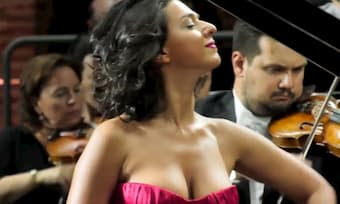
Dear Khatia Buniatishvili

I apologise for my profound ignorance. My wife and I are dedicated aficionados of both classical music and jazz. My wife teaches piano and is very astute at judging technique. As for me, not being a musician in any sense of the word, I simply go along for the ride. Our ignorance comes from the fact that, until a few weeks ago, we had never heard of you, even though we thought we knew all the great virtuosi. We now know that you were born in 1987, which makes you 35; that you are Georgian – as I might have guessed, since your name ends with -vili; and that you were only in your early twenties when you were signed on by a prestigious recording company. Now you are constantly in demand in live performances and apparently each one of you recordings sells in the hundreds of thousands. In other words, in classical music, you are a major star. Silly us for not knowing.


We discovered you when I was doodling around on Youtube looking for something entertaining before we went to bed. I found you solo-ing in Gershwin’s Rhapsody in Blue in front of a French audience in Lyon. My wife and I were immediately rapt. How skilled you were. The speed and dexterity of your fingers on the keyboard. And the awareness we had of the punishing your fingers must be taking, especially in those very percussive parts of the score. Again and again and again you must have rehearsed all this, punishing your fingers with every note. What strength and fortitude you must have. We were glad to notice in one close-up that your fingernails were cut very short and unsullied by nail polish. You fingers would have been in constant pain if you’d been playing with longer nails. Musically, it was excellent and extraordinary.

But, dear Khatia, we were also aware of your beauty. Your glossy black hair, your olive complexion, your perfect nose and eyes, the brash red lipstick. I can’t remember if it was my wife or I who first said “She’s gorgeous” or “She’s beautiful” but in the course of your performance, we each said the same sort of thing many times.

And we were aware of your performative-ness. 


Khatia, you are as much actress as virtuoso pianist. In the soulful and slow moments, you sway and close your eyes, as one who is basking in the aethereal beauty of the score. In front of your audience, you are playing the role of being carried away by the music. In the moments when you hands are still and only the orchestra is playing, you look across to the conductor and the large bank of musicians, not as one who wants merely to be sure when she comes in to play her next note, but as a connoisseur who is appraising, with approval, her fellow musicians. You are performing perfectly the role of being exported to another region of appreciation. And of course there is what is apparently one of your trademarks. As you lean over the keyboard, you let your beautiful, glossy ringlet-ed swathe of black hair fall down over your face, momentarily making you a woman of mystery. Then, when the score perks up and becomes more lively, you toss your head back and the glossy, ringlet-y black hair flies back into place – a manoeuvre exactly like Rita Hayworth tossing back her hair in a much-appreciated moment in Gilda.  It’s sexy as hell, Khatia, and you know it.

Speaking of sex, that very low-cut dress. Those amply-displayed, eye-catching bosoms. In your acting you are selling your sex as much as your music.

Am I a dirty old man for pointing this out? Am I a censorious male chauvinist denigrating a great musician? No Khatia. My wife and I couldn’t ignore your theatrical technique and admired your brashness as well as loving the music. But we did gasp a little at your next performance which we saw the following night.


This time you were playing, in front of an Israeli audience in Tel Aviv, Tchaikovsky’s First Piano Concerto. Tchaikovsky is always sobbingly soulful, and this is one of his sobbing-est, perfect for your theatrical skills, as was your encore which was the most solemn and sombre of Brahms’ Hungarian Dances, slower in pace and allowing you to lay off the percussiveness a bit. The closing of the eyes, the swaying, the admiring looks at conductor and orchestra, the beautiful hair falling down over your face and then swishing back in place with a toss of your head. All played perfectly. Yet you sold sex even more insistently than you did in Lyon. This time you were wearing a dark blouse, but semi-transparent leggings letting us see your beautiful legs and thighs almost up to the reproductive parts of your anatomy. You were a spectacle as much as a sound. Yes, we again admired your beauty and loved the music you [and the orchestra] were making, but we couldn’t help laughing a bit at your attire, even if it did make me nostalgic for youth a bit.


You do know what you’re doing Khatia. And of course you do know what is appropriate for your audience. For on the third night of finding you on Youtube, we saw you performing at a music school in France, before an audience of quite young children and their parents. This time, still gorgeous, you were attired more modestly with no arousing flesh on display, and you were playing without an orchestra but with your older sister Kavanta, one year your senior and with looks as attractive as yours. You shared the piano, first playing a composition for four hands by Franz Schubert; than collaborating on six of Brahms’ Hungarian Dances. I’m sure either of you  could have played these dances solo, but you took the right side of the piano and your sister took the left side and the music was wonderful.


So what am I saying to you Khatia? I’m saying that we both know even classical music is a branch of showbiz and its performers act out roles. But you act your part more blatantly than most. Your gestures, your movements, your glamour, your sex and sex-appeal. I understand that in some quarters you have been severely criticised for this. You have been berated in the Guardian for your “barnstorming technique”.  On line I have found one pundit who hates you so much that he sets out to prove you are a dreadful pianist. He is of course wrong. Musically, your performances are delightful, invigorating, and attractive to large audiences.

I could daydream about you, but I know what I have seen is a persona, and not you. And whenever I see so great and young a performer as you, I think of time’s winged chariot. Soon you will be in your forties, then fifties, then sixties and older. I’m sure that you will still be the great pianist you are now, but the sexual attractions will have to be severely modified unless you wish to court ridicule.

Khatia,  my final word on you is what I once said about Renee Fleming – how unfair it is of Nature to make some people both so talented and so beautiful.

Sincerest good wishes 

An Admirer


Monday, June 6, 2022

Something New


We feature each fortnight Nicholas Reid's reviews and comments on new and recent books. 

“WINTER TIME” by Laurence Fearnley (Penguin, $NZ 36); “EDITH AND KIM” by Charlotte Philby ( The Borough Press / HarperCollins, $NZ32:99)


            Laurence Fearnley’s latest novel Winter Time is the most compelling narrative she has yet written and the one that every reader will want to read to the very end. I say this up front because, frankly, I have had mixed feelings about some of her previous novels. In newspapers I reviewed her earlier novels Room, Edwin and Matilda and Mother’s Day. On this blog, you can find my reviews of her The Hut Builder (published 2010) ; Reach (2014); and The Quiet Spectacular (2016). To quote from my review of The Quiet Spectacular: “Despite their many merits, I did note the awful weight of overt symbolism and rather arch patterning in Reach; and the tendency to preach in The Hut Builder. These tendencies run amuck in the over-patterned, over-symbolic and over-preachy The Quiet Spectacular, to the point where the characters become mere ciphers and walking ideas.” Winter Time does not have any of these faults. Partly a whodunnit, or at least something very close to a whodunnit, its story is relatively straightforward. And if Fearnley has any message to preach to us, it is implicit and built into the characters, rather than spelled out polemically.

            Roland is the eldest in what was a very unhappy family. None of his siblings married or had children. His youngest brother Isaac was killed in an accident years ago, his sister Casey is long gone, and now his other brother Eddie has died in a crash. Eddie’s ute veered off the road and landed him in a canal where he drowned, unable to fight his way out of the vehicle. Roland is very different from Eddie. Eddie was a sturdy outdoors bloke, a deer culler working for the conservation people. Roland is gay. He has deserted the old family home in the South Island and moved to Sydney where he and his gay partner run a health food business. But Roland loved Eddie and remembers him fondly as the guy who looked after him when they were kids. Even though Roland was the older one, Eddie shielded him from the rages of their father Gerard, who eventually walked out on the family. Eddie didn’t try to test Roland’s manliness with outdoor tasks the way their father did. And Eddie was appreciative of Roland’s indoor skills, especially his culinary arts.

            So Roland flies from Sydney to his original home town for his brother’s funeral. (The town is given the fictitious name Matariki, but will easily be recognised by some readers as what has rapidly become a tourist town in the Mackenzie Basin.) As soon as Roland looks at the site where Eddie swerved off the road, he senses that something is amiss. He suspects foul play of some sort, and the main thread of the novel has him trying to find out all he can about his brother’s death. In this search, he is helped by a sympathetic woman called Bay whom he meets in the local café and who says she knew Eddie. There is a major snag in Roland’s search for the truth however. Somebody has been able to steal Roland’s on-line identity, and is posting deliberately inflammatory messages under Roland’s name. They are designed to stir up anger between trophy hunters who want to shoot deer and tahr for sport, and cullers who are there to thin out these animals in the interest of conservation.   

As always, I do not give away too much plot when dealing with a novel that has an element of mystery. The author has a right to expect her twists of plot not to be revealed. Enough to note that Laurence Fearnley throws a number of mis-directions at us and comes to a plausible conclusion about the guilty party.

There are many skills in this novel.

Fearnley weaves the backstory of Roland’s family seamlessly into Roland’s search for answers.

She is very good at noting how this South Island town has changed over the years. Roland’s childhood memories of an unpretentious little town are matched with the town’s current commercialisation and the flashy holiday homes than are build there for the very wealthy, locking out less affluent people.

In the person of Roland’s next-door neighbour, Mrs Linden, she creates a character so grotesque as to be funny, yet at the same time disgusting and almost sinister.

The relationship of Roland and his partner Leon is handled very delicately, but not idealised. Leon, the older man, is a pragmatist, wanting their health food business to expand even if it means compromising their standards. He is an entrepreneur first. Roland is more the idealist and the dreamer, wanting to stick with their original programme and not very good at the business side of things. There are mild ruptures in their relationship. They realise they are getting older and no longer feel the intense first buzz of love, yet Leon is clearly annoyed when Roland leaves him on his trips to New Zealand. He has a strong strain of possessiveness.  Fearnley has moved far beyond the sort of advocacy books we used to read about gay men, who were depicted as flawless so that we could more easily feel for them. Here she has created a credible but far from perfect pair whom we can still like.

Her greatest skill, though, is setting her story in a harsh South Island winter, which she depicts with careful and close observation. Fearnley has much expertise when it comes to mountains and the outdoors (remember she co-edited an anthology about New Zealand mountains, and helped write a mountaineering friend’s autobiography). It shows here as she charts the seasons changing, the snow, the semi-thaw, the way plants behave in the cold and the inconveniences for walkers and other travellers. The chilliest images in Winter Time are of Roland alone in the family home, with the cold biting at him. A perfect image for a man who is lonely, worried in his heart and stumped in his enquiry.

Others may make a different judgement, but this is for me Fearnley’s most relatable novel.

  *.  *.  *.  *.  *.  *.  *.  *.  *.  *.  *.  *.  *.  *.  *.  *.  *.  *.  *


            I admit that I requested a review copy of Charlotte Philby’s Edith and Kim under a misapprehension. Charlotte Philby is the grand-daughter of the Soviet spy Kim Philby. Seeing her name on the cover of Edith and Kim I assumed, wrongly, that this was going to be a work of non-fiction, a grand-daughter’s memoir or non-fiction account of her grandfather and his circle. I was wrong. Edith and Kim is a novel – based on fact but a novel nevertheless. Charlotte Philby, journalist, columnist and author of three previous novels, says clearly in her opening author’s note that this is “a work of fiction based on  facts as I have variously found them, reimagining the lives of two people from starkly different backgrounds.” She further notes that some characters are invented. Some of Kim Philby’s letters are reproduced, but the author says she has made some of them up.

All of which puts me very much on my guard. Checking this novel against various books I have on Kim Philby and Edith Suschitsky (often known by her married name Edith Tudor-Hart) and their espionage activities, I find that this novel sticks very much to the historical record – but of course the thoughts, feelings and attitudes of Edith, who dominates the novel, are very much the author’s invention. And the author’s interpretation of events is hers too.

Viennese-born Edith Suschitsky was the daughter of a Social-Democrat bookseller and in the 1920s and early 1930s, she was much interested in the German Bauhaus movement. Embracing modern art in all its forms, she took up photography. But being Jewish, she and her family were very wary of the antisemitic-inflected Austrian version of Fascism that was on the rise and was soon to take over Austria. Like many others of her generation, Edith thought that Communism would be a bulwark against Fascism and she joined the Communist Party, becoming a courier between Austria and England.

It was in Austria that she met public-school-and-Cambridge educated Kim Philby, son of a very pukka British imperialist, who hadn’t yet committed himself to Communism. Back in London, Edith introduced Kim to Soviet agent Arnold Deutsch, who checked Philby out and then recruited him for the party. As is well-known, Philby then spent most of the 1930s building up a deep cover for himself by loudly supporting right-wing causes. He was a Times correspondent in the Spanish Civil War, covering the Franco side and writing enthusiastic dispatches on Franco. He joined the Anglo-German Fellowship, which was essentially a Nazi-controlled front seeking approval for Nazi Germany’s re-armament. Diligently playing the role of a Tory patriot, he seemed just the sort of chap that England’s secret service would approve, and by the early 1940s the Soviet spy was embedded in MI5.

While all this was going on, Edith Suschitsky had settled in London, set herself up as a professional photographer, and married the English doctor Alexander Tudor-Hart. Because she was seen at a Communist rally in London, she was observed by MI5 and was known to mix with Communists – but although she was investigated a number of times, she was never caught out in spying and was never prosecuted for anything. The only time she was jailed had been in Vienna when she was incarcerated for a few months before leaving Vienna for good.

Once all this is settled, the novel concentrates on Edith. Kim Philby is never really seen in close-up – except in the letters he wrote to Edith from the 1960s on, when he had been exposed and had fled to Russia. Edith and Kim has three forms of narration. There is the third-person account of Edith’s life over the years – very intimate and detailed, taking up most of the novel. There are  reproductions of authentic MI5 documents (retrieved by Charlotte Philby from the archives) tracing Edith’s movements in formal language – and sometimes redacted so that some people’s names aren’t mentioned. And there are those 1960s-on letters from Kim. It is interesting how much the exposed spy talks about trivia like the weather, and makes a few comments on old friends back in the day – but of course never says anything about his spying activities.

And how does Edith’s life play out in this novel? Fairly drab and pedestrian, to put it simply. She gets a little upset when Stalin makes his pact with Hitler in 1939, but unlike many others, she still sticks with the party. Her marriage disintegrates and she has two or three lovers, but she gets angry with one who questions the righteousness of the Communist cause. When Hitler double-crosses his pal Stalin and invades Russia in 1941, she is heartened to see Communism again fighting Fascism. And for the first time she really does do some spying, getting documents related to Britain’s atomic research (passed to her by the likes of Nunn-May and the friends of Klaus Fuchs), photographing them and handing them over to Soviet agents. By 1956, she is upset by Khrushchev’s denunciation of Stalin, but she still believes in her chosen ideology.

Yet while all this is going on, she is most concerned with her young son Tommy, who is mentally impaired and whom she takes to various doctors and psychiatrists (including Anna Freud) for treatment. Edith would like to believe that the only cause of Tommy’s impairment is trauma caused by living through the Blitz. In fact, he was mentally much more deeply afflicted than that and had to spend the rest of his life in psychiatric hospitals. [One source I read said that Tommy was schizophrenic, but that term is not used in this novel]. Edith’s aching for Tommy’s recovery almost resembles her aching for all Communism’s promises to be fulfilled. At least, that’s the way I read it, even if it wasn’t the author’s intentions.

This is a very earnest novel, and as novels-based-on-fact go it is true to the record. By focusing on somebody who was really a very minor player in the Cold War, Charlotte Philby is making clear to us how unglamorous spying usually is, peopled by unhappy people playing small roles at the bidding of manipulative masters. In the end, all I was left with was a sense of desolation to think of all those people of goodwill who, unknowingly, harnessed themselves to the cause of a totalitarian and genocidal state.

Something Old

 Not everything worth reading is hot off the press. In this section, we recommend "something old" that is still well worth reading. "Something Old" can mean anything from a venerable and antique classic to a good book first published four or more years ago.     

TWO SHORT BOOKS. “GRIEF IS THE THING WITH FEATHERS” by Max Porter (first published 2015) ; “FOX” by Margaret Wild and Ron Brooks (first published 2000)

            When it comes to these “Something Olds”, you know my form by now don’t you? I usually bombard you with detailed summaries of fat novels (mainly from the 19th or early 20th centuries) – often novels of which you have never heard. But this time I’ve decided to break the mould. Here are comments on two short books, each of which may be read easily at one sitting. And each of which is well worth reading. Read both of them carefully and you realise that each is about intimate grown-up relationships, even if one is apparently a children’s picture-book.

  *.  *.  *.  *.  *.  *.  *.  *.  *.  *.  *.  *.  *.  *.  *.  *.  *.  *.  *


Published by Faber and Faber in 2015, Max Porter’s first book Grief is the Thing with Feathers, was an instant bestseller, was hailed with positive reviews, was later turned into a play, was translated into many languages and has been reprinted numerous times, so the odds are that you’ve already heard of it. It has been called a prose-poem, but in my book that means simply prose.

The title is a revision of Emily Dickinson’s line “Hope is the thing with feathers” –  possibly a reference to angels. In Max Porter’s novella, Grief is a scrawny crow. The tale is told in three voices. A mother has died in an accident, leaving behind a grieving father and two young boys. The voices are Dad, The Boys and a Crow. Where does the Crow come from? It comes from Ted Hughes, to whom there are a number of references. Dad is attempting to be a scholar and is writing a book, for an obscure, minor publisher, to be called  Ted Hughes’ Crow on the Couch: A wild analysis. Late in the tale, The Boys, with some sympathy for Dad, tell how Dad once went to a Ted Hughes symposium at Oxford. but found himself to be a little fish, overwhelmed by the academic types. Out of all this, one understands that as Dad grieves for his wife, he has probably conjured Crow out of his studies… and yet there are sequences where The Boys seem aware of Crow.

As Hughes died 1998, 17 years before Grief is the Thing with Feathers appeared, there was no controversy over the use of his name. Besides, Faber and Faber were also the publishers of Hughes and, for the record, Hughes was a devotee of Emily Dickinson and once edited a selection of her verse. To give the rest of this book’s backstory, note that Max Porter was not presenting an autobiographical narrative. His wife and children were in good health. He constructed Grief is the Thing with Feathers out of memories of his father dying when he was a young child.

This novella charts phases in grief, beginning with the initial shock and the not-always-helpful expressions of sympathy offered by well-meaning people. As Dad says early in the piece “The doorbell rang and I braced myself for more kindness” (p.4) Crow offers  a more anarchic approach. To conquer grief, Crow pours into Dad’s mind horrific images of what could be, creating a virtual shock treatment. Crow offers to treat grief directly. Crow says blandly “I believe in the therapeutic method” (p.12) Dad is aware that his marriage was not always harmonious, but he still feels great loss, as in his realisation We will never fight again, our lovely, quick, template-ready arguments. Our delicate cross-stitch of bickers” (p.20)

In the first shock of loss, there is the tendency to see bereavement as a universal tragedy which should be honoured and grieved by all the world. The Boys say “There should be men in helmets speaking a new and dramatic language of crisis. There should be horrible levels of noise, completely foreign and inappropriate for our cosy London flat.” (p.14) This level of grief can tip over into the grandiose. Later in the text, Dad says “I wanted to build a hundred foot monument to her… Everybody passing could comprehend how much I miss her” etc. etc. But Crow responds “Eugh… you sound like a fridge magnet.” (p.50) The grandiose is deflated.

Then there is the phase of guilt, in which the bereaved accuse themselves of not being constant to the memory of the deceased; of beginning to forget the deceased; of letting their minds wander off into more trivial things. The Boys at first remember their mother mainly as an absence – the lack of the childcare they were used to. Something is missing. Later they try to tough it out, but are a tiny bit ashamed of their flippancy when they think they can find a substitute for their mother. The Boys say “We watched London and London offered us possible mothers in jeans and striped T-shirts and Ray-Bans, so we spotted them and liked the nasty insensitive self-harm of it. We were blasé with a babysitter who said ‘How can you laugh about it, it’s so sad?’ ” (p.66) Father too feels uneasy about himself as he seeks comfort in another woman.

Crow tells a number of fables and cautionary stories. The longest (on pp.54-58) has him driving away the demon of grief by sheer anarchic behaviour. This anarchy is really the fullness of life, where one thing happens after another as life continues and grief is gradually muted. And yet a level of real grief will always remain. Rebelling against the concept of “moving on” from Grief, Dad snaps “Moving on, as a concept, is for stupid people, because any sensible person knows grief is a long-term project. I refuse to rush. The pain that is thrust upon us let no man slow or speed or fix.” (p.99)

There is a sort of reconciliation to come, but the main effect of Grief is the Thing with Feathers is the pain of loss.

  *.  *.  *.  *.  *.  *.  *.  *.  *.  *.  *.  *.  *.  *.  *.  *.  *.  *.  *. 


Very different, but still very powerful, is the Australian children’s picture-book Fox, published in 2000. The text is by Margaret Wild, the images by Ron Brooks. I note that the blurb of the first edition I have says Fox is “a story that is as rich for adults as for children.”

Indeed it is.

Here is a very simple tale. In the Australian outback, Magpie’s wing is burnt and Magpie cannot fly. Magpie (who is referred to as “she”) is helped by Dog (“he”), who is blind in one eye. Dog says Magpie can “fly” again if she sits on his back while he runs. They become bonded partners. He becomes her wings and she becomes his full sight. But along comes Fox (“he”). Fox’s red coat is glamorous. Fox can run faster than dog. Magpie swears she will never desert dog. Magpie knows Fox smells of “rage and envy and loneliness”. But Fox says he can make her really feel she is flying and Magpie finally succumbs to Fox’s promises. She sits on Fox’s back and he runs far, far into the desert… where he dumps her and runs away, declaring “Now you and Dog will know what it is like to be truly alone”. And in the very last words of the book, we are told of the maimed Magpie “Slowly, jiggety-hop, she begins the long journey home.

It is hard for an adult to read this text without seeing it as an adult story of seduction. Magpie (woman) is seduced by the flashy glamour of Fox (rootless delinquent man), coming back to herself only when she remembers the domestic security and reliability she has left behind in Dog (unglamorous husband or partner). This must be the true history of many affairs.

In Ron Brooks’ large, wide-page illustrations, Fox is certainly the most glamorous character in the book. Dog is an unglamorous mustardy brown. The red of Fox’s coat is carried over into the harsh redness of the desert into which Fox runs. And Ron Brooks presents the text in the form of naïve, childlike printing. Does this represent the clarity of a story which even children can understand. But if so, what is the message that is being presented? To beware of untrustworthy strangers, perhaps?

To me, Fox is as adult as a real children’s picture book can be.


Something Thoughtful

 Nicholas Reid reflects in essay form on general matters and ideas related to literature, history, popular culture and the arts, or just life in general. You are free to agree or disagree with him.  

QUALITY OR IDEOLOGY?

Here’s a very old problem that some critics seem never to have wrestled with.

When you judge a work of fiction (be it short-story, novel, film or TV series) do you assess it for what it says, or do you assess it for how well it says what it says? In other words, do you praise a work of fiction by how much you agree with its ideas and to hell with the quality of its prose or production? Or do you praise it for the quality of its prose or production and to hell with its ideas, whatever they may be? I’ve dealt with this problem before on this blog. To be precise, when reviewing Henry de Montherlant’s tetralogy Pitie Pour Les Femmes back in 2014, I wrote the following:

I resist vigorously the notion that fiction should be praised or blamed solely in terms of the values it expresses. The sort of criticism that concentrates on morality and values alone will rapidly become the sort of criticism that is really promoting propaganda. I am a socialist or a feminist or an agnostic or a  Christian. Therefore I endorse literature that advances the cause of socialism or feminism or agnosticism or Christianity. Should I adopt this approach, I will end up praising the second-rate because it confirms those values which I already profess; and decrying much worthwhile work because it does not share my world view. I sometimes think of this approach to literature as the high-school approach, because the main emphasis of many high-school English teachers is to give their classes novels that will promote healthy attitudes, “improving” novels that teach tolerance and gender equity and justice and so forth. A good scheme for advancing a peaceable society, perhaps, but a very bad way to approach literature if you have got beyond the classroom …And yet, having said all this, I am as wary of the approach which concentrates solely on aesthetics. Let us look at Louis-Ferdinand Celine’s dense prose, let us consider how he piles detail on detail, let us analyse his fascinating mixture of classical and demotic phraseology – oh, and let’s just not happen to notice his nihilism, the frankly loopy ideas he endorses and his rampant anti-Semitism. If the values-fixated approach to criticism leads to the endorsement of propaganda, the aesthetics-fixated approach leads to a sterile art-for-art’s-sake mindset, which detaches literature from the world around it. It is the talent, skill or genius of the writer as a writer that makes the writing competent, very good or brilliant. We should always be responding to, and judging, the words on the page. But what the writer is promoting, advancing, criticising, in sympathy with or satirising in fiction also has to be considered.

As a critic or reviewer, I should be able to say sometimes that, while I approve of a novel’s outlook, it is nevertheless a very bad piece of writing.  Conversely, I might sometimes have to say that something is outstandingly good as a piece of writing, but that its implicit moral values are defective.”

That is what I wrote eight years ago, and I’m still sticking with it.

Why am I resurrecting this old material? Because recently I saw a gross example of a film widely over-praised, I believe, for its ideology without much real scrutiny of its aesthetic merit.

I ask you to control yourselves here. Please don’t collapse with the vapours, as I’m about to commit heresy.

I thought Jane Campion’s film  The Power of the Dog was itself a dog - dull, plodding, poorly paced, manipulative and in part wilfully obscure. I know it won Jane Campion an Oscar as best director. I know it was highly praised by the great majority of reviewers and critics world-wide. As a New Zealander I know it’s very unpatriotic of me not to praise a New Zealand director and to be so negative about a film which was largely filmed in Otago and Auckland. Obviously I’m committing treason as well as heresy. But there it is. I have this awful habit of making my own judgements on things rather than following a trend.

If you haven’t seen it, here’s a curt synopsis.

1920s in Montana. Phil (Benedict Cumberbatch) is a nasty piece of work – a rancher who bullies and belittles people. He bullies his sister-in-law Rose (Kirsten Dunst) so badly that Rose becomes an alcoholic. He bullies the local Native-Americans by not letting them buy the surplus hides he’s about to destroy, so he’s also racist. Most of all, he bullies Rose’s son Peter (Kodi Smit-McPhee) whom he sees as weak and effeminate. He shows his nastiness when he callously burns the pretty paper flowers Peter has made to decorate the table. Hiss the villain folks.

Phil is macho, aggressive and racist. Therefore he is the model of toxic masculinity. But he’s also single. An unmarried man. Hmm. That’s suspicious. Aha! Peter spies on Phil and discovers Phil is actually homosexual, fixated on his relationship with a cow-poke he knew years ago. Clearly he once slept with his cow-poke buddy. So that explains it neatly. Phil is a bully and a thug and excessively macho because he’s suppressing who and what he really is. He’s punishing effeminate Peter as atonement for his own sexuality. And he is irredeemable.

Solution? After Phil has messed up the lives of both Rose and Peter, Peter (who is studying medicine and toxicology) works out a way to poison Phil with anthrax and without being suspected of murder. So Peter kills Phil, the bully is dead and Peter smiles at what he has done. Happy ending.

Now lets admit that this synopsis could have made an interesting film. But let’s also note that it falls apart both in terms of its ideas and in aesthetic terms.

Its minimalist musical score was hailed as a deliberate riposte to the standard grandiose scores that accompanied old Westerns. The Power of the Dog is intentionally an “anti-Western”. Regrettably the much-praised score is bland and forgettable. The film’s pace is leaden – everything played slowly, much vague camera movement, redundant shots of farmhands. And in spite of moving as slowly as a stranded chuck-wagon, it still manages to be wilfully obscure in places. More than one viewer told me that they couldn’t work out exactly what happened at the end because Peter cutting up strands of hide to make a belt wasn’t clearly related to infecting Phil with anthrax. Some who watched it on Netflix, rather than at the movies, said they had to watch the last quarter-hour twice before making any sense of it.

And the film’s ideas? In the end, it is of course justifying murder. Annoyed by a bully? Okay – kill him. Problem solved. As for the critique of “toxic masculinity” – do you really believe that all macho thugs and bullies and racists are suppressed gay guys? Some may be, but it’s highly unlikely that the great majority are. So what does the film’s diagnosis of Phil really tell us? Very little, because it’s dealing with an unrepresentative specimen.

My beef here is my strong suspicion that The Power of the Dog was over-praised by critics determined to show they opposed toxic masculinity – a current simplistic and modish preoccupation. A prime example of a film being praised for ideology rather than merit.

How DARE I say these things when the critical consensus was so favourable?

Because I do dare, that’s why.