-->

Monday, November 6, 2017

Something Old


Not everything worth reading is hot off the press. In this section, we recommend "something old" that is still well worth reading. "Something Old" can mean anything from a venerable and antique classic to a good book first published four or more years ago. 


“THE OLD PATAGONIAN EXPRESS” by Paul Theroux (first published in 1979)


            As I remarked once before on this blog (see review of Ray Bradbury’s Fahrenheit 451), you may assume when I review a book that I have literally read it from cover to cover, held it in my hands and methodically deciphered all those black marks on the pages. But in my recent dark period, when my eyesight was (for some months) severely impaired, I could neither read nor write in the conventional sense and spent many hours listening to talking books, podcasts and the like. Thus it was that, through 14 CDs, making about 15-and-a-half hours of reading by a very good American reader, I experienced one of Paul Theroux’s earlier travel books The Old Patagonian Express.

            The American novelist Paul Theroux (born 1941) has had many successes with his fiction, most notably his novel The Mosquito Coast. But I think for many readers he is better known for his travel books, most of which involve his taking long train journeys. His first bestseller was The Great Railway Bazaar (by train across Europe and through Asia) and he later wrote Dark Star Express (the length of Africa by train), Riding the Iron Rooster (across China by train) and his most recent (reviewed on this blog) Last Train to Zona Verde, a very dispiriting return train journey in Africa. At the time he wrote Last Train to Zona Verde. Theroux seemed to be saying that this would be his last travel book.

            Published in 1979, The Old Patagonian Express was Theroux’s second travel book. It recounts the two months or so he spent travelling by train from his home in Massachusetts to the deepest south of Argentina – in other words southwards through the United States and the length of Central and South America.

Of course there is no direct rail link from Boston to Patagonia so, as he always does, Theroux began by conning railway timetables and seeing where and how he could make (often perilous and uncertain) connections. He also seems to have prepared himself by reading older and more venerable travel books about the areas he was to pass through. At least he every so often quotes from such books to compare his impressions with those of earlier travellers. He appears to have packed a little library of books to read en route. Interestingly, none of these have anything to do with the countries he is passing through. He mentions reading Edgar Allen Poe’s Narrative of Arthur Gordon Pym, Mark Twain’s Pudd’nhead Wilson (which he rates more highly than I did when I reviewed it on this blog) and Boswell’s Johnson.

Theroux’s rationale for taking the train is a good one. As he correctly says, air travel is no journey at all, but an instantaneous dumping of the traveller from one environment into another. You see nothing of the slow transformation of landscapes that a train journey permits. Theroux deliberately takes no camera with him. His aim is to record in detailed descriptions what his eyes have seen – not to piece together his journey from snapshots. Every so often he also makes it clear that he writes a detailed diary every day, which will later be worked up into this book.

In reading The Old Patagonian Express, it is wise to remember that it was written 40 years ago, and some of the political situations to which it refers have passed away. (For example, Theroux conspicuously avoids visiting Nicaragua, because a civil war was then raging there, and the Argentina he visits was still the Argentina of the junta).

So what are the pleasures of reading (or listening to) this book?

Much is the simple pleasure of decription as the various trains pass through barren deserts, or have Theroux gasping in the thin air as they cross the Andes, or allow him to see the wide reaches of the pampas. Much is the pleasure or surprise of the unexpected spectacular event, such as the football match in El Salvador which turns into a full-scale riot. In terms of human habitation, it is not always a pretty world that Theroux observes. From Mexico to Patagonia, there are many descriptions of urban slums, sprawling squatter camps outside the cities, naked and unwashed children begging and an indifferent (but much smaller) affluent class often living in what amount to gated communities. Nor does Theroux stint on recording the run-down quality of most Latin American trains and their discomfort, or the type of accommodation provided by rat-infested or flea-infested hotels. In short, there is much human squalor in this book.

            Like all good travel writers, however, Theroux is aware that a worthwhile travel book does not run on descriptions alone. (Leave the pretty descriptions of the damned obvious to tourist brochures, guidebooks and most travel blogs I’ve seen). The lifeblood of a good travel book is the human encounter, usually meaning conversations with strangers whom the writer meets. Theroux (fluent in Spanish and in many other languages) has no difficulty buttonholing locals or fellow-travellers and chatting with them. And here, I’m afraid, I encounter an element of this book which arouses my scepticism, as it does with all memoirs which purport to give remembered conversations verbatim. Doubtless Theroux scribbled up versions of his conversations in his diary as soon as he could, but even so, it strikes me as odd that he always comes out best in any argument or quarrel he has with others. I cannot help suspecting that in at least some cases he has used his literary skills to tidy up the conversations he had, or to sway things his way.

            More than one critic has noted Theroux’s tendency in his travel books to adopt a haughty or sardonic tone towards his fellow human beings. He is the superior, literate, civilised traveller taking the measure of those he encounters and often finding that they do not measure up. Indeed he often comes close to sneering. But I give him credit for being an equal opportunity sneerer. Bolivians, Peruvians and Argentinians boasting about their country come in for his flak. (According to Theroux such nationalistic boasting is endemic in Latin America). Corrupt or bribe-accepting officials and complacent railway staff are the subject of his righteous scorn. But he is as hard on his fellow-Americans.

While he is still chugging through the USA he meets a ridiculous, weedy, pasty-faced health-food fanatic who believes all ailments will be cured if only people stuck to a diet of nuts. In the Texas border town of Laredo he sees American men and college boys routinely crossing the border to make use of the brothels on the Mexican side. Theroux makes some ripe comments on the hypocrisy of the American townspeople who pretend there is no vice on the American side of the border while ignoring the fact that it is the American clientele that keeps the Mexican brothels in business. He saves buckets of satirical venom for the small expatriate American community which then controlled the  Canal Zone in Panama (this was shortly before control of the canal was handed over to Panama). Despite years of residence, most of these expatriates haven’t bothered learning Spanish, are inward-turning, regard the Panamanians as an inferior species, pay them lower wages for the work they do, and generally have the mentality of colonial overlords.

Theroux’s most surprising attack on fellow-Americans comes late in the book. It is clear that Theroux has a fairly sceptical attitude towards religion, although he does take a lively artistic and historical interest in all the Spanish churches and cathedrals. But in Argentina he meets a bunch of American tourists spouting the standard (predominantly Protestant) prejudices againct South American Catholic church art. Look at all those excessive images of the naked Christ suffering, with depictions of open wounds and blood. Look at all those detailed images of saints and martyrs being tortured. It’s sheer masochism or sadism! Look at all those golden altars and gold leaf decorations in countries that suffer dire poverty. It’s exploitation of course! Etc. etc. etc. In response, Theroux lectures them by noting that where people are already suffering greatly, they take great comfort from learning that the sufferings of Christ and the saints for them were even greater. And to clothe such images in gold reassures them that this suffering and this belief really are precious. In other words, the religious art is a true reflection of the culture. If, argues Theroux, North American churches are decorated with more restraint and sobriety, and if their images of the suffering Christ show him barely bruised, it is because well-fed North American Christians are complacent and hardly know what real physical suffering is.

In Theroux’s account at least, this riposte effectively silences his interlocutors.

For some readers, the highlight of this book will be Theroux’s long conversations, in Buenos Aires, with the famed Argentinian writer Jorge Luis Borges (then in his 80th year). At this point I have to confess a prejudice of my own. I am no expert on Borges, but the little I have read of his work has not warmed me to him. It seems to me that he was preoccupied with leaping into unreal fantasy worlds and word-games, a sort of higher whimsy. Once again admitting my limited knowledge of the man’s work, I do wonder how much this was the product of trying to maintain a literary career in a country that was too often ruled by oppressive dictators – in other words, an evasion of dangerous everyday social realities. Be all this as it may, Theroux entertains the blind Borges by reading him selections from Poe and Kipling and other writers whom Borges admired and the two of them exchange literary banter, some of it sounding (on Borges’ side) very much like grumpy old man talk, with Borges having nothing positive to say about any living writer and clearly hankering for his favourite late 19th or early 20th century authors.

By the way, Theroux himself rates this meeting as the highpoint of his trip and says he looked forward to seeing Borges in the same way that the 19th century travel writer Kinglake, in his classic travel book Eothen, looked forward to meeting the eccentric Lady Hester Stanhope in the Middle East. While this may be so, I beg to note, as you will see from my review of Eothen on this blog, that when he actually met Lady Hester, the portrait Kinglake painted of her was one of gentle mockery, quite unlike Theroux’s affectionate view of Borges.

For all its unevenness, and for all its haughty scorn, The Old Patagonian Express is a very entertaining book. But I must conclude with one element that greatly amuses me, as it does in many other travel books by Theroux and others. Theroux is desperately eager to tell us that he is not a tourist. Other Americans or Europeans who share train carriages with him are mere tourists, but he himself is a serious traveller and therefore a different species. This approach may well be justified when Theroux is dealing with people on a five-day package tour to see Machu Picchu. But it becomes snobbish imposture when he is belittling German or French backpackers who have clearly been in South America for longer than he has, have seen more and seem to know some local customs better. Theroux presents them as monosyllabic and ignorant. At which point I feel like saying “Listen mush, you’re an intelligent, perceptive, well-read and entertaining writer, but your whole long Americas trip was only two months. It’s not as if you’re the great expert on all the lands you visited. Frankly, you’re a tourist, so stop pushing the other tourists around.” It was this strain in Theroux’s writing that angered a very nice woman I know when she compared her own tourism in Africa with Theroux’s snobby comments on tourists in Last Train to Zona Verde.  In fairness to Theroux, I do have to note that in that later travel book he himself berates his own tourist status and questions the whole validity of travel books based on short visits.

In spite of which moaning I still recommend The Old Patagonian Express as a good read (or listen).

Something Thoughtful


 Nicholas Reid reflects in essay form on general matters and ideas related to literature, history, popular culture and the arts, or just life in general. You are free to agree or disagree with him. 


AN ELITE FORM OF DUMBING DOWN


Recently, I came across the following quotations from the philosopher and cultural critic Hannah Arendt. They appeared in her essay “The Crisis in Culture”,  first published in 1961 in her collection of essays Between Past and Future. At this point in her essay, Arendt was distinguishing between “culture” (basically great and challenging works which have come to us from the past) and “entertainment” (what is ephemeral, undemanding and basically intended to fill up our spare time).

She wrote: “those who produce for the mass media ransack the entire range of past and present culture in the hope of finding suitable material. This material, moreover, cannot be offered as it is; it must be altered in order to become entertaining; it must be prepared to be easily consumed.”

Of real works of art, she goes on to say: “their nature is affected when these objects themselves are changed – rewritten, condensed, reduced to kitsch in reproduction, or in preparation for the movies. This does not mean that culture is spread to the masses, but that culture is being destroyed in order to yield entertainment. The result of this is not disintegration but decay, and those who promote it are not the Tin Pan Alley composers but a special kind of intellectual, often well read and well informed, whose sole function is to organise, disseminate, and change cultural objects in order to persuade the masses that Hamlet can be as entertaining as My Fair Lady, and perhaps as educational as well. There are many great authors of the past who have survived centuries of oblivion and neglect, but it is still an open question whether they will survive an entertaining version of what they have to say.” [Underlinings added for emphasis.]

Of course, after most of 60 years, there are some things here that now sound a little dated. Perhaps we could substitute something like Mamma Mia! for My Fair Lady and we might say “the music industry” rather than “Tin Pan Alley”, a phrase which means little nowadays. We might remark that it would be television and the internet rather than “the movies” which now do most of this cultural simplification, although the movies are still part of the process. If we read only these quotations, we might also think that Arendt is attacking pop culture and the mass media per se, and in therefore (to use the easy insult word) an “elitist”. In fact she isn’t. The essay as a whole makes it clear that she understands the legitimate functions of the mass media and also the necessity for “entertainment”. Then we might consider how, over the past haf century, television and film have been more readily recognised as media capable of rising to the status of real art.

But having said all this, I think the substance of these quotations still stands, is still a valid and accurate comment on our current cultural situation, and has stood the test of time.

I could break off my remarks at this point, and simply say “I agree” or “Well said” to Hannah Arendt. But you know the sort of verbose and pompous chap I am, so I cannot refrain from amplifying her comments by giving modern examples of the deleterious process she describes

Item: Concerning “a special kind of intellectual” I am so tired of hearing academics on radio and elsewhere informing the masses that “poetry can be FUN!!” I have never doubted the literal truth of this statement – since when has there not been a rich tradition of light and amusing verse? But the subtext of this statement now is “Let’s forget that wearisome, serious thing poetry is. Let’s make it easy-peasy. Let’s not produce anything that requires serious reading and thought.” So roll on academics producing light, whimsical verse designed to grab Demos. Result? Demos thinks that this is all poetry need be. After all, isn’t that what Professor XTZ said?

Item:Let’s produce operas in such a way that they are relevant; that they speak to people now; that they don’t trouble people by getting them to decode in any meaningful way what the opera really has to offer.” Result? Patronising modern-dress (or undressed) productions of classic operas that narrow their meaning to something topical and often trivial. Audiences are not invited to enter into the imaginative world of the composer or librettist. They are invited to see a show similar to a “musical” or to a soap-opera such as they can watch any evening at home. We don’t want all this high culture stuff, do we? The whole process is patronising inasmuch as it assumes that the audience of this particular art form is too stupid to themseves be able to pick up whatever modern resonances an opera, produced in traditional style, has to offer.

Item:We have to get the youth audience. We have to get a new generation acquainted with the great plays of Shakespeare. So let’s produce Shakespeare’s history plays on television as if they are Game of Thrones. Lots of power plays. Lots of sex. Lots of violence.” Thus was born the Hollow Crown series, filmed in 2012 and 2016. Sure, Shakespeare’s plays are indeed full of sex, violence and power plays – but this series stripped back and greatly abridged the texts whenever there was the opportunity to show the blood and guts, and filmed them like a horror show. I’d be a hypocrite if I didn’t admit that I quite enjoyed the two seasons; but there is absolutely no way that this will get young people pursuing Shakespeare seriously. More likely, when confronted with a full Shakespearean text or an uncut production of a Shakespeare play, people who have seen the Hollow Crown series are more likely to yawn and ask “Why isn’t this more like Game of Thrones?

Thus I could witter on with more relevant examples, but my basic message should be clear. “A special kind of intellectual” is still on the loose, and Hannah Arendt is still right.

Monday, October 23, 2017

Something New


  SPECIAL NOTICE TO READERS:  CONSTRAINTS ON MY TIME, PLUS MY RECENT VISUAL IMPAIRMENT, MEAN THAT I HAVE DECIDED HENCEFORTH TO PRODUCE THESE BLOG POSTINGS FORTNIGHTLY RATHER THAN WEEKLY.

 
We feature each week Nicholas Reid's reviews and comments on new and recent books.

“FLOW – Whanganui River Poems” by Airini Beautrais (Victoria University Press, $NZ30); “ALZHEIMER’S AND A SPOON” by Liz Breslin (Otago University Press, $NZ25); “BAD THINGS” by Louise Wallace (Victoria University Press, $NZ25)


As a reviewer, I pay more attention to New Zealand poetry than do most other reviewing platforms, apart from those that are specifically dedicated to poetry. I always treat new collections of poetry with care and respect, and it is only very occasionally that I feel the need to rebuke a current poet for sloppy writing, cliché-ridden ideas or unthought-through concepts. There is much good new poetry out there. Even so, it is only occasionally that a new volume of poetry has made me sit up with admiration and pure delight. To give a (partial) list of the best volumes of poetry I have had the pleasure of reviewing on this blog, I would name Richard Reeve’s Generation Kitchen, Elizabeth Smither’s Night Horse, Sue Wootton’s TheYield, David Eggleton’s The ConchTrumpet, David Howard’s The OnesWho Keep Quiet, and  Ian Wedde’s The Lifeguard , not to mention an excellent volume selected from a poet’s published works so far,Vincent O’Sullivan’s Being Here.  

Apart from my personal taste, what is it that makes me list these particular collections? I think it is the fact that all these poets have a strong sense of form. They all understand what the shape of a poem should be, and they know how metre and (more occasionally) rhyme can be used to best advantage where needed. In other words, they know about the poet’s craft.

I am very happy to add Airini Beautrais’ Flow – Whanganui River Poems to this list. Flow is Beautrais’ fourth collection of poems, but it is certainly her most ambitious so far. As in her third collection (reviewed on this blog), Dear Neil Roberts, Beautrais displays the welcome gift of accessibility. Some of her allusions may make a few readers scratch their heads, but she is never wilfully obscure and her thematic intentions are always clear. Again as in Dear Neil Roberts, Beautrais’ focus is on the part of New Zealand she inhabits. As she says in her Dedication, she is a Pakeha whose family have for six generations lived near the Whanganui River. Flow, she says, is a “collage” or “polyphony” as the many and diverse stories it tells about the Whanganui region cannot be welded into one single narrative.

This very generous collection (nearly 180 pages of text) is divided into three sections – each almost as long as many complete collections of poetry.

The first section, “Catchment”, covers the whole region and all the tributaries that feed into the Whanganui River as it flows north-west from Tongariro, then turns south at Taumarunui and heads towards the sea. A few of the poems in this section present a modern viewpoint, presumably based on the poet’s own experience. But most convey, in the first-person, the experiences of 19th and early-to-mid 20th century Pakeha explorers and settlers – surveyors, tree-fellers and loggers, labourers, farmers, and folkloric figures like the multiple prison-escapee George Wilder.

The second section, “A Body of Water”, deals with the river itself and the settlements upon it. More of the poems in this section are pure “nature” poems, descriptive of the river and its surrounding landscape.  There are fewer poems in the first-person and a clutch of poems about the non-human life in the river (poems about trout, graylings, freshwater crayfish, eels and eel-traps, lampreys etc.). There is an awareness of both the messiness and the otherness of nature, as in one of Beautrais’ best poems “Seed” (pp.82-83), with its catalogue of

Red grain of wood, wet oozing sap,

domatia where the tiny leaf-mites sleep,

ripe pulpy humus dropped and mashed

by rotting rain, the orange berries flushed

on twigs of foetid plants, the swoop

of water black with tannins in the deep-

cut stream. All live things spill your smell,

all death exudes your taste, and in your fist fits all.”

Even so, the Pakeha pioneers loom large (poems about cartographers and bridge-builders) and there are poems about specific individuals – a long poem called “Fire” about the Anglican missionary and explorer Richard Taylor, and a poem called “Foundlings” about Mother Mary Aubert at the Jerusalem settlement.

As for the third section, “The Moving Sand”, it focuses on the city of Wanganui itself, where the river flows into the sea. Once again, reflections on the current scene mix with 19th century testimonies from “lieutenant” or “constable” or “Mrs Field” – the voices of early Pakeha settlers adjusting to the fact that the large, unruly, black-sand beach, where winds whip the sand about, is not the same as a polite English beach where one can picnic sedately. There are a couple of poems (“Eunice”, “Stormbird”) about ships that were wrecked on the harbour bar, and there is certainly room for Airini Beautrais to go political or satirical – a poem (“Meat Workers”) about meat workers protesting at a lock-out, and a poem (“Dead Port”) ridiculing repeated attempts to turn Wanganui into a major port. For those who get the allusion, the poem “Glow in the Dark” is a sad reflection on Iris Wilkinson (“Robin Hyde”), who spent a short time as a reporter on a Wanganui newspaper.

All I’ve done so far is to walk you through the contents of this expansive book. I have not said anything about its quality, and why it is the engaging thing that it is.

Here are some ideas.

In the first place, Beautrais (despite often writing in the voices of others and occasionally sounding like a descendant of Edgar Lee Masters) really does write within her own experience, never pretending to be other than a Pakeha, never claiming to channel the perspective of the region’s indigenous ancestors. She has the wonderful ability to turn very personal experience into something much greater. Take the last two stanzas of the poem “Plotlines” (pp.23-24) where the concept of “story” segues easily from a domestic situation to the longest earthly time-scale:


My son always wants a story. Tell me a story about a T-rex

who was far away. Tell me a story about a spider

 who was lonely. And if the plotline doesn’t develop:

‘That wasn’t a story! I want a proper story!’


Obstacle, obstacle, obstacle, solution.

Even a three-year-old knows the basic devices.

Obstacle, obstacle, obstacle, attempted solution, failure.

The greatest stories of all time are geological.


            A truly great poem like “Roads”, dated to a visit made in 2013, works by using a present experience to show the impossibility of re-capturing the past.

            Then you note the care she has taken to shape this whole collection. The first section, for example, both begins and ends at Cherry Grove, Taumarunui. The last poem in the book, “North Mole” drags a modern perspective back to primal origins by presenting Kupe as a surfie.

            Most impressive, though, is Beautrais’ facility with form. In both “Clear Away” (pp.25-26) and “Flood” (pp.126-129) she takes on the type of multi-directional conversation that was a favourite with poets of the Romantic era. Some poems are a celebration of pure sound, as in the title poem “Flow” (p.84), which follows the whole course of the river from the mountain to the sea in insistent anapaests. Formally-structured and rhymed sonnets are within her range (see pp.172-175). Indeed rhyme is a major device in her arsenal. This can lead to some problems. “Into the Ground” (p.35) and “Only Dancing” (pp.43-44) read very much like doggerel, but this is probably intentional – both poems are meant to be rough working-men’s ballads, and doggerel was the norm in such.

            Flow is an ambitious and impressive collection from a poet who is immersed in her chosen subject and knows how to make it sing.


            *   *   *   *   *   *   *   *   *   *   *   *   *   *   *   *   *   *   *   *

            No disrespect is meant to two other good collections of poetry if I deal with them more briefly.

            Liz Breslin’s debut volume Alzheimer’s and a Spoon is exuberant, witty, great at wordplay and delightful to read. And this is very odd because the poems (most written in the first person) are about serious matters that could easily have become the occasion for solemnity. The poet’s aged grandmother sinking into Alzheimer’s. The older woman’s distant and garbled memories of surviving Nazi-occupied Poland. The way Alzheimer’s eats away at vocabulary. The crushing banality of the internet and the way nonsense goes “viral”. And yet here these matters are accounted for with a lightness of touch that (not to get too solemn about it myself) suggests a resilient human spirit unwilling to be crushed. Breslin creates collages from found materials – such as her “Lifestyle Creed” - and challenges us with “riddle” poems, using a variety of verbal techniques to draw us into her worldview and empathise even as we laugh. God gets a look-in with a certain wariness, only on the edge of mockery, suggesting the uncertain soul. There is that old paradox that wit can be a serious business, and it certainly is here.

            In her third collection of poetry Bad Things, Louise Wallace (“poet, not celebrity housewife” as the blurb helpfully says) goes for free verse, prose poems, aphorisms, pithy and brief observations and a few truckloads of irony. A clutch of poems reference Meryl Streep, Reese Witherspoon, Robert Redford and other such Hollywood icons, usually in the form of personal encounters which read like the poet’s dream diary. The prose poem “The olives” is a sophisticated take-down of a certain sort of self-indulgent pseudo-art film. The poem “Constellations”, on conceptual art, is as near as well-bred poet can come to saying it’s bollocks, but the statement is carapaced with irony to cushion the blow. And there are poems on food, on middle-class domesticity, and on clothes. The most affecting are the most personal – familiy relationships. As for the poem (well, letter really) about the “other” Louise Wallace, it clearly reflects a great annoyance in the poet’s life and comes out as the letting-off-of-steam.

Something Old


Not everything worth reading is hot off the press. In this section, we recommend "something old" that is still well worth reading. "Something Old" can mean anything from a venerable and antique classic to a good book first published four or more years ago. 

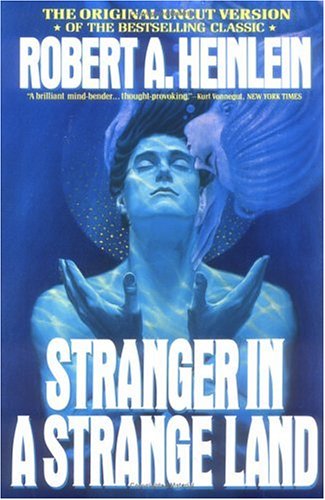
“STRANGER IN A STRANGE LAND” by Robert Heinlein (first published in 1961; longer version first published 1991)


            Some books you read for pleasure. Some you read because you think you should. And some you read because you have to (reviews etc.).

But there is a very small category of books that you read because somebody has earnestly and repeatedly recommended them to you. For me, one such book was Robert Heinlein’s Stranger in a Strange Land.

            If I am searching for escapist or genre reading, science fiction is far from being my first choice (and pure fantasy is of little real interest to me). I have, however, read the odd entertaining SF novel and have even read some that give real food for thought. Robert Heinlein (1907-1988) I knew, largely by reputation only, as a prolific American SF hack who emerged out of pulp fiction in the 1940s and hit his stride as a big name in the 1950s and 1960s. I remember as a kid reading one of the books Heinlein wrote for juveniles – Have Spacesuit, Will Travel. Apart from that, the only one of his books I’d read was The Puppet Masters, a vigorous piece of pulp in which aliens invade the Earth, attach themselves to human brains and proceed to drive human beings as their slaves, until there is a real human fight-back and a rousing finale of the sort that pulps require.

It was enjoyable brainless entertainment.

            Then a friend started telling me that I really should read what was touted as Heinlein’s magnum opus and SF masterpiece Stranger in a Strange Land - a book that was said to come to grips with really important matters and raise all manner of profound philosophical questions about the human condition.

So I gave it a go.

            In the preface to the 1991 edition of the novel that I read, Robert Heinlein’s widow said that this was the uncut version. Stranger in a Strange Land was 160,000 words when it was originally published in 1961. The 1991 edition restored the full 220,000 word version that Heinlein apparently laboured over for much of the 1950s and then presented to the publishers. In 1961 the publishers told him to cut it by about a third – which he did.

By the time I got to the end of the 1991 edition, I decided that the original publishers had been right. At 654 pages in the edition I read, Stranger in a Strange Land is formless, rambling, repetitive and incredibly dull. A flatulent bore, complete with jejune ideas. At most its central situation and ideas might have made a couple of good short stories in a pulp magazine.

A synopsis to orient us.

A Third World War has happened, and commercialised religious organizations have huge influence in the USA. Michael Valentine Smith is a human male who has lived his whole life on Mars and has been brought up by Martians (who are never fully described but who have quite brutal ideas on who or what should live or die). Michael Valentine Smith is brought to Earth for the first time and kept under wraps, for observation, first in a hospital, then in a government facility. He knows nothing of the human condition. He knows nothing of human sexuality and has never seen a woman before.

Smith is sprung from his confinement by Jubal Harshaw, an offbeat physicist and author who is often Heinlein’s mouthpiece. Jubal proceeds to orient him to the realities of the world. Having lived all his life naked, Smith does not know what clothes are, what war is or how jealousy feels. He has psychic abilities and superhuman intelligence. Why he has these attrbutes is never clearly explained, except that we have to take it as a “given”. He is also unbelievably wealthy as he nominally “owns” Mars and the mining rights thereto. There is much page-filling detail on financial tussles over this.

These earlier sections of the novel are like a ham-fisted combination of Frankenstein and Candide. I mean the parts of Mary Shelley’s original novel Frankenstein, where the monster gets a convenient crash course on human history and mores, just as Michael Valentine Smith does. And I mean the way Voltaire’s satire has an incredibly innocent young man exposed to humanity’s follies and shortcomings.

Gradually Michael Valentine Smith the Martian gets to display his mental and physical powers. At first he dabbles in a religion, the “Fosterite Church of the New Revelation”, that sounds a little like Scientology (segregation of inner and outer members; highly sexed inner members). Perhaps this should not surprise us. Heinlein was a sometime friend of fellow-SF writer L. Ron Hubbard, founder of Scientology, and apparently the two of them once had a bet on who could found the more outrageous religion.  

This first dabbling in pop religion, and his increased knowledge of human sexual interaction, lead Michael Valentine Smith to found a “religion” of his own, the “Church of All Worlds” in which all religious traditions from all planets are equally valid (and therefore equally invalid?). But celebrations are based on sexual intercourse, the complete merging of personalities and there being no God but the collective self. As Michael Valentine Smith has broken with his former Fosterite colleagues, the novel leads to his public martyrdom when the Fosterites call him a heretic from their original beliefs and his church is attacked. (Apparently Heinlein’s working title for the novel was The Heretic.) After this there is a memorial feasting on his body, in which his friend, and now acolyte. Jubal Harshaw takes part. This, according to the novel, is based on a Martian rite, though at least part of Heinlein’s intent is clearly to parallel and ridicule the Christian idea of the Eucharist. But, for all the mayhem, Smith’s followers are conveniently teleported to safety, and Smith gives advice from the afterlife on how his huge fortune can be used to build up his church, evangelise the Earth and change human mores forever.

I was sorry to have to tell my friend how amazed I was that this bundle of bilge and half-baked ideas could be taken seriously by any adult reader. As in so much science fiction, the level of ideas is not high. Comments on art, religion, sex and so forth come across as, at best, undergraduate discussions, and the rambling plot cannot disguise their flimsiness. Was this really the great satire on religion, and the great attack on received sexual norms, which I had been told it was?

It’s probably a bit unfair to point out the many topical references that have faded (gossip-columnists are called “winchells”; political commentators are called “lippmanns”). But it’s not unfair at all to show how much this all plays as a Californian surfie’s sexual daydream. Jubal’s ideal sex life – three nubile young women look after him – resembles an early 1960s Playboy–inflected male version of sexual liberation. And though I often find third-wave feminists annoying, I cannot but agree with those of them who have criticised this book for its idiotic version of what women are.

Then there is an incredibly evasive made-up blur-word that frequently occurs in Stranger in a Strange Land. The word “grok” is used to mean something like “intuit and fully comprehend” by Martians. Smith “groks” many things which we are invited to see as signs of his superhuman intelligence and his superhuman morality. It is interesting, then, that Smith “groks a wrongness” in homosexuality, which shows how much Stranger in a Strange Land itself reflects a past set of norms. Nirvana, for the followers of the Martian, is unrestrained heterosexual shagging.

To contexualise things, I should say a few more words about Robert Heinlein. He trained as a naval officer. He dabbled in politics and was originally a “liberal”. But he turned right in the 1950s, outraged that some people, as he saw it, jeopardised America’s security by questioning the manufacture of nuclear weapons. He now identified as a conservative libertarian and he supported the very right-wing Barry Goldwater’s presidential campaign in 1964. Along with all the libertarian stuff about free and unrestrained sex, his books show also a strong belief in the need for a powerful military order. For example his juvenile book Starship Troopers makes military service a requirement for citizenship.

Much of Heinlein’s output, including Stranger in a Strange Land, is simply a projection of the idea that, behind the protection of a strong military, Americans should be able to live a sybaritic life of uncommitted sex.

When the novel first appeared in 1961, enthusiasts said it showed the way to a future of human liberation from oppressive sexual morality. In the 1960s the novel was a hippie favourite, and was the basis for a Californian cult. I repectfully suggest, it didn’t show the way to the future. At best, it showed the way to some of the dippier aspects of the 1960s, and it can now safely be forgotten.

Something Thoughtful


 Nicholas Reid reflects in essay form on general matters and ideas related to literature, history, popular culture and the arts, or just life in general. You are free to agree or disagree with him.


DON’T CANONISE THEM UNTIL THEY’RE DEAD

There’s a very sound lesson that most religions learnt long ago.
Don’t canonise anyone until that person is dead.
If you start calling a living person a saint, that person might just go on to do unsaintly and reprehensible things. Much better to wait until that person is safely dead and buried and the record of a complete life is available. Then, if no copybook has been blotted, that person may be safely canonised.
In this secularised world, some people think we are beyond the concept of sainthood. Not so. See how names such as Mahatma Gandhi, Nelson Mandela, Abraham Lincoln or Martin Luther King are always invoked as touchstones of human goodness and the highest human aspirations (not always justifiably, I’d have to add).
But what a problem we create for ourselves when we start speaking of “living saints” and make an icon out of somebody who is still alive.
Item – 26 years ago, in 1991, Aung San Suu Kyi, then aged 46, won the Nobel Peace Prize. All right-thinking people in the West revered her. She was the lady from Burma who stood up to that country’s military junta and called for a return to democracy. (NB – few people in Burma call the country Myanmar, which is a name imposed by the military junta). Always dignified in her demeanour when she appeared in interviews, she promoted non-violent protest against the military regime and suffered house arrest. Who wouldn’t admire her?
I admit that I was as impressed by this image as everybody else I knew. Six-and-a-half  years ago, when I began writing this blog, I produced an enthusiastic review of the Swedish journalist Jesper Bengtsson’s book about Aung San Suu Kyi called Strugglefor Freedom.
So what happened to call this image into question?
Now aged 72, Aung San Suu Kyi is the de facto political leader of Burma, even if she has an uneasy alliance with the military, who still control some major ministries. The Burmese military has been carrying out what is internationally recognised as “ethnic cleansing”. Over 450,000 Rohingya Muslims have so far been driven out of Burma and have fled to neighbouring Bangladesh, as their villages have been burned down and their livestock impounded.
Aung San Suu Kyi’s reaction has been to support the military.
Discreetly cancelling an appearance she was going to make at the United Nations – where she might have had to answer some awkward questions – she has preferred to make, from her home base, the sort of ambiguous statement about violence “on both sides” that is beloved by those who are perpetrating violence. She has accused the international press of exaggerating the Rohingya Muslims’ plight and has done her best to suggest that the army was simply quelling an armed uprising. There has been a widespread movement in Europe to have her Nobel Peace Prize revoked.
One undertone in all this which I find very interesting is the assumption many make in the West that, Buddhism being a peaceful religion, a Buddhist majority like that in Burma would not approve of state violence. Some real study of history would soon disabuse people of this view. In Asia, Buddhist populations have been as ready to resort to arms as Hindu, Muslim, Taoist, Confucian, Shinto, Sikh, Jain, Parsee or any other populations. And Aung San Suu Kyi is clearly one who sees a non-Buddhist minority as not being “real” Burmese citizens. She is a nationalist in the strictest sense of the term.
There is one lesson we can take from this. We should always look at the fine print when we start nominating people as saints or heroes. (See my post The Bad Against the Worse on the way the doctrinaire neo-liberal Emmanuel Macron became the darling of the press, simply because the opposing candidate was clearly so much worse.)
More to the point, though, we should follow the church’s example of not canonising anyone until the coffin is buried or the ashes scattered. After all, the whole life of Aung San Suu Kyi could see her changing her mind, condemning the army’s actions and reasserting the rights of a minority.
Until that happens, however, she is firmly off the calendar of saints.