Monday, June 16, 2025

Something Old

 Not everything worth reading is hot off the press. In this section, we recommend "something old" that is still well worth reading. "Something Old" can mean anything from a venerable and antique classic to a good book first published year or two ago.

ANTI-MEMOIRS” by Andre Malraux (First published in 1967: English translation by Terence Kilmartin 1968)

In reviewing the literary works of Andre Malraux, I have written on this blog accounts of his first four (and best known) novels,  Les Conquerants (1928), La Voie Royale (1930), La Condition Humaine (1933) and L’Espoir (1938) – all produced within ten years. He also wrote a novella called Le Temps du Mepris (1935), basically a piece of propaganda which he later disowned. But the fact was, he began to lose interest in writing novels at all. In 1940 he published a novel called Les Noyers de l’Altenburg [The Walnut-trees of Altenburg] which was intended to be the first volume of a family saga to be called  La Lutte avec l’ange [The Struggle with the Angel], but the sequence never appeared. And that was the end of his life as a novelist, even though he had much life ahead of him. From that point on, he wrote only non-fiction books about art, culture and politics; and [in the 1950s] he regularly gave lectures on French television.

In 1967, when he was 66, he produced his Anti-Memoirs, nine years before he died. It was the longest book he ever wrote. What exactly are “Anti-memoirs”? We expect memoirs to be somebody’s account of both personal and public life, preferably presented in some sort of chronological order. Malraux breaks our expectations. In a rather pompous Preface, he explains what anti-memoirs are. He says he will not be giving us a full autobiography, but will deal only with outstanding and interesting things. Among other things, this means [though he does not say so] that he never mentions his two wives, his children and his mistresses. It also means that he does not write in chronological order. He jumps from one era to another, noting each era he is dealing with [presented thus---]. He is very interested in telling us of important people – known world-wide and leaders of countries – whom he met and talked with. Certainly he was, under de Gaulle’s instruction, a sort of ambassador for French culture. But much of what Malraux writes comes across as him telling us how important he is. There is a sort of snobbery here. It is not surprising that Anti-Memoirs is dedicated to [the widowed] “Mrs John Fitzgerald Kennedy”, that is, the glamorous Jackie, wife of the American president. Malraux had escorted her in her visit to Paris and he was making sure we knew it. Malraux introduces each of the five parts of Anti-Memoirs by labelling each with the title of one of his novels. I shall ignore these but note the eras that he notes. 

     Cover image of Malraux years before he wrote Anti-Memoirs
 

Dear reader, I found it a chore to be ploughing through nearly 500 pages of Malraux’s self-praising work [me using the English language version]. The things I do for you! But – dammit - Malraux does sometimes produce passages of literary brilliance.

Here goes.

Part One begins his memories in [1913], concerning the family he grew up in. His father told him eccentric stories as relayed from his grandfather. Although Malraux and his family lived in Dunkirk, their grandparents came from Alsace whence they had left when the Germans took over Alsace [after the end of the Franco-German War of 1870-71]. One of grandfather’s friends was influenced by the philosopher Friedrich Nietzsche, and part of his ideas of strength, courage and dominance seeped into, or at least was a part of, young Malraux’s beliefs … but Malraux admits that what he remembered of his grandfather was little and much of what he heard were really family fables. Leaping to a group labeled [1934 – 1950 – 1965] he suddenly moves into talking in detail about the meaning of monuments in many different cultures – the Sphinx; the hidden parts of the Versailles palace; the remnants of Nazi monuments that had been destroyed that the Second World War; the pyramids of Mexico; a sacred tree in Senegal that is worshipped. From all this he deduces that all sacred things in all societies are simply a human yearning for something to bind a community together. Malraux was never a professional archaeologist, but he liked to present himself as one. So [1934 – 1965] he writes of his attempts to find the site of the Queen of Sheba as if he were an archaeologist. [He does not note that real archaeologists debunked his ideas.]. So far, we have heard family fables and his desire to examine ancient things, almost in terms of mythology.

De Gaullle with Malraux when he was Minister for Culture
 

Part Two turns to his relationship with General de Gaulle and how later he became an ambassador once de Gaulle was president. First [1923- 1945] he recalls his brief visits to India in the 1920s. He notes that France was not really involved with India and it was only in 1958 that de Gaulle attempted to make an accord with India…. But Malraux, in his non-sequential way, segues into telling us about how, immediately after the Second World War, the Gaullists were able to trump the French Communist Party which was trying to take over all the organisations that had been part of the Resistance. Through many pages, Malraux tells us in detail, word for word, what de Gaulle said to him and what he said to de Gaulle. But is this really verbatim? Immediately there is the suspicion that Malraux is in fact embroidering what he may be vaguely remembering what was said… and this runs through many other conversations that he claims to have had throughout Anti-Memoirs. He goes on to tell us that he and de Gaulle and the veteran politician Leon Blum discussed the nature of what the French parliament should be and in effected shaped the future nature of French democracy. Then [1958 – 1965] he tells us what de Gaulle said about the situation in Algeria and how he was going to outwit the pieds noirs [“black feet” – meaning those French Europeans who had settled in Algeria and were opposed to giving Algeria independence]. It is in this era that de Gaulle stabilises French politics by introducing the Fifth Republic. De Gaulle, says Malraux, sent him to some French possessions such as the Antilles, French Guiana and Martinique as an ambassador to persuade those territories to join the new French Union. Malraux reports that some crowds agreed with this plan while others heckled him. Later, de Gaulle sends him on a “good will” journey to present him to Asian leaders as an expert in French culture… at which point he once again falls into a long conversation with the Indian prime-minister Nehru… as if it were verbatim, which it obviously isn’t. To himself, he speculates on what Indian courage is and he spends many pages considering the courage of Indians suffering poverty, the courage of Indians forbearing British colonialism, the courage of both Hindu and Muslim during the violent partition which separated India from the new state of Pakistan. But [1944-1965] the idea of courage leads him into a long fugue about the courage he saw in the French Resistance, especially the maquis, and how in 1944 he was captured and faced the possibility of being tortured by the Gestapo. He managed to persuade his captors that he was not in the Resistance and ultimately he was let go…. This is a very vivid account of events and, along with his descriptions of life in the prison, it is one of his best pieces of writing. But he also presents some events that are questionable – his derring-do in taking charge of all the prisoners and rallying them to continue the fight after the German warders had fled; or his tale of telling a German General that his cause was lost. It’s moments like these that we fear his chronicle is unreliable.

Part Three returns us [1958 – 1965] to the matter of India. In over 26 pages, Malraux tells us how he reacted to the Hindu religion and how he was impressed by its mysticism. Again, as so often in his prose, there is a vagueness about what he is discussing. Sceptical as a reader, I find much of what he says sounds superficial, as if he has not really absorbed what Hinduism really is. Indeed to me, what he writes here is very like the later hippies who went on pilgrimages to India ‘cos Eastern religions were way cool man. [How dare I say this? Because I have a devout Hindu son-in-law who has taught me much of his religion.] Whereupon, goodness knows why, Malraux turns to [1940] giving us a very vivid account of how he had been part of a tank battalion, and his crew were caught with him when they stumbled into a German trap. As in his writing of action in L’Espoir, this is an excellent example of Malraux’s reportage at his best. There follows [1948-1956] 34 tight pages purporting to be a long conversation Malraux had with the Indian prime-minister Nehru, dealing with religion, art, philosophy and the future of both India and the West. Once again [aren’t I repetitive?] I refuse to believe that this conversation was verbatim. It is highly unlikely that Nehru was mainly interested in Malraux’s theorising. More likely, Nehru was more interested in pragmatic diplomatic things.

Part Four is the strangest and most unhinged section of Anti-Memoirs, being a potpourri of memories Malraux recalls from his experiences in South-East Asia in the 1920s and after the Second World War. This section is 101 pages long. It is an extraordinary fugue i.e. it runs in all directions. It is made up of random conversations as various characters he knew speak of Annam and other parts of once was part of France’s empire. Malraux rakes over the type of things he had written about in his novel La Voie Royale. In these conversations, many of his characters are given fictious names – one being called Baron Clappique (the name of a major character in his novel La Condition Humane). Presumably this was for discretion. Much of these conversations take place in Singapore. In some respects Malraux, to his credit, is criticising what French colonialism was like in South-East Asia as old French buffers twaddle along about how good the old days were in Vietnam. But remember Anti-Memoirs was written at a time when the U.S.A. was involved in Vietnam in a quagmire which the French had started… and lost… and as the U.S.A. ultimately also lost.

Part Five. Looking in detail at the city of Hong Kong, Malraux spends some pages giving us a glamourised version of Mao Tse Tung’s “Long March” etc. Going to Canton he sits his way through the popular Communist propaganda “opera” The East is Red. He talks with a Chinese ambassador who, like other Chinese Communist intellectuals, is aware that Malraux had written two more-or-less pro-Communist novels set in China  Les Conquerants and La Condition Humaine.  Then he gets to speak with Chou En Lai… and finally he has an audience with Mao Tse Tung himself… And alas, this is yet another case of Malraux writing something that is probably not fully truthful. It is highly unlikely that Mao talked with him at great length, but Malraux presents it as a long philosophical discussion between two wise statesmen. So we have Mao congratulating Malraux for two of his novels about China, and answering at length all Malraux’s questions about how China was prospering and how feudalism was long gone and how he had good will towards France… though [again to his credit] Malraux notes for us that, though a few years earlier Mao had allowed free speech under the name “Let All the Flowers Bloom”, when Chinese citizens did actually spoke freely, Mao Tse Tung had them all persecuted, jailed or shot. 


French postage stamp honouring Malraux the year he died [1976]

And so, rounding off this long potpourri, we return to France. As Minister of Culture under President de Gaulle, Malraux had the honour of giving, at the Pantheon, the oration for the Resistance hero Jean Moulin [see more about  Moulin elsewhere on this blog]. Thinking of this, he then goes into accounts of Nazi atrocities in camps. But in this case he produces a very moving piece of work, once again showing how he could be an excellent reporter when he tried. With his stories of how the maquis were tortured if they were captured, with his understanding how war had turned to barbarism, and with how ordinary people had to cope with it, he tries how to make sense of it all. Here he is at his best.

Having read and reviewed Malraux’s five most significant books, I could make all manner of comments about Malraux as novelist and journalist. But before I do that, you will be given later on this blog a review of what his first wife thought of him and a review of what is regarded as the definitive biography of him

Something Thoughtful


Nicholas Reid reflects in essay form on general matters and ideas related to literature, history, popular culture and the arts, or just life in general. You are free to agree or disagree with him.              

                      IT”S NOT ONLY HOLLYWOOD THAT MAKES BAD MOVIES

As some of you might already know, my father [long since deceased] was an academic, Professor in English Literature. But he was also very interested in film. He was important in setting up New Zealand’s Film Societies that allowed people to watch foreign films – that is, films in foreign languages. [Film Societies seem to have become fewer in the last few decades because foreign films are now readily available on many platforms.] However I do remember him saying to an audience “Just because a film has sub-titles does not mean it is a masterpiece.” The fact is, there are always people who believe that they are getting “culture” because they are seeing films from Italy, France, Sweden, Russia etc. This attitude was something I saw when I was a film-reviewer [for thirty years] and went to film festivals. I would hear people raving over a French farce, an Italian romance story, or a German crime story, when I found them to have the same sort of scenarios and cliches that one could find in Hollywood films or on TV [or Youtube]. The simple fact is that even foreign film-makers can create trashy movies too. Of course I hasten to add that most Film Festivals also present us with many excellent foreign films. But my father’s dictum stands.  “Just because a film has sub-titles does not mean it is a masterpiece.”

Why am I writing about this? Because currently I have been trotting off to the nearest art film-theatre to watch some foreign films.

Recently there was an Italian Film Festival. Because we had a limited time to go to the festival, we scanned the brochure to see what film looked likely to be the most engaging. We hit upon a film which seemed to be interesting, called Welcome to the South. It began quite amusingly, about a postman from (northern) Milan who was transferred to (southern) Naples, where he had to adjust to a culture very different from the one he knew. So far, so engaging. But alas, the movie eventually collapsed into a cutesy Hollywood-style man-just-happens-to-meet- dream-girl etc. romantic rubbish of the sort that one could see in any TV sitcom. Definitely not a masterpiece just because they were speaking Italian. I am sure that there were many good films in the Italian Film Festival, but alas, we had chosen the wrong film.

            At the time I am writing this, there is a French Film Festival showing in Auckland. Once again, we scanned a brochure looking for worthwhile films. This time, we had the leisure to book in for four films. And the first we saw proved to be outstandingly good. This was Le Fil [The Thread]. In a small town in the south of France, a man is accused of  murdering his wife. An ageing retired lawyer agrees act for the defence. At least half of the film is set in the courtroom and half in the lawyer for the defence searching for clues to what could have happened. There are no frills. The film goes at a leisurely pace, the style is almost minimalist, but it is gripping throughout. It raises all the questions about the ambiguities of the law, the extent to which hearsay has its role, prejudices being presented to the jury, the possibility that the accused is too simple-minded to defend himself, how defence and prosecution can misread the nature of the accused etc. No, this is not an ordinary whodunnit. It is an analysis of the whole legal system.  The film was directed by the seasoned actor Daniel Auteuil, who also played the leading role. And yes, you had to read sub-titles.

            Nowhere near the same greatness was another film in the French Film Festival, which I saw on my own. This was Saint-Ex, a very romanticised account of the early years of the aviator Antoine de Saint-Exupery – when, in the early 1930s, he was flying bi-planes for a French postal company in Argentina. This involved flying these primitive machines around or over the Andes – very dangerous. The sequences of flying towards titanic mountains, dealing which planes conking out at high altitude, bracing for strong head-winds and snow, were all very frightening and spectacular. However I was aware that many of the ground-level sequences were pure fiction. Antoine de Saint-Exupery was undoubtedly a very brave man, but the film added romantic moments, a brave rescue that in fact did not happen, and characters who never existed. In other words it was like many other films that claim to be “historical” when in fact they are not. I’m nagging on like this because I have read most of the books Antoine de Saint-Exupery himself wrote, so I know a lot about his life and literature. [See on this blog my review of his Pilote de Guerre


So far, then, what have I dealt with? One dud film, one excellent film and one quite interesting but flawed film.  My wife and I have yet to see two more films that we have booked to see in the French Film Festival. And the dictum remains: “Just because a film has sub-titles does not mean it is a masterpiece.”

Snarky footnotes: For the record, the handsome young actor playing the role of Saint-Ex looked nothing like the real Saint-Ex…. And most Americans know Antoine de Saint-Exupery only because they’ve read or heard of his one and only children’s book Le Petit Prince (The Little Prince).

                                         The Film's version of Saint-Ex.


                                                           The Real Saint-Ex.

Monday, June 2, 2025

Something New

 We feature each fortnight Nicholas Reid's reviews and comments on new and recent books.  

“THE BOOK OF GUILT” by Catherine Chidgey (Published by Te Herenga Waka, $NZ 38) 


                                      The New Zealand Cover for "The Book of Guilt"

            England in the 1970s – but it’s a dystopian version of England. The Second World War finished when Britain made a deal with Germany after Hitler was assassinated, Germany was allowed to keep the territories it had conquered and England was not invaded. In England, a certain Dr. Roach is regarded as an expert in medicine and health. With  the approval of the government he has set up a series of Sycamore schools in remote areas away from towns, some for boys and some for girls, where they are taught ethics and cleanliness and healthy sports and are told about some science and a very patriotic version of history with only one set of books, known as The Book of Knowledge, to teach them. Dr. Roach regularly visits Sycamore Homes to check how they are getting on. In one of the Sycamore schools, a boy called Vincent tells us in the first person of his experience. He is one of a set of triplets – Vincent, Lawrence and William – and they are looked after by women, Mother Morning, Mother Afternoon and Mother Night. They are the only parents the boys know.  They are reaching the age of adolescence and Vincent is beginning to question things. Such as why have other boys disappeared? And why he, Lawrence and William are the only boys still living in the school? And when are they going to visit Margate where, they are told, they will have a whale of a time? And why are they separated from girls? Girls have to be called “young ladies” and are kept in other institutions except on special days when they can fraternise with the boys under supervision. Vincent, Lawrence and William may be triplets, but they have slightly different temperaments – Vincent is more likely to question things, Lawrence is a little bit of a pedant and is afraid of going against the rules, and William likes fun and games and sometimes breaks the rules. But on the whole they are normal boys who get on together.

            Vincent’s first-person narrative dominates most of the novel, but there are two other characters who speak in the first person. One is a young girl, Nancy, who is beginning to wonder why her parents always keep her indoors and won’t allow her to meet other people. The other is a member of parliament, a woman dubbed The Minister of Loneliness, who is beginning to have doubts about the real nature of the Sycamore schools while her boss, the Prime Minister, is mainly interested in saving money and therefore shutting down the Sycamore schools.


                                  The English cover for "The Book of Guilt"

            Among reviewers, only swine would give away all the twists and surprises of a new novel. [On my blog I am happy to give away whole plots only if I am dealing with old, well-known or classic novels.] Surprise is an important weapon for novelists, and I am not going to give away all the surprises. But I can say that it would have to be a very dull reader who did not understand, by a third of the way through The Book of Guilt, what the schools were really up to, viz, using boys [and girls] as human guinea-pigs in testing drugs, trying a sort of hypnosis by getting the boys to tell their dreams in the hope of finding out which of the boys could possibly become a delinquent, and weeding out and disposing those who were not perfect. And possibly [as I guessed early in the novel] that while the triplets are fully human beings, they had been cloned, that is, made artificially instead of being born the natural way. Much of this rings bells for me as I remember Aldous Huxley’s Brave New World, where people are cloned [not that the word “clone” was known in the 1930s when Huxley was writing] and where people who were not physically perfect could be eliminated. I should also note that towards the end of his novel, Huxley has a character who neatly explains how the whole system works. Catherine Chidgey also, late in the novel, has a character who explains how the whole system works. Then there is, in The Book of Guilt, a minor character who notes that without Dr. Mengele’s work many medical breakthroughs would not have happened.

            Chidgey makes it clear that her dystopian England is very influenced by Nazi ideas. But she also has other issues. One is the bigotry of “ordinary” people when they have to meet the cloned. This surely reminds us that every so often in [existing] England there are outbreaks of xenophobia. She drops in mentions of the type of TV programmes young Nancy likes to watch. One is Jim’ll Fixit, in which children were given all the things they had requested. This is a reference to the programme that, beginning in the 1970s, was hosted by Jimmy Savile but who, after his death, was revealed as a paedophile and predator who violated children. Maybe [I surmise] Chidgey was pointing out that children are often misled about what they think is good for them. There is clear reference to the Moors Murders - involving the murders of children. Then there is the complaisance of the general public who don’t really want to look into the flaw’s and rules of the country they live in. And Chidgey gives us a prime minister who seems awfully like Margaret Thatcher... wnich seems to be linked to the type of ultra-patriotic curriculum that is taught in the Sycamore Homes.  In some respects then, Chidgey is using satire to critique England as it is rather than critiquing a dystopian England.

 Catherine Chidgey now seems to be New Zealand’s best known and most widely read novelist. Her novel The Book of Guilt moves at a steady pace. She looks deeply into the psychology of her major characters but she also makes vivid her minor characters with their unique habits. Even if she deals with weighty things, she knows how to turn a tale and she moves her narrative to a surprising ending which I will not reveal.

I do not usually refer to what other reviewers have wrtten, but in this case I had a good look at what they said because the issues Chidgey raised are essential ones. Too many reviewers seemed to assume the novel is simply a warning against Nazi ideas which “could happen here”, so we should watch out for totalitarian states. Two of Chidgey’s novels The Wish Child and Remote Sympathy (both reviewed on this blog) are set in Nazi Germany and of course Chidgey deals with some of the horrors of the Nazi regime. But among many other things, she is concerned with how children are treated – or mis-treated. Even before the Holocaust was set in motion, the Nazis ruled that mentally-impaired people or people who were suffering chronic diseases were of no worth, could produce nothing and therefore they should be eliminated… “humanely” of course. Nazi doctors poisoned or suffocated people in gas vans. But this idea was not wholly invented by the Nazis. From the late 19th century right up to the Second World War the idea of Eugenics flourished in much of the Western World, with the basic idea that only fit people should be allowed to give birth, others should be sterilised, with some advocating the elimination of unwanted people “humanely”.  Eugenics was not a small movement but was mainstream . It was embraced by many people in England (Marie Stopes and others), in America (Margaret Sanger – who was greatly admired by Hitler) and even in New Zealand where some of the founders of the Plunket Society were in favour of sterilising the poor and the weak. Nazis greatly expanded the ideas that had been promoted by the Eugenics movement.

Why do I go on at length about this? Because, at least in my view, far from being only a warning about totalitarian states, The Book of Guilt is also a warning about forms of Eugenics that are still with us. Your turn to tell me if I’m wrong about that.

 Footnote: The Book of Guilt was released first to an English audience. Only some months later was it marketed in New Zealand. Hence the two different front-covers. I understand that there was a third front-cover for Austrailan consumption, but I haven't been able to track it down.

Something Old

Not everything worth reading is hot off the press. In this section, we recommend "something old" that is still well worth reading. "Something Old" can mean anything from a venerable and antique classic to a good book first published year or two ago.    

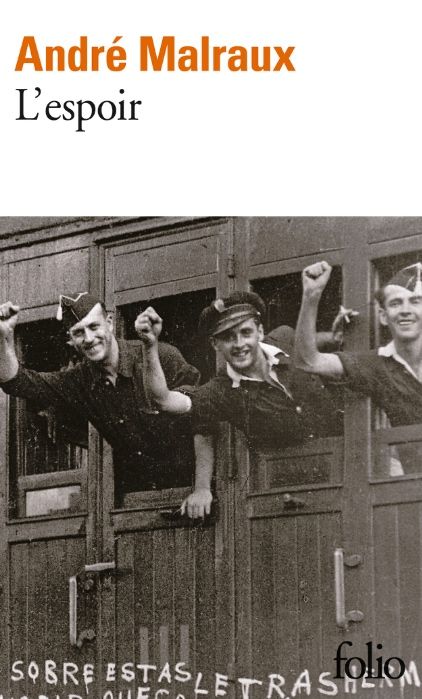
“L'ESPOIR” by Andre Malraux [first published in French in 1938; published in various English language translations as either Days of Hope or Man’s Hope ]


            In two of his first three novels, Les Conquerants and La Condition Humaine, Malraux wrote about upheavals in China in the 1920s. They very much aspired to be partisan reportage. [His other early novel La Voie Royale was more in the nature of an existential adventure story.] While Les Conquerants was written in straight-forward language, La Condition Humaine was marred by Malraux’s tendency to insert pseudo-philosophical passages where characters vented their vague ideas. L’Espoir was also in the nature of reportage, but this time the prose was very much matter-of-fact. Certainly characters discussed their ideas, but not with the vagueness of Malraux at his worst. Why should this be so different from the blurred prose of La Condition Humaine? My hunch is that this time Malraux was deeply involved in what he was writing about – not trying to deal with a country which he did not fully know. L’Espoir is set in the Spanish Civil War. Still more-or-less a very left-wing thinker, Andre Malraux went to Spain to fight against Franco’s military uprising. He put together a flying squadron to assist the official Republican air-force and he acted as a gunner [not as a pilot] in many sorties. One of the main characters  - Magnin – is obviously based on Malraux himself and L’Espoir is the longest novel Malraux ever wrote, maybe because he wanted to chronicle all the things he had seen or heard in Spain. It is worth noting than Malraux’s whole experience was in the early part of the Spanish Civil War – about 9 months – but the war itself dragged on for three years (1936-39). By the time L’Espoir was published in 1938, it was clear that Franco’s forces were well on the way to winning the war, so there is a certain irony in the novel’s title.  There was espoir [hope] in the early part of the civil war when the Republic believed it could defeat Franco… but by 1938, espoir was becoming a faltering hope.

            Synopsis: this long novel is divided into three Parts, with the first Part itself divided in two. I use here the headings as given in the English translation I read.

            Part One – First part: “Careless Rapture” – the time when those opposing Franco think they will easily defeat him. Across Spain, many railways and railway stations have been taken over by Franco’s forces. Magnin is putting together his squadron. Franco’s forces appear to be marching towards Madrid. Magnin’s squadron attempts to forestall the enemy by bombing a Francoist column at Medalline… but they are aware that the [Nazi] German planes, lent to Franco by Hitler, are better than the planes that the Republican air-force has. The squadron has some victories… but this is only because Nazi Germany is not yet fully armed. At this stage, some of Magnin’s colleagues are sceptical about the quality of the Republican Army. Two characters [Manuel and Ramos] rudely refer to the Republican Army as “a comic opera army”… but then, world-wide, army, air-force and navy tend to boast about how much better they are than other parts of their own forces. Nevertheless, it is true that the official Republican Army is aware that to some extent they will have collaborate with various left-wing groups – Socialists, Communists, Anarchists etc. But, for Magnin and his men, the problem is discipline. So many of these groups are disorderly.  


Part One – Second part: “Prelude to Apocalypse”. The scene moves to Tolado, where the Alcazar, the fortress held by Francoist forces, is being besieged by Republican forces. The matter of discipline is once again raised – and this is where Malraux pens many conversations. The Socialists tend to stand with the official army. The Anarchists and Anarcho-Syndicalists believe that separate groups would work best. The Anarchist Negus says that the Communists only pretend to be interested in the welfare of Spaniards as a ruse to take over the country. The Communist Manuel insists that there has to be severe discipline if anything is to be achieved and there should be one unified army. [Towards the  end of the Spanish Civil War, the Communists turned on the Anarchists and the P.O.U.M. and “purged” them… which was one of the reasons that Malraux began to shift away from the Far Left… but that was in the future at the time this novel is set.] Despite his authoritarian attitudes, Manuel has a long conversation with Ximenes,  a Republican Army Officer who is fighting against Franco, but who is also  a committed Catholic. In a peasant town, Ximenes asserts the need for the church, but also understands why the peasants have turned against the priests who have bullied them. There is a brief truce, when the garrison holding the Alcazar is able to get some provisions. Sometimes the Republicans and Francoists shout curses at one another. The Republican air-force bombs the Alcazar, artillery is fired at the Alcazar, and sappers tunnel in, attempting to blow up the Alcazar – but the Alcazar is never captured. By this time Franco’s army is approaching… and there is an awareness that some Republican soldiers are preparing to desert to Franco’s side. So Toledo is lost and the Republican army and its allies retreat back to Madrid. There is much brutality. A character called Hernandez has treated well the Francoist garrison when there was a truce. He chooses to stay in Toledo, even though he knows that Francoist soldiers will recognise him as a “Red” when they take over Toledo – and they will put him in front of a firing squad.

Part Two “The Nanzanares” So the anti-Franco forces head desperately back to Madrid, with many troops deserting on the way and understanding that Franco’s army is reinforced with Moors. What is hope now? The hope that Madrid will hold as a bastion, especially as the International Brigades (volunteers from many nations) have arrived to protect Madrid. Some volunteers are regarded as unable to really fight, but the Communist volunteers are the most disciplined. [The reality was that the International Brigades were largely run by Communists.] The Republican government leaves Madrid and sets itself up in Valencia. Malraux now cuts back to Magnin’s squadron. Magnin is still in charge but one pilot, Leclerc, is lowering morale by telling other pilots that their planes are very inferior and no match for the German and Italian planes. Magnin has to fire Leclerc. Meanwhile, it dawns on some that many people in Madrid are really on Franco’s side. [Malraux never uses the term, but this refers to what some would later call the “Fifth Column”.] Meanwhile Nazi planes bomb the Basque town Guernica…. At this stage Malraux inserts a long conversation with a Catholic man who is opposed to Franco and the more intransigent members of the Catholic hierarchy, but who points out that in Madrid there are many compassionate priests who are helping the wounded and sick and they are very much needed in the city…. There is also a long passage wherein people discuss the merit of Italian painting…. But the Moors are coming and the Francoists are coming and hell breaks loose. Much of Madrid is overwhelmed and the Moors almost take over the university city, but they are repelled. Francoists take over the central hospital as it is an excellent place for them to snipe from… so the sappers dynamite it. There are fires everywhere, fire-fighters climbing up or falling off ladders and much panic. But on the other side of Madrid, Franco’s tanks advance but they are destroyed… and more enemy troops are pushed back to the Sierra. At which point a squadron of Soviet planes fly in, their appearance more-or-less saving the day. Madrid is saved.

By this stage you might have noticed that this novel is more a panorama than anything else. There is no one central character, but there are many characters – perhaps inspired by the popular 1930s  idea that history is built on groups of people - “the people” and solidarity – rather than individuals. Characters come and go… and in the parts dealing with Madrid, we sometimes hear the dispatches of an American journalist called Slade.


And so to Part Three “The Peasants” In the south of Spain, peasants are attempting to escape further north as Franco’s forces move in.  But there is a great boost of morale when the Republic wins the Battle of Guadalajara. Mussolini wanted to reach glory by sending his forces to Spain , but his army was easily routed by the Republic…. And, as Malraux admits in this novel, even some generals on Franco’s side were glad that Mussolini’s forces had been humiliated. They did not want another army butting into their war. The civil war goes on. Magnin’s squadron finds out where there is a hidden Francoist aerodrome. They try to bomb it but some of their own fragile planes are shot down… and some pilots who had survived joined the crowds of peasants who are trudging north. And here the novel really ends. Walking along with the peasants, even the Communist Manuel comes to understand that the desperate, humble peasants, who assisted the downed planes, do not like seeing anarchists destroying their churches. Manuel dominates the last section of the novel, resigning himself to not knowing what eventually Spain will be like but hoping for he best.

So much for my overlong synopsis which, believe it or not, misses out many characters whom Malraux had created. If enjoyed at all, it is mainly good reportage based on things that the author had either experienced or heard about. It is built mainly on action. And, greatly to his credit, Malraux admits that events in the civil war were not a matter of black and white. As he shows, not all Spanish Catholics supported Franco [though probably most did]. Not all opponents of Franco were united [there were many factions that were at odds with one another]. This was quite unlike most novels about the Spanish war that were written in that era. They were usually very partisan one way or the other – Left or Right. Of course Malraux was fighting against Franco… but he began to be very wary of Communists in particular.

At which point I step away a little from Malraux’s novel and give you some of my own reflections on the Spanish Civil War.  Throughout L’Espoir, Franco’s forces are referred to as “fascists”. But this is not exactly accurate. Just as the Republicans had factions [Constitutional-ists, moderate Socialists, Anarchists, Communists, Catalonia nationalists] so on the Franco side were there factions [conservative Royalists, most of the Catholic Hierarchy, Carlists and of course the relatively small Falange who were the only real Fascists]. To hold his forces together, Franco forced the Carlists to be integrated with the Falange and all to be under his command. Fascists there were. But as George Orwell noted in his Homage to Catalonia, Franco’s aim was to restore a very conservative Spain, more like Feudalism than Fascism. Throughout the civil war, the Left dubbed their enemy as “Fascists” while the Right dubbed their enemy as “Reds”. Nowadays, most historians refer to the opposing forces as Republicans [the Left] and Nationalists [the Right].The Spanish Civil War is one of the most mythologised wars ever written about. Both Left and Right authors have presented their side as heroic, often distorting the truth. Reading the English-language version of L’Espoir, I was amused to find on the back-cover blurb the statement that “the Alcazar was bombed to surrender”. Actually the Alcazar never surrendered, which is why the Franco-ists chalked it up as a great victory…. And so I could burble on.

For the record, you can find on this blog reviews of books related to the Spanish Civil War – The Spanish Civil War by Hugh Thomas ; The Spanish Holocaust by Paul Preston; Homage to Catalonia by George Orwell; and if you are interested in philosophy The Tragic Sense of Life by Miguel de Unamuno. As for Andre Malraux, the Spanish war changed his perspective. While he loathed the far right, he became more sceptical of the far left. He also began to lose his interest in writing novels.


Something Thoughtful

Nicholas Reid reflects in essay form on general matters and ideas related to literature, history, popular culture and the arts, or just life in general. You are free to agree or disagree with him.  

                                                       S**TIFICATION ON LINE

Some months ago I saw in the New Zealand Listener a think-piece about the way Facebook had degenerated as a means of communication. Time was, Facebook was set up as a means of letting people express their ideas, keep in touch with others, keep conversations going, have polite disagreements and in effect be a sort of communal ongoing talk. For a while, that was the way it was. But it has mutated into something very different from that. Enter what the pundit called “shitification”, that is, Facebook has been loaded with shit. Regrettably much of this is true.

Item: Although you may still find some legitimate discussions going on, on Facebook, there are now unfortunately many dishonest and misleading groups such as an outfit called Cellion. In order to gain attention, it posts as “news” things that are complete fiction. Recently, I saw on Facebook, Cellion posted the “news” that Joe Biden and his wife had died in a plane crash. Of course readers wanted to know more. But if you wanted more, you had to go to Cellion’s notes, where you were told that your computer was infected unless you followed certain rules. In other words the thing was a scam. Using the same technique Cellion has also posted many other blatant fictions as fact. On Facebook, Cellion also deals with titillating images of young women almost showing their knickers, just this side of pornography. This is a prime example of “shitification”.

Item: It is on Facebook that you can now find advertisements which claim to have unique medicines or implements used in work. Usually such advertisements are for legitimate goods, but they sell their wares by saying of other companies that  “they don’t want to you know this” as if their own goods have something special. By the way, who are “they”? This is advertising by conspiracy theory. The very proliferation of advertising is also shitifying Facebook.

Item: Facebook regularly gives lists of “people you might want to know”. You just have to push a button and your “friend” will be able to contact you because you have given away your code. I’m sure there are people who want to have new friends, but as soon as you agree to push that button you will be bombarded with things you are not in the least interested in. Whenever I see the “people you might want to know” list popping up, I immediately delete it.

I am not saying that everything on Facebook is worthless. I would be a hypocrite if I did not mention that every fortnight I post on Facebook what my blog is up to. I also find on Facebook some interesting stories, although when Facebook tries to tell us about films or classic novels, Facebook seems to depend on AI, thus giving us cliché-phrased comments – and Facebook is notorious for presenting photos of the wrong person when doing a biography. [Example – when Facebook did a bio of the indigenous American actor Graham Greene, with it went a photo of the English novelist  Graham Greene… and Facebook is filled with such AI howlers.]. And on the whole, Facebook presents too much sensationalist rubbish.

Of course Facebook is not unique in its “shitification”. Other platforms are also filled with dross, such as Youtube – but Youtube is at least a little more orderly, even if it seems to spend most of its time squealing about American politics from one quarter or another. And as any sane person will tell you, watching too much of either Facebook or Youtube is always a great waste of time.


Monday, May 19, 2025

Something New

We feature each fortnight Nicholas Reid's reviews and comments on new and recent books.  

“TONY FOMISON – Life of the Artist” by Mark Forman  (Auckland University Press, hardback, $NZ59.99 )


I deliberately begin my review of Mark Forman’s biography of Tony Fomison with a clear judgment. Mark Forman has done an heroic piece of work. He was diligent in chasing down facts about the painter’s life. It’s a matter of no stone being left unturned. He has interviewed as many relevant people as possible – friends or relations of Tony Fomison, painters who did or did not get on with him, critics who wrote about him positively or negatively, odd people who at some time lived with him, women who sometimes looked after him or who got sick of him, people of different ethnicities who got to know him. Mark Forman scoured archives for letters from friends or painters or family members who knew him; or comments about him that had been written by journalists in newspapers about the arts world. In short Forman has been as thorough as humanly possible. This can only be called the definitive life and work of Fomison and it is highly unlikely that any other biographer of Fomison will be able to top it . BUT there is the big problem of overload when we are given too much information. I am reminded of once setting out to read the full version of  Boswell’s biography of Johnson and finding it so overloaded that I gave up on it. I did not give up on Tony Fomison – Life of the Artist, but sometimes its precise-ness becomes a bit of a chore to read.

            There is one major merit of this biography – when speaking of art and painting, Mark Forman does not talk down to his readership. Too many art critics and art chroniclers use a refined [and largely redundant] recherche vocabulary when interpreting or explaining works of art. I have long believed that [like most post-modernist criticism] the main aim is to show how clever the art critic is and how superior the critic is to us inferior readers. None of that nonsense for Forman. He writes clearly about how art changed in New Zealand in Fomison’s life-time and the different phases of Fomison’s work. When he analyses a painting by Fomison, he says clearly what he believes Fomison was aiming at, he takes us through the techniques Fomison used to create effects in a painting, and what effect the painting had on the general public. BUT one major problem mars this biography. Tony Fomison – Life of the Artist is filled with photos of Fomison, his friends and family – but there are no images of Fomison’s work itself. On Pages 404-to-407, Forman explains that Fomison’s family did not allow any of Fomison’s paintings to be reproduced. The result is that the reader [unless he or she has an archive of Fomison’s work] cannot really visualise what the artist was producing. It is as if this fascinating book has been sabotaged.

            Thus for my general review, but you would be very annoyed if I left it at that. so let’s get to the main things Forman says about Fomison’s life and work.

The life of Tony Fomison (born 1939; died 1990) was often erratic, sometimes sordid and taking a long time before he really became engaged with painting. He was born and raised in a working-class suburb of Christchurch. Life-long he boasted about his working-class origins and he was always ready to rant about the bourgeoisie – a common affectation among painters and poets when they want to boost their prestige with their mates. Young Tony Fomison was a sickly child, asthmatic and extremely self-conscious about his lean and spindly legs. At school he was very much a loner, finding it hard to make friends. Years later, says Mark Forman, Tony Fomison claimed that he never wanted to socialise. He didn’t do well at school, but he loved drawing and read voraciously. In his two years at art school, he always got C-minus grades.

Surprisingly, as a teenager, Fomison began to take a great interest in the Maori rock carvings which could be found in South Canterbury. He studied them on his own, cycling to distant sites and drawing his impressions of the carvings. He became, in effect, an “amateur archaeologist”… but his interest went further than that. He was later to write and have published articles, in reputable journals, papers about the rock formations. There was even the possibility that he could become a full-time archaeologist, but in his early 20’s he turned to more interest in painting with a side-interest in sculpture. A few of his paintings were sold. More important, he was awarded a scholarship to study art in London and Paris. Knowing that expressionism has run its course, he was first interested in modernist works like those of Francis Bacon with his contorted images of people in some sort of agony. These had a profound influence on Fomison’s later work, but even more influencing him were the paintings he saw by Goya, Caravaggio and other masters of the late Renaissance. In that situation, though he was never a Christian, he became very interested in the image of Jesus and he was later to paint many images of Christ, though most often as Christ either dead or in agony. Some critics have carped over the fact that Fomison was so influenced by classic European art. There was [and in some quarters still is] a prejudice that New Zealand painters should paint only New Zealand themes.

All this so far makes it sound as if Fomison was on a steady course as an artist. But this was far from the case. From the time he had left his parents’ home, he had tended to live in various places of squalor. It was when he was in London and Paris that he became addicted to hard drugs, moving from amphetamines to heroin and trying to make a living as a dishwasher. In Paris he was jailed for three weeks for vagrancy and by the time he returned to London, he was deeply depressed and seriously considered suicide. He had abandoned painting. His sister Julia, who was a nurse, managed to get him put in the Banstead psychiatric hospital, where he stayed for three months. He dried out a little, although the destructive drug culture remained with him and he was still able to access drugs.

Now in his late 20’s he returned to New Zealand, hooked up with another drug-using painter Philip Clairmont, and tried to adjust once again to conservative Christchurch. He went back to his parents home until his father kicked him out. He had a hard time getting back to painting, painted versions of Christ but also painting distorted images of people gurning [making grotesque faces]. Mark Forman makes it clear that, despite his bohemian way of life and his general slovenly presentation, he was capable of dressing himself respectably when he needed to – especially when he resumed his interest in the Maori stone carvings and dealt with museums and experts in the field. By the early 1970’s, the drug LSD was banned in New Zealand. Fomison had used the drug, so he now ran on opioids  - as well as heroin. In 1972 he tried to get off opioids and took the methadone treatment. Many younger painters of his generation claimed that hard drugs inspired their work.  Police raided the house where he lived and he spent six weeks in prison – but there he was given the opportunity to paint. Being allowed to paint five hours a day got him back to painting regularly. The first real exhibition of his work made him better known. Mark Forman explains carefully how Fomison’s styles and techniques in painting had changed. He now often painted on hessian and, with much difficulty, he had mastered the art of working with oil paints – something that had previously daunted him. Fomison’s paintings were often dark, and his images of Christ were mainly of the corpse of Christ.

It is only when we are about half-way through Tony Fomison – Life of the Artist that Mark Forman deals with Fomison’s sexuality. In mid-career Fomison fell in love with the very middle-class painter Marc Way. Marc was gay but, much as he admired some of Fomison’s work, he was not interested in having any sexual relationship with him. In fact, Marc Way was repelled by Fomison’s messy and disorderly life. Fomison tried to become part of the gay community but he never got further than going to some dances organised by gays and he never had a real gay friend.  He remained what he had been when he was a teenager – a loner. Gay or not, the hard fact is that, in domestic matters, the people who tried most to help him were women. For three years Diane Perham propped him up, made sure he was fed, tried to keep his house orderly, until the moody painter became intolerable. It is a hard fact that many creative people are often self-obsessed and ignorant of other people’s needs. Thus with Fomison. Later Daphne and then Emily Karaka helped him out for a while, but it always ended with them being repelled by him.

Fomison made the decision to move to Auckland where he, at different times, lived in Grafton, Ponsonby and Grey Lynn, usually renting old and in some cases nearly decrepit houses. Only later in his life, when he was in his 40’s, did he get a mortgage for a house of his own – and then he aimed for what would look more like respectability.

Fomison painted some images based on Maori culture, but at least one Maori pundit objected to a Pakeha dabbling in Maori beliefs and legends [more recently – after Fomison’s death – it has become necessary for Pakeha to apologise should they deal with Maori lore]. However, living in Ponsonby, which had not yet become the gentrified and expensive Auckland suburb that it now is,  there were many Pasifika people, especially Samoans. Some were Fomison’s neighbours and he soon found comradeship with them. This was in the era when the conservative Prime Minister Robert Muldoon was encouraging the police to carry out “dawn raids” to round up “over-stayers” - Pasifika people who had overrun the time they were given visas to work in New Zealand. [More level-headed people pointed out that there were far more British and Australian “over-stayers” in New Zealand, but Muldoon ignored that.] In that climate Fomison sided with the Samoans and became more interested in their culture. This led to something that is still controversial. Undergoing much pain, Fomison submitted to having the traditional Samoan  tatau – the sacred tattoo that elite Samoan male adolescents were given – carved upon his body. It was a long and painful process – and unfortunately there were complications and his blood was poisoned. Much medical help was needed to cure him… and there were some Samoans who believed that Fomison did not have the right to have the tatau. And when Fomison eventually visited Samoa – together with a film-crew led by Geoff Stevens – he discovered that he really didn’t fit into Samoan culture at all. Nevertheless he had painted the mural the “Ponsonby Madonna” for the Catholic boys’ school St. Paul, where most of the teenaged boys were Samoan. The Blessed Virgin Mary was depicted as a Samoan woman and Jesus, also depicted as Samoan, was presented as a teenager, not a baby in his mother’s arms.

Mark Forman has perforce to tell us much about the art galleries Fomison had to deal with and the people who ran those [public or commercial] galleries – fixing the prices for paintings that were there to be sold, organising an artist’s exhibition, sending out invitations to art critics etc. The art critics could be positive or negative about Fomison’s achievement. Forman makes it clear that there had been many “schools” of painting about which the critics could quarrel. Very much influenced by Toss Woollaston (who mainly painted landscapes) and even more influenced by Colin McCahon, Fomison early agreed that some sort of human figure should be important in a painting – a representation of human conundrums. One critic claimed that Fomison had become New Zealand leading painter. By contrast, the critic Francis Pound still clung to the merit of abstract art [mainly influenced by American trends] and saw little merit in Fomison’s work.

By the mid 1980’s, it was clear to many of his friends that Fomison was “losing it”. He did wildly eccentric things, forgot people’s names, or couldn’t remember basic things. It is easy to believe that his huge intake of illicit drugs hadn’t helped his brain [not that Mark Forman dwells on this]. But by this stage he was more hooked on alcohol than on drugs. Nevertheless, he was given a residency in the Rita Angus Cottage in Wellington… though he didn’t much like it and thought it was inadequate for a place where he could paint. Later he went to Coromandel and spent some time with the influential potter Barry Brickell, who had strong ideas about using nature as the way to express ones ideas. Fomison liked Brickell but their relationship was brief.

As 1990 approached, it was clear that many of Fomison’s fellow painters were dropping out of sight or dying. Philip Claremont had hanged himself. It was also clear that Fomison was turning back to more traditional inspirations. The problem of trying to identify himself with other ethnicities led him, in his final days, to paint a number of paintings based on characters in Shakespeare’s plays. Overwhelmed by his consumption of alcohol, his system gradually broke down. In 1990, he went to Waitangi on Waitangi Day, but his body gave in, he fell and was injured, was rushed to the Whangarei hospital, and died on 7th February 1990. He was 50 years old. Mark Forman notes that Fomison’s funeral was directed by a churchman who spoke of Fomison as if he were a saint… even though Fomison was not a religious person. Many friends and fellow art people and Fomison’s mother and some members of his family were present.

There is no doubt that Tony Fomison was an important and influential New Zealand painter. But, as Forman makes clear, he was not always a person you would not want to deal with. Often he could be completely aggressive, deliberately provoking or insulting people. He would turn up when invited to parties and would then abuse his host. His behaviour towards the women who helped him was often appalling. Emily Karaka left him after an event [not entirely Fomison’s fault] when she was injured in his house. He had a violent fight with his estranged brother Michael. And there were many petulant public displays. The most notorious was when he had designed some posters for a play production of Kafka’s  Metamophosis. Invited to sit in the front row, Fomison spent the whole play heckling the actors and making his own rude comments on what he thought of the play. The audience tried to shut him up to no avail. When the play was over, the play’s director [Raymond Hawthorne] confronted Fomison and said “How would you like it if I came to one of your exhibitions and wrote shit over your paintings?’ (Quoted pg. 279)… not as if Fomison would have been phased by being chastised. Why did Fomison so often behave this way? It’s easy to speculate. All the drugs and booze would have broken down his inhibitions. There was his sense of being an outsider and not having many real friends – an attitude he had had since childhood. His uncertain attitude to sex and his experience of not being fully accepted by the gay community. His shame about the shape of his body etc. etc. etc. These are mere guesses on my part and – of course – I could be completely wrong. But there was something that made him too often unable to deal reasonably with other people.

Enough of this speculation! The fact is, many great painters were eccentric, misanthropic, misogynist, sadistic or whatever, doing cruel things to other people . Caravaggio probably committed murder and had an unhealthy interest in teenaged boys. Eric Gill had incestuous relations with is daughters. Both Rodin and Picasso sexually abused the women who posed for them… and so on. Not that Fomison had ever done anything as bad as that, but it remains true that many creative people are so absorbed in their work and ideas that they regard other people as less important than they are, and therefore not to be considered. If we pass some sort of judgment on artists, we should first and foremost be interested in what the painter has created and leave the biography behind.  Like the person or not, Fomison was a major figure in New Zealand art, sometimes daring, sometimes provocative, sometimes very earnest and willing to change styles when he knew one sets of inspiration had been exhausted. Mark Forman knows this and has correctly saluted Fomison.
 

Pompous Footnote: I was so annoyed that this book lacked images of Fomison’s paintings, that I went to some art galleries and found a few of Fomison’s works… whereupon I, with my very limited pocket camera, took some [amateurish and slightly cockeyed] photos. Here they are.

            At the Auckland Art Gallery, I took a snap of Fomison’s Skull Face, a frightful image of a face decaying.

            Also at the Auckland Art Gallery I snapped Fomison’s Not Just a Picnic, a little didactic but apparently being an allegory of human life – woman, infant, young man, adult man.


            And recently while visiting the Dunedin Art Gallery, I took a shot of Fomison’s Dying Beggar By Ceruti, an example of his making use of Renaissance works. In my view, this painting might as well be one of Formison’s paintings of the dead or dying Christ.


            However I do acknowledge that if you look up Fomison on line, you will be able to see many of his works