-->

Monday, June 6, 2022

Something New


We feature each fortnight Nicholas Reid's reviews and comments on new and recent books. 

“WINTER TIME” by Laurence Fearnley (Penguin, $NZ 36); “EDITH AND KIM” by Charlotte Philby ( The Borough Press / HarperCollins, $NZ32:99)


            Laurence Fearnley’s latest novel Winter Time is the most compelling narrative she has yet written and the one that every reader will want to read to the very end. I say this up front because, frankly, I have had mixed feelings about some of her previous novels. In newspapers I reviewed her earlier novels Room, Edwin and Matilda and Mother’s Day. On this blog, you can find my reviews of her The Hut Builder (published 2010) ; Reach (2014); and The Quiet Spectacular (2016). To quote from my review of The Quiet Spectacular: “Despite their many merits, I did note the awful weight of overt symbolism and rather arch patterning in Reach; and the tendency to preach in The Hut Builder. These tendencies run amuck in the over-patterned, over-symbolic and over-preachy The Quiet Spectacular, to the point where the characters become mere ciphers and walking ideas.” Winter Time does not have any of these faults. Partly a whodunnit, or at least something very close to a whodunnit, its story is relatively straightforward. And if Fearnley has any message to preach to us, it is implicit and built into the characters, rather than spelled out polemically.

            Roland is the eldest in what was a very unhappy family. None of his siblings married or had children. His youngest brother Isaac was killed in an accident years ago, his sister Casey is long gone, and now his other brother Eddie has died in a crash. Eddie’s ute veered off the road and landed him in a canal where he drowned, unable to fight his way out of the vehicle. Roland is very different from Eddie. Eddie was a sturdy outdoors bloke, a deer culler working for the conservation people. Roland is gay. He has deserted the old family home in the South Island and moved to Sydney where he and his gay partner run a health food business. But Roland loved Eddie and remembers him fondly as the guy who looked after him when they were kids. Even though Roland was the older one, Eddie shielded him from the rages of their father Gerard, who eventually walked out on the family. Eddie didn’t try to test Roland’s manliness with outdoor tasks the way their father did. And Eddie was appreciative of Roland’s indoor skills, especially his culinary arts.

            So Roland flies from Sydney to his original home town for his brother’s funeral. (The town is given the fictitious name Matariki, but will easily be recognised by some readers as what has rapidly become a tourist town in the Mackenzie Basin.) As soon as Roland looks at the site where Eddie swerved off the road, he senses that something is amiss. He suspects foul play of some sort, and the main thread of the novel has him trying to find out all he can about his brother’s death. In this search, he is helped by a sympathetic woman called Bay whom he meets in the local café and who says she knew Eddie. There is a major snag in Roland’s search for the truth however. Somebody has been able to steal Roland’s on-line identity, and is posting deliberately inflammatory messages under Roland’s name. They are designed to stir up anger between trophy hunters who want to shoot deer and tahr for sport, and cullers who are there to thin out these animals in the interest of conservation.   

As always, I do not give away too much plot when dealing with a novel that has an element of mystery. The author has a right to expect her twists of plot not to be revealed. Enough to note that Laurence Fearnley throws a number of mis-directions at us and comes to a plausible conclusion about the guilty party.

There are many skills in this novel.

Fearnley weaves the backstory of Roland’s family seamlessly into Roland’s search for answers.

She is very good at noting how this South Island town has changed over the years. Roland’s childhood memories of an unpretentious little town are matched with the town’s current commercialisation and the flashy holiday homes than are build there for the very wealthy, locking out less affluent people.

In the person of Roland’s next-door neighbour, Mrs Linden, she creates a character so grotesque as to be funny, yet at the same time disgusting and almost sinister.

The relationship of Roland and his partner Leon is handled very delicately, but not idealised. Leon, the older man, is a pragmatist, wanting their health food business to expand even if it means compromising their standards. He is an entrepreneur first. Roland is more the idealist and the dreamer, wanting to stick with their original programme and not very good at the business side of things. There are mild ruptures in their relationship. They realise they are getting older and no longer feel the intense first buzz of love, yet Leon is clearly annoyed when Roland leaves him on his trips to New Zealand. He has a strong strain of possessiveness.  Fearnley has moved far beyond the sort of advocacy books we used to read about gay men, who were depicted as flawless so that we could more easily feel for them. Here she has created a credible but far from perfect pair whom we can still like.

Her greatest skill, though, is setting her story in a harsh South Island winter, which she depicts with careful and close observation. Fearnley has much expertise when it comes to mountains and the outdoors (remember she co-edited an anthology about New Zealand mountains, and helped write a mountaineering friend’s autobiography). It shows here as she charts the seasons changing, the snow, the semi-thaw, the way plants behave in the cold and the inconveniences for walkers and other travellers. The chilliest images in Winter Time are of Roland alone in the family home, with the cold biting at him. A perfect image for a man who is lonely, worried in his heart and stumped in his enquiry.

Others may make a different judgement, but this is for me Fearnley’s most relatable novel.

  *.  *.  *.  *.  *.  *.  *.  *.  *.  *.  *.  *.  *.  *.  *.  *.  *.  *.  *


            I admit that I requested a review copy of Charlotte Philby’s Edith and Kim under a misapprehension. Charlotte Philby is the grand-daughter of the Soviet spy Kim Philby. Seeing her name on the cover of Edith and Kim I assumed, wrongly, that this was going to be a work of non-fiction, a grand-daughter’s memoir or non-fiction account of her grandfather and his circle. I was wrong. Edith and Kim is a novel – based on fact but a novel nevertheless. Charlotte Philby, journalist, columnist and author of three previous novels, says clearly in her opening author’s note that this is “a work of fiction based on  facts as I have variously found them, reimagining the lives of two people from starkly different backgrounds.” She further notes that some characters are invented. Some of Kim Philby’s letters are reproduced, but the author says she has made some of them up.

All of which puts me very much on my guard. Checking this novel against various books I have on Kim Philby and Edith Suschitsky (often known by her married name Edith Tudor-Hart) and their espionage activities, I find that this novel sticks very much to the historical record – but of course the thoughts, feelings and attitudes of Edith, who dominates the novel, are very much the author’s invention. And the author’s interpretation of events is hers too.

Viennese-born Edith Suschitsky was the daughter of a Social-Democrat bookseller and in the 1920s and early 1930s, she was much interested in the German Bauhaus movement. Embracing modern art in all its forms, she took up photography. But being Jewish, she and her family were very wary of the antisemitic-inflected Austrian version of Fascism that was on the rise and was soon to take over Austria. Like many others of her generation, Edith thought that Communism would be a bulwark against Fascism and she joined the Communist Party, becoming a courier between Austria and England.

It was in Austria that she met public-school-and-Cambridge educated Kim Philby, son of a very pukka British imperialist, who hadn’t yet committed himself to Communism. Back in London, Edith introduced Kim to Soviet agent Arnold Deutsch, who checked Philby out and then recruited him for the party. As is well-known, Philby then spent most of the 1930s building up a deep cover for himself by loudly supporting right-wing causes. He was a Times correspondent in the Spanish Civil War, covering the Franco side and writing enthusiastic dispatches on Franco. He joined the Anglo-German Fellowship, which was essentially a Nazi-controlled front seeking approval for Nazi Germany’s re-armament. Diligently playing the role of a Tory patriot, he seemed just the sort of chap that England’s secret service would approve, and by the early 1940s the Soviet spy was embedded in MI5.

While all this was going on, Edith Suschitsky had settled in London, set herself up as a professional photographer, and married the English doctor Alexander Tudor-Hart. Because she was seen at a Communist rally in London, she was observed by MI5 and was known to mix with Communists – but although she was investigated a number of times, she was never caught out in spying and was never prosecuted for anything. The only time she was jailed had been in Vienna when she was incarcerated for a few months before leaving Vienna for good.

Once all this is settled, the novel concentrates on Edith. Kim Philby is never really seen in close-up – except in the letters he wrote to Edith from the 1960s on, when he had been exposed and had fled to Russia. Edith and Kim has three forms of narration. There is the third-person account of Edith’s life over the years – very intimate and detailed, taking up most of the novel. There are  reproductions of authentic MI5 documents (retrieved by Charlotte Philby from the archives) tracing Edith’s movements in formal language – and sometimes redacted so that some people’s names aren’t mentioned. And there are those 1960s-on letters from Kim. It is interesting how much the exposed spy talks about trivia like the weather, and makes a few comments on old friends back in the day – but of course never says anything about his spying activities.

And how does Edith’s life play out in this novel? Fairly drab and pedestrian, to put it simply. She gets a little upset when Stalin makes his pact with Hitler in 1939, but unlike many others, she still sticks with the party. Her marriage disintegrates and she has two or three lovers, but she gets angry with one who questions the righteousness of the Communist cause. When Hitler double-crosses his pal Stalin and invades Russia in 1941, she is heartened to see Communism again fighting Fascism. And for the first time she really does do some spying, getting documents related to Britain’s atomic research (passed to her by the likes of Nunn-May and the friends of Klaus Fuchs), photographing them and handing them over to Soviet agents. By 1956, she is upset by Khrushchev’s denunciation of Stalin, but she still believes in her chosen ideology.

Yet while all this is going on, she is most concerned with her young son Tommy, who is mentally impaired and whom she takes to various doctors and psychiatrists (including Anna Freud) for treatment. Edith would like to believe that the only cause of Tommy’s impairment is trauma caused by living through the Blitz. In fact, he was mentally much more deeply afflicted than that and had to spend the rest of his life in psychiatric hospitals. [One source I read said that Tommy was schizophrenic, but that term is not used in this novel]. Edith’s aching for Tommy’s recovery almost resembles her aching for all Communism’s promises to be fulfilled. At least, that’s the way I read it, even if it wasn’t the author’s intentions.

This is a very earnest novel, and as novels-based-on-fact go it is true to the record. By focusing on somebody who was really a very minor player in the Cold War, Charlotte Philby is making clear to us how unglamorous spying usually is, peopled by unhappy people playing small roles at the bidding of manipulative masters. In the end, all I was left with was a sense of desolation to think of all those people of goodwill who, unknowingly, harnessed themselves to the cause of a totalitarian and genocidal state.

Something Old

 Not everything worth reading is hot off the press. In this section, we recommend "something old" that is still well worth reading. "Something Old" can mean anything from a venerable and antique classic to a good book first published four or more years ago.     

TWO SHORT BOOKS. “GRIEF IS THE THING WITH FEATHERS” by Max Porter (first published 2015) ; “FOX” by Margaret Wild and Ron Brooks (first published 2000)

            When it comes to these “Something Olds”, you know my form by now don’t you? I usually bombard you with detailed summaries of fat novels (mainly from the 19th or early 20th centuries) – often novels of which you have never heard. But this time I’ve decided to break the mould. Here are comments on two short books, each of which may be read easily at one sitting. And each of which is well worth reading. Read both of them carefully and you realise that each is about intimate grown-up relationships, even if one is apparently a children’s picture-book.

  *.  *.  *.  *.  *.  *.  *.  *.  *.  *.  *.  *.  *.  *.  *.  *.  *.  *.  *


Published by Faber and Faber in 2015, Max Porter’s first book Grief is the Thing with Feathers, was an instant bestseller, was hailed with positive reviews, was later turned into a play, was translated into many languages and has been reprinted numerous times, so the odds are that you’ve already heard of it. It has been called a prose-poem, but in my book that means simply prose.

The title is a revision of Emily Dickinson’s line “Hope is the thing with feathers” –  possibly a reference to angels. In Max Porter’s novella, Grief is a scrawny crow. The tale is told in three voices. A mother has died in an accident, leaving behind a grieving father and two young boys. The voices are Dad, The Boys and a Crow. Where does the Crow come from? It comes from Ted Hughes, to whom there are a number of references. Dad is attempting to be a scholar and is writing a book, for an obscure, minor publisher, to be called  Ted Hughes’ Crow on the Couch: A wild analysis. Late in the tale, The Boys, with some sympathy for Dad, tell how Dad once went to a Ted Hughes symposium at Oxford. but found himself to be a little fish, overwhelmed by the academic types. Out of all this, one understands that as Dad grieves for his wife, he has probably conjured Crow out of his studies… and yet there are sequences where The Boys seem aware of Crow.

As Hughes died 1998, 17 years before Grief is the Thing with Feathers appeared, there was no controversy over the use of his name. Besides, Faber and Faber were also the publishers of Hughes and, for the record, Hughes was a devotee of Emily Dickinson and once edited a selection of her verse. To give the rest of this book’s backstory, note that Max Porter was not presenting an autobiographical narrative. His wife and children were in good health. He constructed Grief is the Thing with Feathers out of memories of his father dying when he was a young child.

This novella charts phases in grief, beginning with the initial shock and the not-always-helpful expressions of sympathy offered by well-meaning people. As Dad says early in the piece “The doorbell rang and I braced myself for more kindness” (p.4) Crow offers  a more anarchic approach. To conquer grief, Crow pours into Dad’s mind horrific images of what could be, creating a virtual shock treatment. Crow offers to treat grief directly. Crow says blandly “I believe in the therapeutic method” (p.12) Dad is aware that his marriage was not always harmonious, but he still feels great loss, as in his realisation We will never fight again, our lovely, quick, template-ready arguments. Our delicate cross-stitch of bickers” (p.20)

In the first shock of loss, there is the tendency to see bereavement as a universal tragedy which should be honoured and grieved by all the world. The Boys say “There should be men in helmets speaking a new and dramatic language of crisis. There should be horrible levels of noise, completely foreign and inappropriate for our cosy London flat.” (p.14) This level of grief can tip over into the grandiose. Later in the text, Dad says “I wanted to build a hundred foot monument to her… Everybody passing could comprehend how much I miss her” etc. etc. But Crow responds “Eugh… you sound like a fridge magnet.” (p.50) The grandiose is deflated.

Then there is the phase of guilt, in which the bereaved accuse themselves of not being constant to the memory of the deceased; of beginning to forget the deceased; of letting their minds wander off into more trivial things. The Boys at first remember their mother mainly as an absence – the lack of the childcare they were used to. Something is missing. Later they try to tough it out, but are a tiny bit ashamed of their flippancy when they think they can find a substitute for their mother. The Boys say “We watched London and London offered us possible mothers in jeans and striped T-shirts and Ray-Bans, so we spotted them and liked the nasty insensitive self-harm of it. We were blasé with a babysitter who said ‘How can you laugh about it, it’s so sad?’ ” (p.66) Father too feels uneasy about himself as he seeks comfort in another woman.

Crow tells a number of fables and cautionary stories. The longest (on pp.54-58) has him driving away the demon of grief by sheer anarchic behaviour. This anarchy is really the fullness of life, where one thing happens after another as life continues and grief is gradually muted. And yet a level of real grief will always remain. Rebelling against the concept of “moving on” from Grief, Dad snaps “Moving on, as a concept, is for stupid people, because any sensible person knows grief is a long-term project. I refuse to rush. The pain that is thrust upon us let no man slow or speed or fix.” (p.99)

There is a sort of reconciliation to come, but the main effect of Grief is the Thing with Feathers is the pain of loss.

  *.  *.  *.  *.  *.  *.  *.  *.  *.  *.  *.  *.  *.  *.  *.  *.  *.  *.  *. 


Very different, but still very powerful, is the Australian children’s picture-book Fox, published in 2000. The text is by Margaret Wild, the images by Ron Brooks. I note that the blurb of the first edition I have says Fox is “a story that is as rich for adults as for children.”

Indeed it is.

Here is a very simple tale. In the Australian outback, Magpie’s wing is burnt and Magpie cannot fly. Magpie (who is referred to as “she”) is helped by Dog (“he”), who is blind in one eye. Dog says Magpie can “fly” again if she sits on his back while he runs. They become bonded partners. He becomes her wings and she becomes his full sight. But along comes Fox (“he”). Fox’s red coat is glamorous. Fox can run faster than dog. Magpie swears she will never desert dog. Magpie knows Fox smells of “rage and envy and loneliness”. But Fox says he can make her really feel she is flying and Magpie finally succumbs to Fox’s promises. She sits on Fox’s back and he runs far, far into the desert… where he dumps her and runs away, declaring “Now you and Dog will know what it is like to be truly alone”. And in the very last words of the book, we are told of the maimed Magpie “Slowly, jiggety-hop, she begins the long journey home.

It is hard for an adult to read this text without seeing it as an adult story of seduction. Magpie (woman) is seduced by the flashy glamour of Fox (rootless delinquent man), coming back to herself only when she remembers the domestic security and reliability she has left behind in Dog (unglamorous husband or partner). This must be the true history of many affairs.

In Ron Brooks’ large, wide-page illustrations, Fox is certainly the most glamorous character in the book. Dog is an unglamorous mustardy brown. The red of Fox’s coat is carried over into the harsh redness of the desert into which Fox runs. And Ron Brooks presents the text in the form of naïve, childlike printing. Does this represent the clarity of a story which even children can understand. But if so, what is the message that is being presented? To beware of untrustworthy strangers, perhaps?

To me, Fox is as adult as a real children’s picture book can be.


Something Thoughtful

 Nicholas Reid reflects in essay form on general matters and ideas related to literature, history, popular culture and the arts, or just life in general. You are free to agree or disagree with him.  

QUALITY OR IDEOLOGY?

Here’s a very old problem that some critics seem never to have wrestled with.

When you judge a work of fiction (be it short-story, novel, film or TV series) do you assess it for what it says, or do you assess it for how well it says what it says? In other words, do you praise a work of fiction by how much you agree with its ideas and to hell with the quality of its prose or production? Or do you praise it for the quality of its prose or production and to hell with its ideas, whatever they may be? I’ve dealt with this problem before on this blog. To be precise, when reviewing Henry de Montherlant’s tetralogy Pitie Pour Les Femmes back in 2014, I wrote the following:

I resist vigorously the notion that fiction should be praised or blamed solely in terms of the values it expresses. The sort of criticism that concentrates on morality and values alone will rapidly become the sort of criticism that is really promoting propaganda. I am a socialist or a feminist or an agnostic or a  Christian. Therefore I endorse literature that advances the cause of socialism or feminism or agnosticism or Christianity. Should I adopt this approach, I will end up praising the second-rate because it confirms those values which I already profess; and decrying much worthwhile work because it does not share my world view. I sometimes think of this approach to literature as the high-school approach, because the main emphasis of many high-school English teachers is to give their classes novels that will promote healthy attitudes, “improving” novels that teach tolerance and gender equity and justice and so forth. A good scheme for advancing a peaceable society, perhaps, but a very bad way to approach literature if you have got beyond the classroom …And yet, having said all this, I am as wary of the approach which concentrates solely on aesthetics. Let us look at Louis-Ferdinand Celine’s dense prose, let us consider how he piles detail on detail, let us analyse his fascinating mixture of classical and demotic phraseology – oh, and let’s just not happen to notice his nihilism, the frankly loopy ideas he endorses and his rampant anti-Semitism. If the values-fixated approach to criticism leads to the endorsement of propaganda, the aesthetics-fixated approach leads to a sterile art-for-art’s-sake mindset, which detaches literature from the world around it. It is the talent, skill or genius of the writer as a writer that makes the writing competent, very good or brilliant. We should always be responding to, and judging, the words on the page. But what the writer is promoting, advancing, criticising, in sympathy with or satirising in fiction also has to be considered.

As a critic or reviewer, I should be able to say sometimes that, while I approve of a novel’s outlook, it is nevertheless a very bad piece of writing.  Conversely, I might sometimes have to say that something is outstandingly good as a piece of writing, but that its implicit moral values are defective.”

That is what I wrote eight years ago, and I’m still sticking with it.

Why am I resurrecting this old material? Because recently I saw a gross example of a film widely over-praised, I believe, for its ideology without much real scrutiny of its aesthetic merit.

I ask you to control yourselves here. Please don’t collapse with the vapours, as I’m about to commit heresy.

I thought Jane Campion’s film  The Power of the Dog was itself a dog - dull, plodding, poorly paced, manipulative and in part wilfully obscure. I know it won Jane Campion an Oscar as best director. I know it was highly praised by the great majority of reviewers and critics world-wide. As a New Zealander I know it’s very unpatriotic of me not to praise a New Zealand director and to be so negative about a film which was largely filmed in Otago and Auckland. Obviously I’m committing treason as well as heresy. But there it is. I have this awful habit of making my own judgements on things rather than following a trend.

If you haven’t seen it, here’s a curt synopsis.

1920s in Montana. Phil (Benedict Cumberbatch) is a nasty piece of work – a rancher who bullies and belittles people. He bullies his sister-in-law Rose (Kirsten Dunst) so badly that Rose becomes an alcoholic. He bullies the local Native-Americans by not letting them buy the surplus hides he’s about to destroy, so he’s also racist. Most of all, he bullies Rose’s son Peter (Kodi Smit-McPhee) whom he sees as weak and effeminate. He shows his nastiness when he callously burns the pretty paper flowers Peter has made to decorate the table. Hiss the villain folks.

Phil is macho, aggressive and racist. Therefore he is the model of toxic masculinity. But he’s also single. An unmarried man. Hmm. That’s suspicious. Aha! Peter spies on Phil and discovers Phil is actually homosexual, fixated on his relationship with a cow-poke he knew years ago. Clearly he once slept with his cow-poke buddy. So that explains it neatly. Phil is a bully and a thug and excessively macho because he’s suppressing who and what he really is. He’s punishing effeminate Peter as atonement for his own sexuality. And he is irredeemable.

Solution? After Phil has messed up the lives of both Rose and Peter, Peter (who is studying medicine and toxicology) works out a way to poison Phil with anthrax and without being suspected of murder. So Peter kills Phil, the bully is dead and Peter smiles at what he has done. Happy ending.

Now lets admit that this synopsis could have made an interesting film. But let’s also note that it falls apart both in terms of its ideas and in aesthetic terms.

Its minimalist musical score was hailed as a deliberate riposte to the standard grandiose scores that accompanied old Westerns. The Power of the Dog is intentionally an “anti-Western”. Regrettably the much-praised score is bland and forgettable. The film’s pace is leaden – everything played slowly, much vague camera movement, redundant shots of farmhands. And in spite of moving as slowly as a stranded chuck-wagon, it still manages to be wilfully obscure in places. More than one viewer told me that they couldn’t work out exactly what happened at the end because Peter cutting up strands of hide to make a belt wasn’t clearly related to infecting Phil with anthrax. Some who watched it on Netflix, rather than at the movies, said they had to watch the last quarter-hour twice before making any sense of it.

And the film’s ideas? In the end, it is of course justifying murder. Annoyed by a bully? Okay – kill him. Problem solved. As for the critique of “toxic masculinity” – do you really believe that all macho thugs and bullies and racists are suppressed gay guys? Some may be, but it’s highly unlikely that the great majority are. So what does the film’s diagnosis of Phil really tell us? Very little, because it’s dealing with an unrepresentative specimen.

My beef here is my strong suspicion that The Power of the Dog was over-praised by critics determined to show they opposed toxic masculinity – a current simplistic and modish preoccupation. A prime example of a film being praised for ideology rather than merit.

How DARE I say these things when the critical consensus was so favourable?

Because I do dare, that’s why.


Monday, May 23, 2022

Something New


We feature each fortnight Nicholas Reid's reviews and comments on new and recent books.


“NEXT: Poems 2016-2021” by Alan Roddick (Otago University Press, $NZ 27:50); “ANOTHER BEAUTIFUL DAY INDOORS” by Erik Kennedy (Te Herenga Waka University Press, $NZ 25); “MEAT LOVERS” by Rebecca Hawkes (Auckland University Press, $NZ 24:99)


Alan Roddick is a unique figure in New Zealand literature. Now well into his 80s, he was born in Northern Ireland and has lived in New Zealand for the last 70 years. By profession he was a dentist. Well-known as the literary executor of Charles Brasch (whose Selected Poems he edited), Roddick has produced just three collections of poetry since the 1960s – The Eye Corrects (1969), Getting It Right – Poems 1968-2015 (reviewed on this blog 2016) and now Next – Poems 2016-2021. No irony intended, but I like the speed with which he has written his poetry. All power to the poet who thinks long and carefully about what he publishes instead of churning ‘em out every second year or so. Roddick is thoughtful and witty with a keen eye for the natural scene. This collection’s title Next derives from a quotation by Allen Curnow “…so long as there’s a next there’s no last”. Alan Roddick might be an old man, but he’s not giving up on life. As long as he breathes, he sees and lives and looks forward.

Roddick has organised Next – Poems 2016-2021 into four discrete sections, each of which is dominated by a distinct theme.

Poems recalling childhood and the immaturity of young manhood dominate the first section of eight poems, and naturally most of these poems reconstruct remembered life in Northern Ireland. There is a Belfast childhood memory of Christmas carollers coming to the door in snow (“The Waits”); a sequence of memories involving his father’s disorientation in coming to the other end of the world (“Five Ways to Go”) ; a little boy’s view of his mother buying him new shoes (“Because”); an awkward memory of an American soldier in Belfast during the Second World War (“Captain Conroy’s War”);  and the memory of being a child giving a recitation as part of the entertainment at an adult meeting (“On Mr Sherman’s Agenda). In all these poems there is the inevitable tension between experiencing events as a child would have experienced them and reassessing those same events as a very mature adult.    Greater tension comes in adolescence with “In Memoriam” concerning sexual overtones when watching monkeys behaving as monkeys do in the zoo; and especially “What Happened”, a memory of being a young man shut out of a vital conversation and revealing his more callow state of mind. In this first retrospective section, Roddick’s most perfectly conceived poem is “First Crossing of the Southern Alps” , which yields not only a clear narrative situation (a family awkwardly acclimatising themselves camping in wilder New Zealand terrain) but which gives us a clear understanding of a father’s anxiety - a poem not merely of physical detail but of psychological insight.

The nine poems that make up the second section of Next – Poems 2016-2021 turn firmly to the New Zealand scene. They are concerned with New Zealand landscapes and seascapes, but to see them as mere pictorial displays is to under-rate them. Roddick feels as well as sees the scene. The section opens with “Under Pahia Hill”, a gem of a poem. In its three stanzas there is a clear evocation of a specific place but also of a mood. Read this first stanza: “Cosy Nook. A sudden whiff of seal / sharpens the wind. / You watch from the crook of the hill / seas upon seas hit / the harbour entrance. / To make a home here takes practice.” Now dare to tell me that you don’t want to read the two stanzas that follow. Another fine poem is “Southerly” with its conceit that a house battered by the wind is really a ship sailing through rough seas. “Anticrepuscular” is a precise reflection on the phenomenon of seeing the sun’s setting reflected in the eastern sky; while “Midnight at Mt John” is more than stargazing, again playing with the idea that the skies are seen differently in the Southern Hemisphere from the way they are seen in the Northern Hemisphere. Roddick dedicates two poems to Karl Stead, who has apparently mentored him in his poetic development. His shift from Belfast childhood to being absorbed in the New Zealand scene is complete. But there is old age to contend with. His wittiest poem – as unnerving as sprightly - is “Further Reflections”, when seeing multiple images of oneself in a lift raises the question of where life is leading.

I confess that I was least engaged in the third section, comprising literary witticisms and comments on the writing scene. Vers de societe, perhaps. Polite amusement made out of some meetings with Charles Brasch, a critique of a poem by Yeats, and Roddick’s own version of two Russian lyrics among other things. Very civilised, very discreet.

I was happier in the fourth and final section where Roddick faces old age full on. There are some valedictory poems for deceased friends. “Our Last Meeting” is perhaps wistful about the withering effect of time. A chance meeting with a woman he has not seen for decades has him reflecting “The lights changed, and yet again we learned / how old age can make us look invisible / to the young who thronged the crossing there / around us, between us, submerging us / in rapid, bright-voiced conversations, themselves tomorrow’s ghosts.”  Three poems reference fishing, with “Catch and Release” likening death to a caught fish being released into the stream of… what? Eternity? Oblivion?.  There is an awareness that time is short time, best expressed in “Lockdown: Hold it!” where taking a family photo is always an attempt to freeze time. But childhood memory persists in old age (“The Bagatelle Board”). Beloved landscapes are spoiled by time (“The End of a Road”). And we dream of people long since dead (“At Bluecliffs”). The relentless passage of time – and its implicit destination – is best expressed in “At Last – Level Two” where the clanking of a passing freight train at night picks off the minutes.  It would again be misrepresentation to see all Roddick’s poems in this section as being haunted by old age and decay. One string of images speaks of the poet’s great admiration for practical skills – the fisherman’s steady hand which is able to cut out a dry fly that has wounded a lip; the plumber who has the skill to install a tap properly; the skill needed to use an axe. To be is to do.

Roddick doesn’t rage about not going gentle into that good night. He accepts age and death, but insists that his perceptions are sharp and his observation still keen. And life lasts as long as these things are so.

  *.  *.  *.  *.  *.  *.  *.  *.  *.  *.  *.  *.  *.  *.  *.  *.  *.  *.  *.  *.  


            And so to another poet who was born elsewhere. American by birth but New Zealander by choice and based in Christchurch, Erik Kennedy is of a younger and very different generation from Alan Roddick. Kennedy is deeply concerned about climate change and its dire consequences. He co-edited a book on the subject. Kennedy is a polemicist, provocateur and po-faced wit. When I reviewed on this blog his first poetry collection There’s No Place Like the Internet in Springtime ( 2018) I couldn’t help dividing it into what worked and what didn’t, or the good and the bad of his verse, noting the way his hard irony sometimes turned into whimsy. But there was much real wit and vigour to his work.

            Does his second collection take us down the same paths? Again, we have an ironical title Another Beautiful Day Indoors, and the poetry is preceded by epigraphs condemning capitalism. He nails his colours to the mast at once. And so to a generous collection of 52 poems – or at least 52 offerings, for the second section of this collection, entitled “notes towards a definition of essential work”, is what a publicity sheet calls “a sequence of magical realist short fictions”.

            Let’s look at the poems first.

Climate, conservation and ecological matters still tend to be major concerns for Kennedy.  “Studying the Myth of the Flood” allows him to compare the Biblical flood of Noah with possible inundations brought about by climate change, and to implicitly rebuke us for our complacency.  “The First Plant Grown on the Moon” chides that “The moon is full of foreigners, / with our stiff flags and our left-behind shit. / Some corner of a foreign field will be forever / Earth. Let us tend to it.” “Phosphate From Western Sahara” chastises New Zealand for still extracting Saharan phosphate with negative effects on the environment. These jeremiads can be bracing to read, but there is a downside to Kennedy’s style. It can easily turn to rant and exhortation, and the sensitive touch flies away. Consider “Microplastics in Antarctica”, which deals with an insidious form of pollution. In one stanza, Kennedy likens this phenomenon to global dandruff, with the lines “Scratch the scalp of civilisation / and bits of it go all over the place.” On its own, this is an arresting statement But Kennedy immediately follows it with “Concerned about those embarrassing flakes? / You should be” and we are brought down to the level of an harangue in a demo.

Allied to the ecological themes, there is Kennedy’s ridiculing of business, of capitalism, of our present social and economic set-up in general. “Satellite Insurance” ridicules insurance policies and false hopes based on them. “Open-Plan Office” is a deadpan critique of such architectural designs and the deadening conformism they impose on employees. Deciphering its somewhat surreal imagery, “An Interesting Redundancy Package” appears to be the revenge of somebody who has been fired by an unjust boss. “The Dead Men of 2012” is open-ended in that it appears to be about homeless men made so by the social system. When Kennedy puts together his “Composite Sketch of My Enemy”, he shovels together a mass of things he doesn’t like, such as arrivistes, wine snobs, and those who suck up to powerful bosses. This has the cumulative effect of telling us that the poet himself is a far more principled person than such as these.

Some of Kennedy’s work has the effect of placing two bob each way, giving with one hand and taking away with the other. “The Please Stop Killing Us and Destroying Everything That Sustains Us Society” is ostensibly what its title says, an oration in which somebody pleas for a better world. But the audience that listens to this oration are depicted as comfortable, self-satisfied dreamers and the implication is that such pleas are merely a form of entertainment for the well-to-do. “The Black Friday Elegy” concerns a man complaining in a shopping centre. He appears to have a real complaint, but the poem ends “at least he died doing what he loved / complaining about capitalism”, again suggesting that activism is just a game, or that it is an amusement for the poet. Such pieces come across as resigned hipster irony, capped by the title poem “Another Beautiful Day Indoors” where staying indoors and doing nothing is not only a display of lethargy but a way of life. Sheer whimsy comes in a poem about couple having a drone to deliver the rings to their wedding. And sheer sour-puss-ery comes in Kennedy’s dyspeptic moods. Read “Lives of the Poets” and you are told that poets are either ruined by success or they become too comfortable and conformist. “All Holidays Are Made-Up Holidays” sneers at holidays, while “Young Adult Success Stories” ridicules the whole idea, telling us all successful kids have rich parents and that’s all there is to it.

What do I miss here? I miss any introspection or self-assessment. For Kennedy, the rest of the world is at fault and he alone is clear-sighted. This sort of bashing-the-world may work wonderfully with a full-on, no-holds-barred satirist like Swift or Juvenal. But Kennedy’s stance is more often peevishness than outrage, not helped by the laid-back hipster tone which suggests none of it matters anyway. The wit and (sometimes) the skill are there, but the reader gets battered something awful. Not always though. “Cemetery-Going” is a poem that rings true for me, maybe because it matches my own graveyard experiences. And I give credit to Kennedy for his very nuanced “We’re Nice to Each Other After the Trauma”, a reflection on how people felt in Christchurch after the 2019 massacre. It’s insightful and better than most editorials on the matter.

And what of those “magical realist short fictions” gathered together under the title “notes towards a definition of essential work”? Some are sardonic tales of break-ups and improbabilities in unreal settings. “The Planned Obsolescence Rhapsody” is as obvious a tale as its title – a long joke about deliberately making things that don’t last. “Official Printer to the Government” tells us that bureaucrats quickly become executioners. In another ecological ram-raid, “Early Evening at the Coal Plant” eventually equates coal with people making biological weapons. The title story of this section “Notes Towards a Definition of Essential Work” suggests burglary is as honourable as barbering or any other sanctioned occupation – which, come to think of it, is more an anarchist concept than a Marxist one. At least some of Kennedy’s prose productions are as enigmatic as a Kafka sketch.

  *.  *.  *.  *.  *.  *.  *.  *.  *.  *.  *.  *.  *.  *.  *.  *.  *.  *.  *.  *


I’ll begin by admitting a prejudice. I first looked at the cover of Rebecca Hawkes’ Meat Lovers and then flicked through the text, noting two art works. Cover and artworks are by the poet herself – and with their naked human beings and fantastical beasts, I saw them as quasi-Hindu images, especially the cover with its blue goddesses sitting on a holy cow. “Is this going to be a work of belated hippie-ism?” thought my suspicious mind.

Then I started reading the poems and at once realised how wrong I was.

Meat Lovers is not only the fruit of close and critical observation, but is also one of the most forceful and accomplished debuts I’ve ever read. Hawkes is an inspired and skilled poet and Meat Lovers is both intoxicating and challenging. The blurb tells me that Hawkes grew up on a Canterbury sheep and beef farm and the country scene is one of her main preoccupations, but this collection is no pastoral idyll. Having been deeply immersed in farm life, Hawkes often presents it with merciless reality.

The collection is divided into two parts. “Meat” deals mainly with the animals that become meat, and “Lovers” deals mainly with the poet’s emotional and love life, with some lesbian overtones. Put together, the title “Meat Lovers” is ironical as the poet’s ongoing carnivore-ism is paired with her deep knowledge of how messy the production of meat usually is.

In the “Meat” section we encounter, among other things, sanitised and wrapped meat in the supermarket and the lure of nearby sweets; childhood memories of the tar on the road to school; the awful demands made by a pony club; the tailing of lambs ; following her mother through a blizzard for special farm work; coming across a lamed sheep and trying to put it out of its misery by killing it; contemplating killing a kitten from a feral pack; and assisting in the slippery blood-wet birth of a calf. In all these cases, Hawkes presents specific details of discomfort. Her wonderful fecundity of imagery is built on real things, not on abstractions or fancy. The effect is visceral. We are placed so close to the things Hawkes describes that we feel the sweat, smell the smells and hear the baaing and snorting.

There is compassion for the animals, but no sentimentality. In “Flesh tones”, the poem about tailing lambs “The lambs hop back into the flock to greet their mothers. They are the future of meat.” In “The Conservationist”, concerning feral felines, a feral kitten is “this soft furred vermin / flawless awful / psychopath in waiting”. There may be tenderness towards animals, but the slaughterhouse is never far away. The poem “Waif & stray” has her feeding and nurturing lambkins who have been separated from their mothers, and for a moment feeling sentimental “But for now… It is just her & the lambs / while all things birth & butchery happen somewhere else.

While such scenes dominate the collection’s “Meat” section, Hawkes does play some different tunes. The sequence called “Hardcore pastorals” romanticises a little as Hawkes wittily deifies a cow and reveals her sapphic longings. “Petri dish of lab-grown meat” gives us a possible meat utopia, but implies a complex and justified irony by measuring the natural against the synthetic. And “Noonday gorsebloom” is, quite simply, a masterpiece of identity, shape, imagery and history – the type of poem that should appear in all future New Zealand anthologies of poetry.

By now you will have noticed how enthused I am by Meat Lovers – but here I have to put the brake on a little. For whatever reason, I did not find the “Lovers” section as engaging or skilful as the “Meat” section. This is not a prejudice against the subject matter. Hawkes does not stick completely with the vagaries of her love life, although she does chronicle, in “I can be your angle or yuor devil” [misspellings intentional], what appears to be an affair that went badly wrong; and she does reveal some of her interests in “Lesbian vampire film theory”. She also, in “Denying that it was a phase”, gives us some social satire. It is essentially about growing up a bit, when she went to “a dismal fetish ball” and “it turned out celebrating hedonism was / quite boring actually. The display / of everyone’s subversiveness / in uniform corsetry.” How conformist the non-conformists often turn out to be.

None of this rattles me, but the poetry in “Lovers” is limper, less forceful and lacking the energy and dense imagery of “Meat”. It’s almost as if it were written by a younger and more callow poet.

Having said this, half a book of brilliance is still a work of brilliance. Vivat Hawkes!

Something Old

 Not everything worth reading is hot off the press. In this section, we recommend "something old" that is still well worth reading. "Something Old" can mean anything from a venerable and antique classic to a good book first published four or more years ago.     

“RENEE MAUPERIN” by Edmond and Jules de Goncourt (written and first published 1864); and “GERMINIE LACERTEUX” by Edmond and Jules de Goncourt (written 1864; first published 1865).


            America has its Pulitzer Prizes, established in 1917. Britain has its Booker [or Man Booker] Prize, established in 1969. New Zealand has its Ockham Books Awards, amalgamating two different national book awards that were set up in the 1960s. But, well ahead of the Anglophone countries, France has had its Prix Goncourt since 1903; and established in the same year was a rival to the Prix Goncourt, namely the Prix Femina.  In an age where there are now dozens of book awards worldwide, the Prix Goncourt and Prix Femina are still going strong.

I mention all this because, without the Prix Goncourt, the men who gave their name to it might well be forgotten. Think French novelists in the 19th century and you think Stendhal, Balzac, Flaubert, Hugo [if you can stand him], George Sand, de Maupassant, Zola, Huysmans and, in the field of pop novels, Sue, Dumas, Loti and Verne. But the de Goncourt brothers? Um… aren’t those the guys the prize is named after?

So a little introduction to them. Edmond de Goncourt (1822-1896)  and his younger brother Jules de Goncourt (1830-1868) were the sons of a high-ranking army officer with pretensions to aristocratic status. Their parents left them a legacy large enough to ensure that they didn’t have to work for a living and could devote their lives to research and writing. They were unique among literary siblings in that, despite their 8-years age difference, until Jules’ death, everything they wrote, they wrote in collaboration. Neither of them married though both took mistresses – in fact sometimes sharing the same mistress. Though progressive in some of their views – save for the antisemitism they shared with many of their contemporaries -  they were obsessed with the 18th century and first made their name with books about 18th century art (Watteau, Fragonard etc.) and the morals and manners of Revolutionary and pre-Revolutionary France. They were very sensitive about criticism of their work and were prone to getting into squabbles with critics and other writers who disagreed with them. Apparently in France, even now, their most-often-read work is their nine-volume diary, published by Edmond in the 1890s (Journal – Memoires de la vie litteraire). It gives interesting details about the literary life of France between 1851 and 1896, but it also chronicles all the de Goncourts’ quarrels, feuds and bitcheries with other authors.

Yet these brothers, with nostalgic tastes and pretensions to aristocratic status, were very advanced in their aesthetic when it came to their novels. Stendhal and Balzac, despite the melodrama in which both sometimes dabbled, were concerned with the psychology of their characters, although Balzac was moving in the direction of categorising social classes. Loosely speaking, they could be called Romantics. The de Goncourt brothers were seeking Realism, with a tendency to dwell on the lower classes of society. In a way, their Realism was a bridge between the Romanticism of Balzac and the deterministic Naturalism of Zola, which again had its tendencies to melodrama. Like Zola, the de Goncourt brothers were into “documenting” physical facts of life, carrying notebooks around with them, and jotting down things they saw and heard in the streets. Very progressive, and yet, withal, social snobs. [Which reminds me irresistibly of Modernist, but incredibly snobbish, Bloomsbury in the 1920s.]

Now why, you ask, Dear Reader, am I banging on about Edmond and Jules de Goncourt? This is all part of my bibliophilic neurosis in catching up with books that have sat unread on my shelves for years. I own copies of [English language translations of] two of the de Goncourts’ best-known novels, Renee Mauperin and Germinie Lacerteux, the latter often being cited as their most popular and most-often-read novel. So at last I got around to reading them and here are my comments thereupon.

*.  *.  *.  *.  *.  *.  *.  *.  *.  *.  *.  *.  *.  *.  *.  *.  *.  *.  *.  *.  *.  *.  *


I have rarely read a novel as broken-backed and fragmented as Renee Mauperin. At first it seems to be shaping up as the light-hearted story of the eponymous Renee. When we meet her she is a vivacious and spirited young woman chafing at polite conventions. Is this going to be a novel about her winning her way through to greater freedom, like a proto-feminist? In her first of many arguments, she protests at the constraints laid upon young women thus:

We must say ‘Yes’, ‘No’, ‘No’, ‘Yes’, and that’s all! We must always keep to monosyllables, as that is considered proper. You see how delightful our existence is. And for everything it is just the same. It we want to be very proper, we have to act like simpletons; and for my part I cannot do it. Then we are supposed to stop and prattle to persons of our own sex. And if we go off and leave them and are seen talking to men instead – oh well, I’ve had lectures enough from mama about that! Reading is another thing that is not at all proper. Until two years ago I was not allowed to read the serials in the newspaper, and now I have to skip the crimes in the news of the day, as they are not quite proper.” (Chapter 1)

Renee’s parents are nouveaux riches middle-class people who have made their way up from the lower orders, own a mansion outside Paris, and are eager to make profitable marriages for both 20-year-old Renee and their older son, the lawyer Henri. Snobbery and the desire for status are rampant. But Renee is adept at turning away suitors with her cheerful and flippant witticisms. M. and Mme. Mauperin discuss their ambitions for their unmarried children in a familiar setting:

M. and Mme. Mauperin were in their bedroom. The clock had just struck midnight , gravely and slowly, as though to emphasise the solemnity of the confidential and conjugal moment which is both the tete-a-tete of wedded life and the secret council of the household – the moment of transformation and magic which is both bourgeois and diabolic…” (Chapter 5)

So far, the novel is almost like something out of Jane Austen. Mme. Mauperin is concerned and upset and in a tizz about how they will get Renee married, while M. Mauperin – who is much loved by Renee – is more relaxed and unworried. This is more-or-less the same as the roles of Mr and Mrs Bennet when they worry over the marital prospects of their daughters, especially witty Elizabeth Bennet.

At which point the de Goncourts’ novel begins to fall apart. Not only are the authors addicted to writing in very short chapters, but they insist on also having longer chapters that rather gracelessly give us full back-stories of any new characters that we meet in the novel. It is a sorry case of tell-not-show. Thus Chapter 2 gives us the whole back-story of M. Mauperin and how he earned his money; Chapter 6 is a self-contained description of a smooth society priest the Abbe Blampoix; Chapter 8 is a character study of Renee’s lawyer brother Henri, his opportunism and ability to switch his political views depending on the company he is in; Chapter 20 gives us the story of Mme. Bourjot, who plans to marry her daughter off to Henri; and Chapter 35 tells us the whole history of a very minor character, who appears very late in the novel, M. de Villacourt, a ci-devant aristo who has come down in the world and is determined not to let his family name be bought by an haut-bourgeois. It was common for the wealthier middle-classes to pay to have their family names changed to aristocratic titles.

Read as separable essays, there is much to be said for these back-stories. Indeed the self-contained description of a self-satisfied society priest is slyly very funny: 

The Abbe Blampoix had neither benefice nor parish. He had a large connection and a specialty: he was the priest of society people, of the fashionable world and of the aristocracy. He confessed the frequenters of drawing-rooms, he was the spiritual director of well-born consciences, and he comforted those souls that were worth the trouble of comforting. He brought Jesus Christ within reach of the wealthy. ‘Everyone has his work to do in the vineyard’, he often used to say, appearing to groan and bend beneath the burden of saving the Faubourg Saint-Germain, the Faubourg Saint-Honore, and the Chausee-d’Antin… He was tolerant and intelligent, could comprehend things and could smile. He measured faith out according to the temperament of the people and only gave it in small doses. He made the penances light, he loosened the bonds of the cross and sprinkled the way of salvation with sand. From the hard, unlovely, stern religion of the poor he had evolved a pleasant religion for the rich. It was easy, charming, elastic, adapting itself to things and to people, to the ways and manners of society, to its customs and habits, and even to its prejudices. Of the idea of God he had made something quite comfortable and elegant.”  (Chapter 6)

There is also much historical interest in the presentation of Henri Mauperin: “Henri Mauperin was a young Doctrinaire. He had belonged to that generation of children whom nothing astonishes and nothing amuses; who go, without the slightest excitement, to see anything to which they are taken and who come back again perfectly unmoved.” (Chapter 8)

The de Goncourts are clearly implying here that real idealism had been squeezed out of young French arrivistes by the battering of recent history. By 1864, when the novel was written, France had already gone through a revolution and a radical republic, the dictatorship of Napoleon, the restoration of a reactionary monarchy, the second revolution of 1830 and the 18 years of the bourgeois monarch Louis Philippe, another brief radical republic, and then Louis Bonaparte’s coup which made him the Emperor Napoleon III. After all these changes, what could young people believe of governments and parliaments? Better, like Henri, to just look out for your own advancement. Blasé cynicism is the order of the day.

One could say that the novel is held together by the authors’ satirical critique of bourgeois manners, gossip, shallow morality and pursuit of status. Occasionally an older man called Desnoisel, sometime companion of Renee, spars verbally with complacent businessmen who complain about the ungrateful lower classes. Says Desnoisel naughtily in one such encounter: “…you see we have had a revolution against the nobility; we shall have another one against wealth. Great names have been abolished by the guillotine and great fortunes will be done away with next.” (Chapter 31)

Yet for all this, the novel still does not hold together. Renee is lost in these stand-alone episodes and explanatory chapters about other people, and she does not develop credibly as a real character. After a major family tragedy ( I will not go into the details), she sinks into deep depression, sickens and eventually dies. In the midst of this process, we are told:

 Gradually the ways, tastes, inclinations, and ideas – all the signs of her sex, in fact – made their appearance to her. Her mind seemed to undergo the same transformation. She gave up her impetuous way of criticising  and her daring speech. Occasionally she would use one of her old expressions, and then she would say, smiling, ‘That is a bit of the old Renee come back’.  She remembered speeches she had made, bold things she had done, and her familiar manner with young men; she would no longer dare to act and speak as in those old days.”    (Chapter 56)

The stuffing has been knocked out of her and she has advanced to nowhere.

I have the awful impression that the de Goncourts hastily devised the final death scenes and sorrow to wrap up a novel which had got out of control.


 *.  *.  *.  *.  *.  *.  *.  *.  *.  *.  *.  *.  *.  *.  *.  *.  *.  *.  *.  *.  *.  *.  *.  *. 


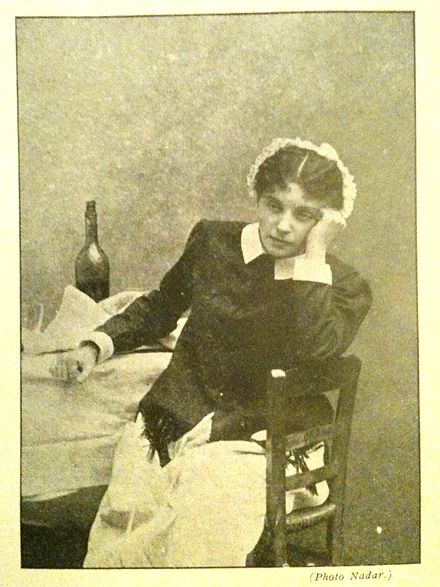
Written in 1864 and published in 1865, Germinie Lacerteux plunges us into the world of the poor and abused, far from the world of Renee Mauperin. It is essentially the story of the progressive degradation and eventual destruction of a poor woman.

A country girl from a poor peasant family, Germinie Lacerteux comes to Paris aged 14. She has been physically abused as a child, and in Paris she is abused by her first employer: “Cursed, scolded and bullied by the proprietor, who was used to abusing his maids and who was annoyed with her for being neither old enough nor ripe enough for a mistress…” (Chapter 3) Shortly after which, while others are out of the house “Joseph was busy sorting dirty linen in a small dark room. He told Germinie to come and help him. She went in, screamed, fell down, wept, begged, struggled, called desperately… The empty house remained deaf.” (Chapter 3) She is raped. The result is a still birth some months later.

Soon things look up for her. She becomes the personal maid to snobbish, haute bourgeoise, but essentially kindly  Mlle. de Varandeuil. In a cruel world, young Germinie for a short time finds consolation in religion, but more than anything she craves for real love and affection. We are told that this is made difficult because she is unattractive with “broad, sturdy, emphatic cheekbones, freely sown with small-pox marks” and “an almost simian character to the lower part of her head, where a big mouth with white teeth and full, flat, crushed-looking lips smiled in a strange and vaguely irritating grin.” (Chapter 5). When she is not at work about the house, she makes friends with a silly gossipy woman Mme. Jupillon. She looks after Mme. Jupillon’s adolescent son “Bibi” Jupillon. In due course she becomes fixated on “Bibi”, follows him, wants his affection. Finally – now aged about 30 - she becomes pregnant to him… and her baby daughter is delivered in a foul hospital, described in detail by the de Goncourts, where she just avoids contracting puerperal fever. “Bibi” accepts the child but the baby girl becomes sick and dies.

“Bibi” deserts Germinie.

Germinie, when not tending to her employer’s needs, takes to drink in a big way… then “Bibi” returns to her as he has a complex plan to exploit her for her money. So desperate is Germinie for human affection that she falls for him again, becomes pregnant again, is deserted again, drinks herself silly again when her employer is away, and has a miscarriage. And in all this her employer is completely unaware of her life outside her home. As the de Goncourts remark: “It was a miracle that this disordered and agonizing existence, this shameful broken existence did not break out. Germinie let nothing of it appear, she let nothing of it rise to her lips, she let nothing of it be seen in her face, nothing appear in her manner, and the curse-ridden base of her life remained still hidden from her mistress…. She led two lives. She was like two women, and by dint of energy, feminine diplomacy, with a coolness that was always present even in the muddiness of drink, she managed to keep those two lives separate, and remain in Mademoiselle de Varandeuil’s presence the honest, sober girl she had been, emerge from her orgy without carrying the trace of it and exhibit when she had just left her lover a modesty like that of an old maid disgusted by the goings-on of other servants.” (Chapter 36)

By the time she definitively separates from “Bibi”, her hunger for love, for human warmth, has become psychopathic, indeed nymphomaniacal.  This woman who has already endured rape, a miscarriage, the loss of a baby and a still birth now basically wants sex – rough sex if possible – to at least let her believe she is both alive and connecting with someone. “At every moment there rose from her whole being the fixations of desire, to fill her with that mad, unending torment, that migration of the senses to the brain; obsession – an obsession which nothing can drive away, for it always comes back, a lewd violent obsession swarming with images, an obsession which brings love in contact with all a woman’s senses, brings it into her closed eyes, rolls it round her head, hawks it hot around her arteries.”   (Chapter 48)

She falls in for a while with a slick libertine and roue Victor Gautruche. Their sexual activity is presented with a masochistic explicitness that would never have appeared in a contemporaneous novel in Victorian England. With Gautruche “ between these two human beings there would be terrible, desperate, deadly love-making, savage ardours and indulgences, raging orgies, caresses full of the brutality and fury of wine, kisses that seemed searching for the blood under the skin like the tongue of a wild beast, annihilations which engulfed them and left them nothing but the corpse of their bodies.”    (Chapter 52)

Gautruche, solely for his own comfort, wants to make their relationship permanent. Germinie, already betrayed and abused by men, turns him down and walks out on him, saying that the only person who has ever really cared for her is her employer, Mlle. de Varandeuil, who still has not the faintest idea that her valued servant lives a different life in her own time from the life she lives at her domestic work. Germinie now hits rock bottom. Desperate for rough sex, she solicits any available man on the streets, not asking for pay. Finally, worn out by drink, anguish and (presumably) rough and random sex, she contracts pleurisy and dies. She is buried in an unmarked paupers’ ditch in the Montmartre cemetery.

Her story has covered many years from adolescence to early middle age.

After Germinie’s death,  Mlle. de Varandeuil discovers for the first time that Germinie has stolen from her, was in debt, and has led an orgiastic life. At first Mlle. de Varandeuil curses Germinie for her deceitfulness. But then her mood softens and she visits Germinie’s grave.

The novel ends with a truly noble, third-person oration, about the fate of the poor – possibly the best thing in the novel.

Remember, this consistently bleak and in many ways depressing novel is widely regarded as the de Goncourts’ best, and certainly most popular, novel. Why? I can only assume that its frankness about sex, its consistent sympathy for the abused Germinie, and its very simple, chronicle-like plot have made it widely readable. The book is on the side of the wretched of the earth. Also, its fame was boosted by Edmond de Goncourt’s turning it into a stage play, which performed well, and Zola later called it the novel that spurred him onto his own literary career. Some have suggested that it gave Zola the idea for his Nana.

But there are problems. As was apparently the case in most of their novels, including Renee Mauperin,  the de Goncourt brothers structure Germinie Lacerteux as a series of very short chapters, sometimes no longer than a page or two. We are in effect seeing a series of vignettes. This is very good when the collaborative authors are producing convincing physical descriptions of the seedier quarters of Paris; but it also means there is not the continuity of thought or psychological development of character that could be found in longer episodes. The life of Germinie is seen in snapshots.

Worse, and again as in Renee Mauperin, the de Goncourts have the awful tendency to tell rather than show. In long paragraphs of analysis, they explain Germinie’s states of mind rather than dramatising them.

There is an apparent awkwardness to the novel’s opening, which is an uncharacteristically long introduction to Mlle. de Varandeuil, how she only just survived the revolution and how she gradually became an “old maid” up to 1830s when Germinie became her servant. All very interesting historically, but hardly relevant in relation to the novel’s main character Germinie. Only at the very end of the novel do we see what the de Goncourts are up to. The novel’s conclusion brings us back to Mlle. de Varandeuil and her feelings about Germinie. In effect, the authors have made Mlle. de Varandeuil their neat bookends. But that opening is still very inept.

An obvious problem for readers is the credulity of Mlle. de Varandeuil. How is it possible that, over many years, the employer, constantly in contact with her maid, could not have had the slightest inkling that Germinie was leading a double life? The answer textbooks give us is that the story is based on fact.  Germinie was based on the de Goncourt brothers’ own maid, Rose Malingre,  who stole from them and whose wild life they knew nothing about until she died. And Mlle. de Varandeuil was based on an aunt of theirs. Alas, while this is true, it still plays unconvincingly in the novel. It might be based on the truth, but it lacks verisimilitude. Sometimes raw truth does not work in fiction.

And the very worst characteristic of the novel Germinie Lacerteux? As later the novels of Zola sometimes did, the de Goncourts really turn their main character into a “type” or a “case” – an example of the oppressed and mistreated working class, degraded by abuse. Does Germinie never think beyond her desperate desire for affection which turns toxic? Is there nothing more to her mind than what the authors neatly explain for us? It would appear not. She is a cipher, constricted by the limits the de Goncourts have imposed upon her.

And now, dear brother, let us turn our microscope upon another specimen


  *.  *.  *.  *.  *.  *.  *.  *.  *.  *.  *.  *.  *.  *.  *.  *.  *.  *.  *.  *.  *

            The de Goncourt brothers wrote a total of six novels. But on the basis of two of their best-known novels, what is a fair assessment of their work? In 2006, a rather tart article in the British Guardian dismissed their novels as “unreadable and forgotten” and went on to say that only their gossipy journal is worth reading. This is too harsh. Despite the messy structure of Renee Mauperin and despite the superficial characterization of Germinie Lacerteux, both novels show sharp flashes of wit, certainly give us a vivid view of both middle-class and proletarian class in mid-19th-century France, and carry the stamp of authenticity in their descriptiveness. Perhaps this means that they are mainly of historical interest. But they are still readable.


Photograph taken in the 1860s by the famous pioneer photographer Nadar of the actress Gabrielle Rejane in the role of Germinie Lacerteux.