We feature each fortnight Nicholas Reid's reviews and comments on new and recent books.
“THE PAPER NAUTILUS” by Mchael
Jackson (Otago University Press, $NZ35); “RETURN TO RUGBY LAND” by David Scott
(published by Bay Owl Press, Columbo); “PACIFIC – AN OCEAN OF WONDERS” by
Philip Hatfield (Bateman Books, $NZ96:99)
 I
made clear in my posting Oedipus inVarious Guises that I am not a great fan of the work of Jean Cocteau; but
in his 1960 film Le Testament d’Orphee
Cocteau scores a palpable hit with the best joke he ever devised. A young
couple are dancing together, each draped over the other’s shoulder; but changes
of camera angle show that each is scribbling away on a pad, making notes on
their experience even as it happens. “Intellectuals
in love,” remarks a third person. Exactly so. The urge to verbalise and
trap with words every experience, and the urge to over-analyse such powerful
things as love and loss, are common sins among intellectuals. And they may be
part of what irks me in Michael Jackson’s The
Paper Nautilus.
I
made clear in my posting Oedipus inVarious Guises that I am not a great fan of the work of Jean Cocteau; but
in his 1960 film Le Testament d’Orphee
Cocteau scores a palpable hit with the best joke he ever devised. A young
couple are dancing together, each draped over the other’s shoulder; but changes
of camera angle show that each is scribbling away on a pad, making notes on
their experience even as it happens. “Intellectuals
in love,” remarks a third person. Exactly so. The urge to verbalise and
trap with words every experience, and the urge to over-analyse such powerful
things as love and loss, are common sins among intellectuals. And they may be
part of what irks me in Michael Jackson’s The
Paper Nautilus.
As
I’ve done occasionally before, I’m going to begin with a conclusion. I enjoyed
reading The Paper Nautilus, admired
the clarity of [most of] Jackson’s prose, and found more than a few enlivening
anecdotes and reminiscences en route. But I also found some of Jackson’s
underlying assumptions questionable and, given that a great part of the book is
straight autobiography, found muted versions of self-justification throughout…
which may, of course, be inevitable in the genre of autobiography. So I have a
kind of love-hate relationship with this book – at one and the same time
interested by it, finding some ideas provocative, but also irritated. You may
conclude that therefore it must a good book because it is thought-provoking,
and that might be your own conclusion if you read it.

Born
in 1940, so now approaching his 80th year, New Zealand-born,
US-resident Michael Jackson, academic, anthropologist, poet, and writer of
fiction and non-fiction, is here summing up key events in his life. Subtitled
“A Trilogy”, the book is in three parts. Jackson’s declared theme is loss, a fitting
theme for a man of his years. In my usual cloth-eared, flat-footed,
bibliographic way, I offer you first a summary.
Part
One, titled “Theme and Variation” is
largely in the genre of essay. One might at first take the theme of loss to
refer to the traumatic sense of loss when a loved one dies. This does figure
largely in the book; but “loss” also takes in the loss of the past itself, not
only in the sense of enfeebled memory that old age brings, but also in the
sense that we cannot ever fully recreate or re-live the past. And then there is
the past that happened before any of us were born. As Jackson says: “Do we not breathe the same air that our
forebears did? Don’t the muted voices of the past echo in the voices we hear
today?” (p.16)
There is something a little watery
and unfocused in this first section of The
Paper Nautilus. Jackson moves from topic to topic and from example to
example, sometimes only tenuously connected with one another. So we have a sort
of cornucopia – or pot-pourri – of things theoretically related to the topic of
memory. The long-ago small-town experiences of his grandfather are displayed. We
hear of tribal rituals in Sierra Leone, in which the dead are treated as if
they were still alive. We have pages on Iris Wilkinson (“Robin Hyde”) and the
loss of her child. A survivor of the Holocaust speaks of those who now live
only in memory. But there is also the loss of expectations. For thirteen pages
(pp.39-52), Jackson recounts meeting in New Mexico, many years since he last
knew him, the once-flamboyant Aaron Friesen, who, in 1950s New Zealand, had cut
a dash among the literary figures of the day and was regarded as a potential
literary heavyweight. Friesen has become a grumpy, unfulfilled old man, with a patient wife who
still believes he is a great writer. But she is deluded. Jackson says that on
being asked to find a publisher for some of Friesen’s work, he discovered : “The poems were all in need of revision. Most
were so mediocre and maudlin that not even historical curiosity could justify
their publication.” (p.49) In itself, this is not an uncommon story. It is often
the fate of the “big noise” on campus, or among bohemians, whose spark goes out
very quickly once it is discovered that he is all show and really has nothing
to say. A lost expectation.
Part Two,
entitled “Significant Others” is more
fully in the genre of autobiography.
Jackson writes in detail about his own bohemian life in Wellington in the early
1960s and how the place strikes him when he visits it many years later. But this
segues into the story of his bohemian friend Leon Donnelly, who had the makings
of a Classicist, who won a scholarship to Oxford, but who turned his back on it
all, basically bumming out in Athens, dabbling in painting, dabbling in [Greek]
politics, and finally settling in Rangitikei for an aimless life fuelled by
whisky and marijuana. Without its being directly spelled out, this too seems a
story of lost potential or lost possibilites.
Jackson
moves on to matters more directly concerning his own life story.
For a while
he works with the homeless. For a while he works in Africa. He does an MA in
psychology but gradually moves into anthropology. But the most important thing
is meeting and marrying his first wife Emma. In some ways it is a turbulent
marriage. The love is intense, but they wedded in the first place because both
had won doctoral scholarships to Cambridge and apparently, for the purposes of
accommodation, it was more convenient to be a married couple. They had a
daughter and – a little awkwardly and causing some stress – Jackson went with
wife and daughter to Sierra Leone to do anthropological research. What takes
over this story, however, is Emma’s long suffering of cancer, the various
palliatives or cures they sought, and eventually her death. This is the central
loss in The Paper Nautilus and, I
surmise, the key event that set Jackson writing this book in the first place.
Coping with this loss sometimes has Jackson trying to reconstruct the past,
reconnect with people who knew his wife, and otherwise defeat the verdict of
death. And there is always the fear that he is losing the very memory of his
wife.
Part Three,
entitled “Constant in the Darkness”, shifts
into the genre of fiction. Jackson
reworks the stories he has already told in the form of a novella. The justification
for writing this third, fictionalised, part comes from an idea of Paul Auster
which Jackson summarises with approval: “that
every person comprises several selves and that fiction writers flesh out some
of these inner personae in their work, as well as events that might have come
to pass had they taken a different road in life.” (p.160) So we get what
might now be called a “mash-up” of what Jackson has already told us in Part
Two. In the fictitious characters of Sam, Harriet and Zoe we have the same
motif of a man who has one daughter and whose wife dies. But Jackson draws into
the lifeline of these people things that, in real life, happened to others. For
example to Sam, in part a fictitious version of Jackson himself, is attributed
the story told in Part Two of a man who sold his house when his wife died, but
who later wanted to buy it back as it contained so many memories of his wife.
There is also a fictitious artist called Max who seems to have attributes of both Leon
Donnelly and Aaron Friesen; and there is a woman called Rachel whose field of
study is autobiographical memory. Each fictional character combines aspects of
a number of real people.
To put it
simply, I am not sure that this mash-up really works, or that it adds anything
to what we have already been told. It may be argued that the whole book is an
exercise in showing how the essential idea of loss can be conveyed in three
different genres. But my own instinct says that if Jackson wanted to write a
fictitious account of people and ideas that intrigue him, then he should have
attempted a novel with more complex and developed characters, rather than this
somewhat schematic novella.
Thus for my
flat bibliographic account of The Paper
Nautilus. But what are my real discontents with it?
First, a
prejudice of mine. I am middle-class, but I am not happy in the company of
middle-class or academic bohemians. By this I mean people who see themselves as
being an exception to the rest of the middle-class, more perceptive than those
other middle-class yobs and therefore superior to them. The Paper Nautilus is replete with globe-trotting bohemian bourgeois,
even the dishevilled and bum-like ones, who are always capable of coming up
with an apt literary quotation in the conversations they have, or who can cite
a work of art. And boy, do they loathe the mass of society without noticing
what they have in common with others. Take this example - when pondering on his
relationship with Leon Donnelly, Jackson muses “Was it simply habit that bound us together? Or a similar loneliness,
born of a shared love for the same landscapes but a common estrangement from
the settler culture that had imposed itself on the land and never come to terms
with it?” (p.142 – emphasis added). When I read this, I felt like shouting
“But you’re part of the settler culture
yourself, sunshine, and you’re as much involved in imposing yourself on the
land as anyone else.”
There are
also moments when Jackson mentions something in passing without really analysing
it. Speaking of Lansana Suma, at one time an anthropology colleague in Sierra
Leone, he notes: “… he railed against the
privileges of expatriate whites and their sordid adulteries, and cursed
anthropology, which he regarded as the bastard child of slavery, along with
colonialism and the extractive economies that were destroying his country’s
future.” (p.130) Apparently Lansana Suma moved out of academe and into
promoting Islam. Jackson attributes Lansana’s angst to the force history
itself. Having only a layman’s idea of what academic anthropology is, I’m in no
position to condemn it as “the bastard
child of slavery”, but I have often wondered how much it in fact imposes
upon other peoples categories devised largely by Europeans. More to the point,
I can sympathise with Lansana’s railing against “the privileges of expatriate whites and their sordid adulteries ”,
especially when he is up against whites who casually mention sleeping with
African prostitutes. But Jackson seems not to see it this way.
In another
area of my discontent, I wonder if, in Part Two, Jackson is really showing raw
honesty, or theatrical display, when he reproduces letters he exchanged with his
wife early in their marriage? They reveal very intimate things and were
obviously written, on both sides, in a state of high emotion. Is he honouring
his late wife’s memory in sharing with the world a particular letter from Emma?
It says “you also know about my
nymphomania between that parting [from
another lover] and meeting you. I even
slept with my best friend’s husband.” (p.100) It might be therapeutic for
him to recall and deal with all these things, but it is in no way enlightening
for his readers.
Somewhere in
the same ballpark, I make it clear that I sympathise with a man who has felt
the extremest form of joy when he first met his wife, and who suffered the
deepest and most traumatic forms of misery and despair when he wife died after
prolonged illness. Any devoted husband would howl with anguish. But Jackson is
writing many years after the event, and the style in which he writes is overwrought
and theatrical – a dream of passion, an enforced ceremony – as if we are being
invited to admire the depth of his feelings.
Of his first meeting with his wife, he writes:
“But then I met Emma, and for the first
time in my life everything became clear. Emma was my caryatid, the column that
held me up, a figure that filled my heart with such love and longing that when
we were apart , I felt as though my soul had suffered a partial eclipse.”
(p.93)
Of her death
from cancer he writes: “Knowing that she
was dead and could not be perturbed by anything I did or said, the most
dreadful cries of lamentation burst from my throat, cries of agony that would
reverberate for years, despite the poetry wrung from my soul like blood from a
stone.” (p.147)
“Catyatid”?
“Lamentation”? “Reverberate”? THEN, I am sure these reactions were sincere and
heartfelt. NOW the language is artificial and self-consciously
“literary” and the actor is on stage in full make-up, trying to recreate what
he once felt.
Part Three
is avowedly fiction, but is nevertheless a reflection on autobiographical
events. On the death of his wife Harriet, the fictitious Sam is reported as
thinking thus: “Within days he realises
that he possesses only fragments and will never be able to compose a meaningful
mosaic with them. He agonises over whether he knew her at all, and whether
loving someone, living with them from day to day, is a matter of not knowing
but of something beyond our conceptual grasp – like the genius of Django
Reinhardt with his two paralysed
fingers, Bach’s counterpoint, or simply the inertial force of habit.”
(p.190 emphasis added). Okay, it is clear that we cannot hold in our memories
all there is to remember about somebody we loved. Indeed, the reflection is
obvious to the point of banality. It is banally obvious, too, that nobody can
know everything there is to know – such as every single thought – even about
somebody with whom we live intimately. But to extrapolate from this that “he [never] knew her at all” or that living with and loving somebody “is a matter of not knowing” is a way of
avoiding the real situation of (genuine) love and marriage. To use an
unfashionable word, faith – and trust – have to come into it. I do not and cannot
know everything there is to know about my wife – but I know her, in our
everyday life, better than anybody else does or can. We shape each other. We
are not asocial, autonomous individuals. Being two autonomous individuals
appears to be Jackson’s conception of marriage.
Which very
thought brings me back to the “intellectuals
in love” tale at the head of this review. To over-think love and loss, to
break them down into discrete parts, is to destroy them and give a special
place to one’s own feelings. The ego struts.
* *
* * *
* * *
* * *
* * *
* * *
* * *
* * *
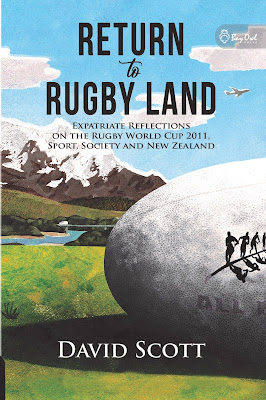 A
book by another, very different, New Zealand-born expatriate.
A
book by another, very different, New Zealand-born expatriate.
Born and raised in New Zealand, David Scott has lived
elsewhere for the last fifty years, and is currently resident in Sri Lanka. In
2011, he came back to New Zealand to follow the Rugby World Cup over the eight
weeks of September and October. A Sri Lankan newspaper had commissioned him to file
stories on each match. That year, the All Blacks won the cup, as they did in
the next RWC contest. Return to Rugby
Land, which chronicles Scott’s 2011 visit, was first published as an e-book
in 2015 and only now appears in (printed) book form.
Any
rugby-centred book I receive is likely to provoke me into giving the history of
my complete and lifelong non-engagement with the game; but I will refain from
doing that here. I already explained my attitude towards rugby in my review, on
this blog, of Desmond Wood’s New ZealandRugby Country, back in 2017.
Return to Rugby Land gives accounts of each match in italics, and does indeed have whole sections dealing with the
nature of rugby and its impact on New Zealand society. As Desmond Wood did,
David Scott takes time to analyse the origins of rugby as an English public
school invention, and to de-mythologise the idea that in New Zealand the game
first flourished among rugged farmers. In fact, quite early in its New Zealand
history, the game was played mainly by townies and urban professionals with
middle-class aspirations. Scott also analyses such matters as the significance
of the All Blacks’ pre-game haka, and how rugby reflects racial and class
attitudes in New Zealand, and what role women have (or have not) played in the
game.
 Sometimes
Return to Rugby Land gives the impression
that Scott is walking on an intellectual tightrope. He clearly likes the game
itself and is a connoisseur of tactics and skill as displayed by teams and
individual rugby-players. There is no national chauvinism in his reports on matches
and no “boosting” of the All Blacks. But as a middle-class intellectual, Scott
understands there is a thuggish and yahoo aspect to much of rugby fandom; and
partly in response to this, there is a snobbish disdain for the game among many
middle-class intellectuals. Until very recently, there had been in New Zealand
a lack of serious commentary on the game’s cultural impact. Of this, Scott
says:
Sometimes
Return to Rugby Land gives the impression
that Scott is walking on an intellectual tightrope. He clearly likes the game
itself and is a connoisseur of tactics and skill as displayed by teams and
individual rugby-players. There is no national chauvinism in his reports on matches
and no “boosting” of the All Blacks. But as a middle-class intellectual, Scott
understands there is a thuggish and yahoo aspect to much of rugby fandom; and
partly in response to this, there is a snobbish disdain for the game among many
middle-class intellectuals. Until very recently, there had been in New Zealand
a lack of serious commentary on the game’s cultural impact. Of this, Scott
says:
“Is this
neglect a reflection of an intellectual disdain for the masses’ culture? Do
they think cultural cringe is solved by delving into the uneven output of art
and literature while ignoring the great passion for sports?... Is a lady in a
Blue Bulls helmet belting out an aria per se more refined than Vivian Richards
or Dan Carter in their pomp?” (p.75)
So
here is the voice of a man with mixed feelings. I think I can, as a
non-rugby-follower, identify with this. In 1981 I joined marches and demos
against the New Zealand tour of the Springboks, who still represented an
apartheid-ruled South Africa. But my righteousness (or self-righteousness) was
accompanied by a twinge of conscience. Wasn’t I in fact also enjoying myself by
striking a blow against those yobs and slobs who liked rugby? Would I have
protested against a tour by an opera company from a totalitarian state, as
opposed to a tour by a rugby team? Snobby old middle-class intellectual me…
Having
noted all this, I have to point out that rugby itself is only one part of Return to Rugby Land. The book’s
subtitle is “Expatriate Reflections on the Rugby World Cup 2011, Sport, Society
and New Zealand” and most of the text is concerned with Scott’s re-engagement
with the country he had left so long before. Sometimes this takes the form of
harmless travelogue, and descriptions of places Scott grew up in (Oamaru, Blenheim),
with mildly nostalgic (or satirical) notes on how things have changed. He looks
at Palmerston North more-or-less benignly, knows we are better drivers than Sri
Lankans, and observes the poverty of the Far North.
More
often, however, Scott is concerned with social, historical and political
commentary. His views are very left-wing. He is anti-monarchy (fair enough –
I’m with him on that one, though it doesn’t keep me awake at night). He wants
to distinguish himself from the milder middle-class left-wing (thus playing
another tightrope game) and he describes the New Zealand Listener as “the local
journal of what-is-good-for-you” (p.20). Every so often he endorses, or is
at odds with, the views of his brother-in-law the historian Jamie Belich.
Some
of his historical comments are spot-on. He is right to demolish the idea that
New Zealand never had its own equivalent of the old White Australia policy,
noting: “New Zealand managed to keep a
whites-only immigration policy longer than Australia, masked only by myths of
harmonious race relations and letting Pacific islanders in to do unskilled work.”
(p.47) His pages on Maori-Pakeha relations are very accusatory of Pakeha
colonisation and exploitation of Maori (but then, which serious writer isn’t
now?). But he also backs away from the more extreme Maori nationalism that
would deny Pakeha true membership of this country (see especially pp.129-137).
At
one point, he ventures to tell us that nationalism is actually a nasty capitalist
plot, devised to divide the struggling masses. Thinking of how Communist Han
Chinese deal with Tibetans and non-Han Muslims; and thinking of the current
Hindu Supremacist Baratiya Janata government of India, with its profoundly
racist ideology; I am very sceptical of Scott’s claim. Nationalism and racism
have been around since before capitalism existed, and (if we are unlucky) could
well be around after capitalism has gone. The notion that capitalism is always
behind extreme nationalism comes from the days when Communists saw themselves as
“internationalists” and thought, naïvely, that the workers of the world would inevitably
unite.
While
Scott’s interpretations can be interesting and provocative, they often have the
glibness of a Marxist undergraduate who hasn’t bothered to revise or critique
his views since student days. Apparently what New Zealand needs is an
anti-capitalist revolution (see especially pp. 172-177). Ho-hum.
Given
that it is based on observations from 2011, and that it was written by 2015,
parts of Return to Rugby Land now
look a little dated. Scott is shocked at the prices now being asked for baches.
Regrettably, we have lived with inflated house-prices for so long now that we
are no longer shocked. Contemporary with the time he is reporting is the Rena running aground on the Astrolabe
Reef – an event that is now receding into the depths of our memory. When Scott
comments on New Zealand’s involvement in overseas wars, he mentions in passing
New Zealand’s commitment to an international force in Afghanistan. If he were
writing now, he would surely have mentioned Nicky Hager’s book about New
Zealand actions in Afghanistan, Hit and
Run, and the controversy that has surrounded it. He takes a crack at the
notion that “boomers” should be
targeted for “intergenerational theft”,
saying this is a “diversionary tactic”
to make us not see the evil capitalist machinations that have divided us; and that
“it fits in neatly with the aspiration to
cut back superannuation costs”. (p.214) I wonder what he would think of
Green MP Chloe Swarbrick’s recent inane taunt “Okay, boomer” and the kerfuffle that came from it? So I could go
on, noting many other instances where this book is not quite of this moment.
Despite
everything, though, Return to Rugby Land
does say many cogent and perceptive things about New Zealand and is much more
than “the book of the tour”. It is written well in a brisk and informed – if
highly opinionated - style and worth the
reading.
* * * *
* * *
* * *
* * *
* * *
* * *
* * *
* *
Philip J. Hatfield’s Pacific
– An Ocean of Wonders is a very handsome , broad-paged hardback which gives
me the same sort of aesthetic delight that I enjoyed when reading John
McCrystal’s Singing the Trail.
Images are as important as text here, and the images Hatfield has collated are
outstanding. My only quibble is with the title. The words “an ocean of wonders” will immediately raise in most readers the
expectation that this will be about the greatest ocean’s natural wonders –
fish-life, whale-life, bird-life, coral reefs and atolls, the ocean’s vastness,
the living things that can be found in the deepest marine trenches, wind
patterns and tsunamis; and the lives and customs and art-works of the
indigenous peoples who live on the edges of, or on the islands of, the Pacific.
But
this is not what Pacific – An Ocean of
Wonders is at all about. Refreshingly, it does include those indigenous
peoples who lived and live on the continental shores of the Pacific, from the
Aleutians to the Pacific shores of North and South America, Australia and Asia.
Too many books about the Pacific assume that only islanders surrounded by ocean
are to be considered as peoples of the Pacific.. But, after in Part One (“An
Ocean of Peoples”) briefly mentioning the ancient settlement of the Pacific by
Austronesians and others, this book turns to its real subject, which is the
exploration of, and engagement in, the Pacific by Europeans, Americans,
Chinese, Japanese and other colonisers.
So
Part One tells us about the Chinese entry into the Pacific under the Ming
dynasty, then the incursion of Portuguese, Spanish, Dutch, English and others,
their rivalries, their hunger for resources, piracy, licensed privateers and so
forth.
Part
Two (“Empire of Islands”) concerns the age of more systematic exploration by
Europeans – the voyages of Laperouse, Bougainville, Cook and others. Then the
ongoing mystery (to Europeans) of the forbidden islands of Japan, and Western
entry there in the mid-19th century; the age of whaling; the
tightening of British imperialism with its Opium Wars with China; Darwin’s
voyage and conclusions about evolution; the period when it was sometimes feared
that the Pacific had become the “American Lake”, and America took over Hawaii;
the practice of “blackbirding”; and the Russo-Japanese War.
Part
Three (“Islands in a Globalised World”) simply follows the same sort of
historical events into the 20th and 21st centuries –
Japan in the 1st and 2nd World Wars; the problem of
Taiwan, still claimed by mainland China; nuclear testing in the ocean; and only
a very little on indigeous peoples and the lives before the book discusses huge
pollution of the ocean, and the rising tides that are threatening some island
states.
So
this is decidedly not a book devoted to natural “wonders” but to recent history
and very much to a Western perspective. Taken as such, its text and images make a wonderful art
gallery, which, for me, made reading it (and looking at its illustrations) an
exercise in wool-gathering. Those wonderful Japanese prints (reproduced on
pp.21-23), made in about 1803, of a Japanese whale hunt. All those fantastical
maps and charts, drawn by early European explorers, which were based as much on
guess and wishful thinking as on observation. The rarely-seen landscapes of
Hawaii that William Wade Ellis made from his voyage with Captain Cook. And more
than I will list.
Target
audience? The browser. And perhaps those looking for a good present.


