-->
Showing posts with label Henry Fielding. Show all posts

Monday, September 26, 2022

Something Old

Not everything worth reading is hot off the press. In this section, we recommend "something old" that is still well worth reading. "Something Old" can mean anything from a venerable and antique classic to a good book first published four or more years ago.    

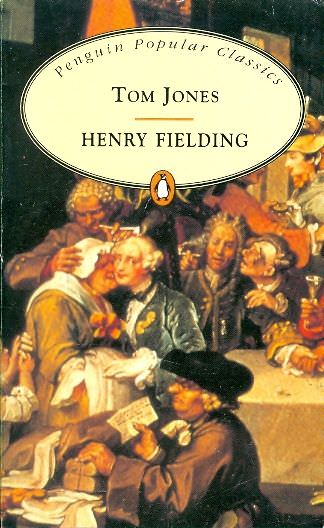
“THE HISTORY OF TOM JONES, A FOUNDLING” by Henry Fielding (First published in 1749)

            A number of years ago, when this blog was young, I made it my business to read all the readable works of Henry Fielding (1707-1754), meaning everything he wrote apart from his journalism (which was prolific). Thus you will find on this blog accounts of two of his three novels Joseph Andrews (still my favourite Fielding novel) and Amelia ; his satire Jonathan Wild ; his travel book The Journal of a Voyage to Lisbon ; his fantasy story A Journey From This World to the Next  and his burlesque play The Tragedy of Tragedies (also known as The Life and Death of Tom Thumb the Great). But the one work by Fielding that I did not cover was his most famous, Tom Jones or if you wish to be pedantic The History of Tom Jones, A Foundling. Why did I not cover it, even if I wrote screeds of notes about it? Because I found the sheer length of it (800-odd pages in the Penguin edition that sits on my shelf) often working against the humour and wit, not helped by the admonitory (if often ironic) personal editorials with which Fielding opens each of the many “books” that make up this quite long novel.


            Easing myself back into Tom Jones after all these years, I’ve decided to take another look at it, so first one of my notoriously simplified synopses – and I’m afraid it’s full of “spoilers” if you haven’t read the novel.

            In the west of England an infant child is discovered in the bed of the benevolent Squire Allworthy. He is believed to be the illegitimate son of the village woman Jenny Jones and the schoolteacher Partridge, who are both run out of town for their immorality. The infant is christened Tom and is brought up by Squire Allworthy in his own household. The squire’s spinster sister Bridget Allworthy marries late in life, but soon dies, leaving her son Blifil, also brought up in Squire Allworthy’s household. Tom and Blifil are both tutored by the sadistic parson Thwackum and the smug rationalist philosopher Square. As a boy and young man, Tom gets into many scrapes, including a brief affair with Molly Seagrim, the daughter of the gamekeeper Black George Seagrim. Tom cools on Molly when he discovers that she sleeps with many men, including the hypocritical Square. But he comes to love, and be loved by, Sophia Western, the daughter of the neighbouring Squire Western. However the self-righteous sneak Blifil hates Tom and contrives to have him banished and sent away by Squire Allworthy.

            The central section of the novel then takes place on the road to London, being a very mixed set of picaresque events. After almost being persuaded to go off and fight against the Jacobites (the centre of the novel takes place during the Jacobite rising of 1745), and having at one point been badly beaten and left for dead, Tom falls in with the banished Partridge, who has become a barber-surgeon and who is virtually Tom’s Sancho Panza (very like the Reverend Abraham Adams to Joseph Andrews in Joseph Andrews). Tom also has a brief affair with Mrs Waters, whom he has saved from being raped by a soldier. And he encounters the very choleric Irish gentleman Fitzpatrick, who is chasing his runaway wife and who happens to be a cousin of Sophia Western.

            Once in London, Tom searches for Sophia, but is snared by the fashionable nymphomaniac Lady Bellaston, who makes him her kept man. Tom discovers Sophia’s whereabouts, and extricates himself from Lady Bellaston. But then many misfortunes fall upon him – he has a fight with the choleric Fitzpatrick and is hauled off to prison after having apparently killed the man. And he discover that Mrs Waters is in fact Jenny Jones. He may have slept with his own mother!

            The happy ending comes (after many, many events that aren’t in this synopsis) thanks to the agency of many people who have reason to be grateful to Tom. Blifil’s treachery and hypocrisy are revealed when Squire Allworthy discovers that Tom is really the son of Bridget Allworthy, and that Blifil (who of course stood to be heir to the squire’s estate) knew the truth all along but suppressed the evidence. The beaten Fitzpatrick recovers from his wounds and forgives Tom for the thrashing Tom gave him, so Tom is guilty of neither incest nor murder. Squire Western of course drops all objections to Tom marrying Sophia now that Tom is heir to the Allworthy estate. And Sophia, once she is persuaded that Tom was not to blame for his affair with Lady Bellaston, forgives Tom for all his scrapes and the couple are happily married.

            For the record, the plot-point of incest being averted was also used in Fielding’s Joseph Andrews (published seven years before Tom Jones) when, for a time, Joseph was led to believe that his beloved Fanny was actually his sister (she wasn’t, so happy ending). In fact this gag was pulled in many novels of the 18th century. Further point – my favourite moment of repartee in Tom Jones comes in Book 13, Chapter 11, where Tom at last catches up with Sophia in London and declares “Oh! My Sophia, did you know the thousand torments I have suffered in this long, fruitless pursuit” to which Sophia replies dryly “Pursuit of whom?” Would that the lady were made of sterner stuff with regard to Tom’s promiscuous shagging when it comes to the unlikely happy ending!

Tom Jones was written in the early decades of the development of the English novel and it is impossible to comment on as we would comment on novels of more recent vintage. First, consider the specific historical setting. Fielding wrote this long novel between 1745 and 1748, letting friends read and comment on sections of it before it was published in 1749 (in six volumes). Being set in the year of the Jacobite rebellion, it is clearly on the side of the Hanoverian dynasty. Fielding wrote anti-Jacobite propaganda and, as a Protestant, excoriated the Catholic Young Pretender. So in Tom Jones there is the (very occasional) anti-Jacobite and anti-Catholic comment, and there is also the stand-alone “Man of the Hill” episode (Book 8) which gives a very Protestant account of the Monmouth Rebellion in the late 17th century. Yet at the same time, Squire Western is a Jacobite sympathiser and there are some scenes in Tom’s journeys where it is clear that sections of the population expect the Young Pretender to win and are making plans to accommodate themselves to him. In other words, intentionally or otherwise, Fielding shows that there was much support for the Jacobite cause in England.

So much for the historical context, which will be of little concern to most readers of Tom Jones. What intrigues me is the question of how “conscious” or “unconscious” a novel it is – are the many coincidences, unlikely surprises, rambling picaresque events and long authorial comments simply the stock-in-trade of early novels; or are they artful and intentional on Fielding’s part? Every one of the novel’s 18 Books begins with a discourse by Fielding on the nature of fiction, especially on his favourite theme that he is drawing his characters from nature. He certainly saturates the tale with irony and shows awareness of the conventions of more fantastic fiction, which he frequently mocks. He addresses his readers directly, telling us, for example, when he is getting bored with a certain chapter and how he is going to end it, reminding us that this is, after all, a made-up story and that it has to observe certain rules and so on. And yet, of course, it is pre-modern, which may show us how nineteenth-century conventions of verisimilitude and author-invisibility have got in the way of more straightforward story-telling The (post-)modern self-conscious authorial voice may in fact be a reversion to the novel’s infancy.

Some of Fielding’s style does take some getting-used-to though, regardless of the novel’s place in literary history. Sometimes, with deliberately ironic effect,  he renders most dialogue in noble, elevated phraseology (except among the obviously low-life characters) – and yet this seems to be his habitual mode when he can’t be bothered rendering dialogue more colloquially. Squire Western veers between such artificial language, befitting a philosophical discourse, and broad West Country dialect. I can accept this as an amusing convention, but did find it irritating when it comes to Tom’s own language. True, he has been brought up in a gentleman’s household – albeit with the horrible Thwackum as his tutor – but by behaviour and external description Tom is essentially a naïve and trusting country chap, handsome enough for women to be fawning over him and really just one step up from the super-naïve Joseph Andrews. Yet Fielding gives Tom powers of expressing himself at need in a style that would have dazzled the best barrister. Classic example of this is in Book 14 where Tom persuades Nightingale (who is on the point of deserting the girl he has impregnated) to embrace duty, morality and true love… and of course Nightingale changes his mind and honourably marries the girl. Such scenes, where Tom improbably steps out of character, make Tom too much the puppet of the author.

Let’s consider Tom a bit more. The novel is very much an apologia for the likeable rascal with a healthy sexual appetite. Fielding is of course careful to show us that Tom is not a complete rascal. Tom has a strong sense of morality, as witnessed in the improbable Nightingale episode, which seems designed to tell us that Tom himself would not abandon a pregnant girl in need. Tom would no more think of not trusting Blifil than Squire Allworthy would until the last moments when Blifil’s treachery is revealed. On a number of occasions Tom is anxious to pay back money he has borrowed, he does not exploit people and he believes the best of them. Yet Tom, all the while protesting his fidelity to Sophia, does in the course of the novel find his way into the beds of Molly Seagrim, Mrs Waters and Lady Belleston. I suspect Fielding wanted to show us that a slightly-disordered sex-life is not necessarily as corrupting or evil a thing as, say, hypocrisy, venality and the type of ambitions that deform Blifil. Fair enough, I suppose, but there is still enough ammunition here to suggest that the novel really offers a defence of what would now be called the “double standard”. Sophia’s virginity is something to be celebrated and is one of her main attractions. Tom’s virginity is something to be cheerfully lost. In case I should seem to be imposing our present scale of values on a book written over 250 years ago, I note in fairness that Fielding does also stress the need for love and commitment in marriage; and another element of the plot is that Sophia is sturdy enough to refuse to marry men (Blifil; Lord Fellamar) whom she has not chosen herself but whom her father has at different times tried to impose upon her.

Of course there could be different ways of looking at Sophia. Is she Dulcinea to Tom’s Don Quixote? In other words, is she an unreal image of a woman who keeps the well-intentioned wandering adventurer going? (Remember Fielding was a devotee of Cervantes, as Joseph Andrews states overtly.) Perhaps not. Unlike the simple peasant girl Dulcinea, Sophia is seen and admired (and perhaps lusted after) by people other than Tom, and Fielding, speaking in his direct authorial voice, insists on Sophia’s goodness and purity to the very end. But the Cervantes comparison is still fruitful. After all, Tom’s moments of high rhetoric about true love are as easily punctured by Fielding’s irony as Quixote’s vision of Dulcinea is by the reality of the simple peasant girl.

Which brings me to the other major Cervantes influence in this novel. Partridge is almost Tom’s Sancho Panza – or at least his travelling companion for approximately half the length of the novel. But he is not a good Sancho Panza – unlike the Spanish original, he does not have a shrewd fund of peasant wisdom to call upon, but is a village pedant with a small stock of favourite Latin quotations, which he keeps repeating. As a comic character, I do not think he comes off. Having said this, though, I have to admit that Fielding was able to speak much more frankly about human nature – and especially sexual behaviour – than another great admirer of Cervantes one century later. This was William Makepeace Thackeray who, in his The Newcomes (reviewed on this blog) created a character (Colonel Newcome) specifically based on Don Quixote; but who, in the Victorian century, had to use euphemism when it came to sex. (The same was true of his Vanity Fair , where the real activities of the sexual adventuress Becky Sharp are cloaked in insinuation and nudge-and-wink language.) Fielding is far more forthright than Makepeace had to be. Just as a matter of interest, the other Victorian novelist who looked back to Fielding with admiration was Charles Dickens, and there are scenes in Tom Jones which inspired Dickens. There is an episode in Tom Jones where the literal-minded Partridge watches a performance of Hamlet and mistakes it for actual events. This is very much like Wopsle’s reaction to Hamlet in Dickens’ Great Expectations.

Thus far my own ideas on Tom Jones, but of course after reading a classic like this, I usually take a look at what other critics have to say. I learn the interesting fact that, when first published, Tom Jones was what we would now call a bestseller. It went through four printings in the first year it was published and 10,000 copies were sold – a huge number for 1749. In comparison, at the same time Samuel Richardson’s Clarissa took four years to sell 3,000 copies. Of course Richardson hated Tom Jones (look up on this blog an account of Richardson’s Pamela, which Fielding parodied mercilessly). Richardson thought Fielding’s characters were “low” and, like Dr. Johnson, thought Tom Jones was simply an apology for rakes. Stripped of class prejudices, the moral debate over the novel was that Fielding assumed morality consisted of instinctive human nature, and hence deprived morality of any guiding principles. Tom is “good” because he was born that way, not because he has reasoned anything out or has had to struggle through any moral dilemmas. And he is saved from the consequences of his actions by sheer plot contrivance. Thus, having been involved in a fierce fight, he avoids killing Fitzpatrick only because the man has such a strong constitution. Having slept with Mrs Waters, he is saved from incest only because, at the last moment, Fielding reveals that Mrs Waters is not his mother after all. [Fielding’s critics assume, rightly enough, that the chances of unwittingly committing incest are greatly increased if one is used to having sex promiscuously.] In effect, said Fielding’s critics, the novel reduces an apparently admirable man to an amiable, unreasoning animal. And it makes Squire Allworthy, supposedly the epitome of reasoned benevolence, a complete dupe until his eyes are opened not by his own insight, but by having other people reveal Blifil’s villainy to him. In passing, we might wonder how Allworthy has spent all these years living with Blifil, Thwackum and Square without once guessing their true characters. Is a man really “all worthy” to be so blind? Fielding may have had a good case in objecting to the prudential morality in Richardson’s Pamela, but Fielding’s critics score in pointing out the unthinking nature of morality as presented by Fielding, and the way Tom Jones misses out the complex of impulse, principle, rational thought and prudence that is in fact involved in all morality. Arguing “good nature” is avoiding the issue.

Or is all this being far to solemn about what is essentially a comic novel? We could argue that Fielding’s critics are missing out on the novel’s deliberate comic conventions – caricature and slapstick and a lack of ratiocination are part of the comic game. Tom Jones may be best read as something like the fable of Chaunticleer in which the boaster and dandy gets off scot-free, even if it wouldn’t happen that way in real life. The novel, then, is a sort of wish-fulfilment cloud-cuckoo land. We laugh because we know that, in fact, this is NOT the way things would turn out in reality, just as the novel’s dialogue conventions (of elevated vocabulary) are not meant to be taken literally. But if we adopt this line – which I think most readers probably do – we cannot also argue that Tom Jones is to be taken seriously in its moral perspective.

Speaking of taking this comic novel too seriously, I read what the cold, analytical bore F.R.Leavis had to say about it. This was the man who wanted every great novel to be as serious and moral as Middlemarch. Leavis thought all the characters in Tom Jones were mere caricatures with no inwardness of soul. Once it is established that Blifil is a hypocritical sneak and Tom is a good-hearted, sensuous young man, there is nothing more to be said about them. They simply act out their assigned roles without in any way growing and developing as real characters. Ingenuity of plot, says Leavis, is all that holds this picaresque novel together. In this Leavis might well be right, but he is still missing out on the nature of comedy.

Enough. By this stage you are bored – if you have read this far – with my extensive comments on a book which is, after all, intended to make us laugh. My chief quarrel with Tom Jones is simply that it is too damned long. For me, its 800 pages become repetitive and wearying. I kept thinking of Bill Shakespeare’s (probably unoriginal) remark that brevity is the soul of wit. For this reason, I favour the more modest length of Joseph Andrews over the rambling Tom Jones, even if both play upon the same sort of humour.


Inevitable Filmic Footnote: In 1963 Tony Richardson’s lively film version of Tom Jones was released to great applause, winning four Academy Awards,  giving a huge boost to Albert Finney’s career, being good box-office and persuading a Welsh crooner called Thomas John Woodward to change his stage name to Tom Jones. I have a vivid memory of this film. It was released in New Zealand in 1964, when I was all of thirteen years old. The censor had given it a restricted certificate, R16, meaning you had to be at least 16 if you wanted to see it. I went to see it with a classmate who was the same age as me but rather more sophisticated than me in negotiating adult prohibitions. He managed to bullshit the two of us into the theatre by claiming that we were 16, and though the usher gave us a sceptical look she let us in. We thought we were very naughty and daring and enjoyed the film as a straight comedy. It was lively and invigorating. Years later I saw this film again on television, but for some reason it had lost its lustre. Maybe it looked too much like film-making in the flashy swinging-London sixties. Ah well.

            Back in 1997 there was a BBC television serial adaptation of Tom Jones, starring the distinctly un-charismatic Max Beesley as Tom. It was a little plodding and stuck closely to the novel. I watched it with one of my daughters, who was then a teenager. When it finished I asked her what she thought of it. “Boys will be boys, I suppose” she said, which does more-or-less sum up the novel.


Monday, September 26, 2016

Something Old


Not everything worth reading is hot off the press. In this section, we recommend "something old" that is still well worth reading. "Something old" can mean anything from a venerable and antique classic to a good book first published four or more years ago.
 
“THE HISTORY OF THE LIFE OF THE LATE MR. JONATHAN WILD THE GREAT” by Henry Fielding (first published in 1743)

            There are times when you know something is a great piece of writing, but do regret that it sticks so relentlessly to the same tone.
            This is essentially my reaction to Henry Fielding’s History of the Life of the Late Jonathan Wild the Great. Though the length of a short novel (about 180 pages in the Everyman’s edition on my shelf), and though filled with varied picaresque incident, the satirical tone of Jonathan Wild is so consistent throughout, and the same satirical targets hit so often, that one reads impatiently to the conclusion.
As I’ve noted before on this blog, I took the time some years back to read my way through all the works of Henry Fielding (1707-54) that are still part of the canon, and I have made posts on most of them – his play TheTragedy of Tragedies (or The Life and Death of Tom Thumb the Great); his travel book Journal of a Voyage to Lisbon; his fantasy-satire A Journey From This World to the Next; and his novels Joseph Andrews (still my favourite) and Amelia. I have yet to make a posting on what is usually esteemed his greatest novel, Tom Jones, but I will get around to it someday. In reading all the above I have of course read only a fraction of everything Fielding wrote in his 47 years. His prodigious quantities of journalism would fill many large volumes and he wrote more than a dozen plays, nearly all of which are now read by specialists only.
            I hesitated before doing a posting on Jonathan Wild for the reason I’ve already given, but here I go anyway. Written after he had already published his first great novel Joseph Andrews, Jonathan Wild appeared originally in Fielding’s Miscellanies, as did A Journey From This World to the Next. In essence it is a parody of “Newgate” books that had a tendency to glamourize the lives of criminals. Fielding writes a mock-heroic biography of a real criminal. Jonathan Wild (c.1682-1725) was notorious for playing both sides of the law. He posed as a respectable businessman who industriously recovered stolen goods and returned them to their owners, while managing to turn in some of the thieves. In this guise he was known as a “thief-taker”. In fact it was he himself who ran London’s gangs of thieves and burglars. He took a generous commission for returning goods his own gangs had stolen and the only thieves he ever dobbed in were those who were expendable to him.
Fielding begins with a mock-heroic account of Jonathan Wild’s ancestors and of his seven years’ transportation in America, and of his sordid quarrels with his mistress Laetitia Snap, who is in fact sleeping with Tom Smirk. Jonathan Wild loses at cards to the cheating Count La Ruse, so he induces Bob Bagshot to rob the count on the highway. He then threatens Bagshot into allowing him to take most of the loot. Jonathan Wild sums up his youthful philosophy when he says: “I had rather stand on the summit of a dunghill than at the bottom of a hill in Paradise” (Book One, Chapter Five)
Showing no mercy for friends or relations, Jonathan Wild proceeds (in Book Two) to ruin his childhood “friend” Thomas Heartfree, a very trusting jeweller, by getting Count La Ruse to buy up much of his stock on credit with no intention of paying him. He has one of his friends captured and hanged for stealing money from Heartfree. Fielding remarks ironically: “These persons are of that pitiful order of mortals who are in contempt called good-natured; being indeed sent into the world by nature with the same design with which men put little fish into a pike-pond, in order to be devoured by that voracious water-hero.” (Book Two, Chapter One) When Heartfree is almost bankrupt, he is locked up for debt. Wild wishes to seduce Heartfree’s wife and comes to her with a plan he says will liberate her husband. It involves taking both her and Heartfree’s remaining stock over to Holland. But en route Wild attempts to rape Mrs. Heartfree. They are captured by a French privateer. Wild is set adrift in a boat, rescued by another French ship, but, once safely in England again, attempts to double-cross his rescuer.
Wild then (Book Three) concocts a scheme to have a man robbed of his wealth by the young hothead Fireblood, but the scheme miscarries, and Fireblood attempts to cheat Wild out of such loot as he has gained. Wild continues to persecute Heartfree. It is only now that Heartfree begins to realize the extent of Wild’s villainy and attempts to have him arrested. With perjured evidence from his cronies, Wild has Heartfree arrested instead. Fielding comments: “Wild, indeed, always kept as much truth as was possible in everything; and this, he said, was turning the cannon of the enemy upon themselves.” (Book Three, Chapter Five) By this time, Wild is running his regular business of trading back stolen goods for profit. Wild marries Laetitia Snap (whose sister Theodosia has been impregnated by the count). They quarrel almost immediately and the sluttish Laetitia is soon having an affair with Fireblood. One gang member, Blueskin, refuses to give over some stolen goods. Wild has him sent to Newgate. There is no honour among thieves.
But now (Book Four) Wild’s fortunes turn for the worse. A new law through parliament severely punishes receivers of stolen goods. He himself is caught out and sent to prison. His wife Laetitia visits him there in tears – but she’s actually crying because she herself has been arrested as a pickpocket. They part with mutual curses. Heartfree’s faithful friend Friendly tries to have Heartfree bailed out, but with no success. On the perjured evidence of Fireblood and others Heartfree is condemned to hang. At which point, miraculously, his wife arrives… and he is reprieved and pardoned. Fireblood had been caught red-handed at some crime and a magistrate realised how worthless his testimony against Heartfree was.
Mrs. Heartfree gives an account of her adventures since she and Wild were parted on the French privateer. These cover four chapters, and involve her at least three times having to preserve her virtue against men who wish to seduce her (including the count who had once conspired with Wild). As she is in the midst of relating these adventures, there is an uproar in the prison as Wild discovers Fireblood with his wife Laetitia (i.e. Fielding clearly and crudely contrasts the Heartfrees’ fidelity with the promiscuity of the criminals).
Wild’s career ends after a long, absurd lecture to him from one of the prison’s incompetent chaplains. It is worth quoting:
And if you are guilty of theft, you make some atonement by suffering for it, which many others do not. Happy is it indeed for those few who are detected in their sins and brought to exemplary punishment for them in this world. So far, therefore, from repining at your fate when you come to the tree, you should exult and rejoice in it; and, to say the truth, I question whether, to a wise man, the catastrophe of many of those who die by a halter is not more to be envied than pitied. Nothing is so sinful as sin, and murder is the greatest of all sins. It follows, that whoever commits murder is happy in suffering for it. If, therefore, a man who commits murder is so happy in dying for it, how much better must it be for you, who have committed a less crime!” (Book Four, Chapter Thirteen)
On the gallows, just before he is hanged, Wild picks the chaplain’s pocket. Fielding concludes with a list of Wild’s Machiavellian “virtues” and an account of how his criminal confederates met their ends and how the Heartfrees prospered.
Clearly, then, this is a mock-heroic and heavily ironical account of a thief and murderer, only very loosely based in the life of a real criminal. As Fielding remarks shrewdly before the tale begins:
To confess the truth, my narrative is rather of such actions which he might have performed, or would, or should have performed, than what he really did; and may, in reality, as well suit any other such great man, as the person himself whose name it bears.  (Fielding’s Preface)
There are three layers to the book – an account of the historical Jonathan Wild; Fielding’s satire on the prime minister Robert Walpole (there are many allusions to Walpole and his party in the guise of Wild and his gang); and Fielding’s determination to show that “great men” such as prime ministers and conquerors are in reality mere rogues like Wild writ large. This book was written in 1742, just after the resignation of Walpole, who was notorious for keeping control of the Commons with bribes and patronage. Says Fielding: “I think we may be excused for suspecting that the splendid palaces of the great are often no other than Newgate with the mask on.” (Fielding’s Preface)
Fielding is angered that “greatness” too often means merely the exercise of power without goodness. He writes:
Now as to that greatness which is totally devoid of goodness, it seems to me in Nature to resemble the false sublime in poetry, whose bombast is, by the ignorant and ill-judging vulgar, often mistaken for solid wit and eloquence, whilst it is in effect the very reverse. Thus pride, ostentation, insolence, cruelty, and every kind of villainy, are often construed into true greatness of mind, in which we always include an idea of goodness.” (Fielding’s Preface)
To this extent, the intention of the satire is something similar to Tolstoy’s attacks on Napoleon in the end-piece to War and Peace. (Fielding often compares Wild to Alexander and Caesar). Both writers are saying that we are too often told to admire public people for all the wrong reasons, and in the process true virtue is ignored, or simply does not play well in heroic fiction. Men esteemed great are “the perfection of diabolism.” (Book One, Chapter One) Such satire is evident when Jonathan Wild reasons, like an ur-Nietszche:
 The art of policy is the art of multiplication, the degrees of greatness being constituted by those two little words more or less. Mankind are first properly to be considered under two grand divisions, those that use their own hands and those who employ the hands of others. The former are the base and rabble; the latter, the genteel part of the creation. The mercantile part of the world, therefore, wisely use the term employing hands, and justly prefer each other as they employ more or fewer; for thus one merchant says he is greater than another because he employs more hands… Now suppose a prig [a cant term for thief] had as many tools as any prime minister ever had, would he not be as great as any prime minister whatsoever? Undoubtedly he would What then have I to do in the pursuit of greatness but to procure a gang and to make the use of this gang centre in myself?” (Book One, Chapter Fourteen)
Wild robbing, receiving and selling stolen goods, contriving at murder and betraying members of his own gang is a version of a prime minister jockeying for parliamentary power, exercising patronage, forming and breaking alliances, using public money for his own purposes etc.
            This, at any rate, is the intention. But does the book actually play this way? The effect of the mock-heroic style is to draw our attention to the sordid nature of the crimes and the private lives of criminals. The mood of the book is most like a satire on the type of “true history” broadsheet of a criminal that would be hawked about at a public execution. Wild’s relationship with his sluttish wife is one signal that there is nothing glamorous in the criminal’s life, and when scenes between them are reported in high heroic language the irony is very heavy indeed. You find it in such things as the extended metaphor describing Wild’s reaction to finding his wife in Fireblood’s arms in the prison: 
As the generous bull, who, having long depastured among a number of cows, and thence contracted an opinion that all these cows are his own property, if he beholds another bull bestride a cow within his walks, he roars aloud, and threatens instant vengeance with his horns, till the whole parish are alarmed with his bellowing; not with less noise nor less dreadful menaces did the fury of Wild burst forth and terrify the whole gate”. (Book Four, Chapter Ten)
            The glaring faults of the book are obvious. There is no intelligent virtue to offset Wild’s villainy. Heartfree is so guileless, innocent and helpless that he comes close to suggesting virtue means weakness and gullibility. Is this similar to the problem Fielding later faced in making a virtuous heroine of the long-suffering Amelia? Mrs. Heartfree shows some gumption in her various escapes during her journeys, but the four chapters in which she relates these are an obvious intrusion in the narrative. There are some good moments – perhaps Wild’s picking the parson’s pocket (to get a cork-screw) on the gallows is the best – but in the end the satiric purpose is so obvious and so often repeated that reading this is like being continuously thumped over the head.

Monday, May 2, 2016

Something Old


 Not everything worth reading is hot off the press. In this section, we recommend "something old" that is still well worth reading. "Something Old" can mean anything from a venerable and antique classic to a good book first published four or more years ago. 

“A JOURNEY FROM THIS WORLD TO THE NEXT” by Henry Fielding (1743)

I’m sure you are aware of the publishing phenomenon whereby certain books are reprinted, not because they have much intrinsic merit, but because they were written by people who are known for better things. This is particularly true of what are known loosely as the “classics”. Matching editions of all the works of some illustrious author are produced, even if some of the volumes are quite forgettable or mere apprentice stuff.   
My case for the prosecution this week is Henry Fielding’s A Journey From This World to the Next, which sits on my shelf in the form of an Everyman’s paperback - although I note that Everyman’s did not get around to including it in its “classics” series until 1973, which suggests that they knew it was really just one of the scrapings of Fielding. A Journey From This World to the Next was first published in 1743 when Fielding (1707-54) was just beginning the most illustrious part of his career. True, this was years after his burlesque farce The Tragedy of Tragedies (or Tom Thumb the Great) and a year after the publication of the delightful Joseph Andrews, which I still insist on finding Fielding’s most enjoyable novel. But all the evidence suggests that A Journey From This World to the Next was tossed off in haste well before Joseph Andrews was written; and it was certainly before Tom Jones or Amelia or the Journal of a Voyage to Lisbon were thought of.
Originally this short book appeared in Fielding’s “Miscellanies”, a hodge-podge of journalism, satire and occasional pieces published periodically. It is a loose satire based on the style of the Greek Lucian, purporting to tell the adventures of a man after his death, trying to find his way into Elysium. The 140-odd pages of A Journey From This World to the Next are divided into two parts, “Book One” and “Book Nineteen” because (in a gag that was also later used in Henry Mackenzie’s The Man of Feeling in 1771), the book is supposed to consist of surviving fragments from an authentic manuscript.
The first nine chapters of Book One are a very robust and lively read – the narrator journeys through the land of the dead, meets the diseased and the pretentious in the City of Diseases and the surprisingly jolly Palace of Death. The pagan Minos acts the part of Saint Peter, judging whether people can go through the gates to Elysium. In every respect these first nine chapters are the best of it. The satire is not as sharp in the following chapters (Chaps. 10 to 25) of “Book One”, which are about the various transmigrations of the soul of Julian the Apostate – he goes from life to life and is continually rejected at the gate by Minos and sent back to Earth to live again. Why was Julian the Apostate chosen to play this role? Perhaps because, as the Roman Emperor who turned his back on Christianity once it had been established as Rome’s official religion, he was for Fielding an image of fickleness and changeability. The irony of this section is that Minos is actually encouraging Julian to improve. After all, Minos could send him to Hades for his sins, but he always chooses to give him another chance to reach Elysium.
Basically, through Julian’s avatars, Fielding gives himself the excuse to satirise various “types” – the standard objects of traditional satire – boastful and destructive warriors, social climbers, religious fanatics, pretentious people, foolish society women, rakes, vain scholars, devious statesmen, violent soldiers etc. He also takes Julian through various ages and countries from the ancient world almost to the present. This allows Fielding to make typically English swipes at Roman paganism, foreigners and especially Catholics. In Chapter 17, superstitious Spanish Catholics are fooled by a faked apparition of St. James; in Chapter 19, corrupt Roman clergy parade in finery and have no money for beggars; in Chapter 20 the saintliness of Edward the Confessor is seen in a ridiculous light; and in Chapter 23, King John is forced to submit to the devious slavery of the Roman church. However, the way “Book One” breaks off abruptly suggests that the narrator is winding up to say satirical things about present-day England (and the way Anglican bishops vote), but is not allowed to do so.
The twenty pages of “Book Nineteen”, labelled “Chapter Seven”, are the self-contained story of Anne Boleyn, told by herself. They are clearly an added-on section – and in fact they were probably written by Henry’s sister Sarah Fielding (as is hinted at the end of “Book One” with the joke that what remains was written “in a woman’s hand”). Anne Boleyn’s story is of artlessness corrupted by ambition; but Minos lets her into Elysium because she has suffered much as Henry VIII’s queen.
The whole of this little book has the air of being thrown together hastily and of course one wonders if it would ever have been reprinted if the author(-s) hadn’t later gone on to greater things. Not that this stops Claude Rawson, in the 1973 reprint, from giving an erudite 24-page introduction relating the book to the whole tradition of classical and Augustan satire – to Lucian and Juvenal and Pope and Swift and company.
As for me, I amused myself as I read it by taking down passages that seemed to strike the right tone of silliness or satire.
There is, for example, the deliberately camp description of the god Mercury as encountered the other world:
“I had not hopped far before I perceived a tall young gentleman in a silk waistcoat, with a wing on his left heel, a garland on his head, and a caduceus in his right hand.” (Book One, Chapter One).
There is an example of how monstrous personification can become:
            We had not been long arrived in our inn, where it seems we were to spend the remainder of the day, before our host acquainted us that it was customary for all spirits, in their passage through that city, to pay their respects to the lady Disease, to whose assistance they owed their delivery from the lower world.” (Book One, Chapter Three).
This is even more evident when “Maladie Alamode” – sexually-transmitted disease – speaks: “She spoke likewise greatly in approbation of the method, so generally used by parents, of marrying children very young, and without the least affection between the parties; and concluded by saying that, if these fashions continued to spread, she doubted not but she would shortly be the only disease that would ever receive a visit from any person of considerable rank.” (Book One, Chapter Three)
            The difference between the straight-and-narrow path of virtue, and the broad highway that leads to the everlasting bonfire is referenced ironically thus:
            On enquiry, we were acquainted that the bad road was the way to greatness, and the other to goodness. When we expressed our surprize at the preference given to the former, we were acquainted that it was chosen for the sake of the music of drums and trumpets, and the perpetual acclamations of the mob, with which those who travelled this way were constantly saluted” (Book One, Chapter Five)
Being asked about the way obscure lines in his plays have been interpreted by editors, the ghost of Shakespeare says what is even more relevant in the age of Harold Bloom and too-clever academic editors:
I marvel nothing so much as that men should gird themselves at discovering obscure beauties in an author. Certes the greatest and most pregnant beauties are ever the plainest and most evidently striking; and when two meanings of a passage are in the least balance our judgments which to prefer, I hold it a matter of unquestionable certainty that neither of them is worth a farthing.” (Book One, Chapter Eight).
When Julian the Apostate is in his avatar as a wise man, he utters words which have a universal truth in the way they show that gravity and solemnity are often mistaken for wisdom:
 I had ever in my infancy a grave disposition, nor was I ever seen to smile, which infused an opinion into all about me that I was a child of great solidity; some foreseeing that I should be a judge, and others a bishop. At two years old my father presented me with a rattle, which I broke to pieces with great indignation. This the good parent, being extremely wise, regarded as an eminent symptom of my wisdom, and cried out in a kind of extasy ‘Well said, boy! I warrant thou makest a great man’…. I had now obtained universally the character of a very wise young man, which I did not altogether purchase without pains; for the restraint I laid on myself in abstaining from the several diversions adapted to my years cost me many a yearning; but the pride which I inwardly enjoyed in the fancied dignity of my character made me some amends.” (Book One, Chapter Sixteen)
Of course Fielding can’t forego some fairly commonplace moralising when he has Julian, in his avatar as a tailor, speak thus:
 For, in reality, who constitutes the different degrees between men but the tailor? The prince indeed gives the title, but it is the tailor who makes the man. To his labours are owing the respect of crowds, and the awe which great men inspire into their beholders, though these are too often unjustly attributed to other motives. Lastly, the admiration of the fair is most commonly to be placed to his account.” (Book One, Chapter Twenty-Two)
So I did find some things to amuse me as commonplace-book fillers in A Journey From This World to the Next. But they were not such as to make me think this was wonderful satire, nor such as would lead me to believe that this was the acme of Henry Fielding’s achievement. Read it as an oddity if you will. Or read it if you are a “complete-ist” seeking to cover all the works of Henry Fielding.

Monday, August 25, 2014

Something Old


Not everything worth reading is hot off the press. In this section, we recommend "something old" that is still well worth reading. "Something old" can mean anything from a venerable and antique classic to a good book first published four or more years ago. 

“AMELIA” by Henry Fielding (written 1749-51; first published late 1751, but dated 1752)

            As I’ve remarked already a number of times on this blog [look up the three entries for Henry Fielding on the index at right], time was I took it into my head to read my way methodically through the works of the 18th century master Henry Fielding. Of his three full-length novels I admitted that Tom Jones was clearly the masterpiece (and I might one day get around to proving that on this blog), but that I found Joseph Andrews the most entertaining.  Then there was the problem of Fielding’s Amelia.
Published late in 1751 and his last major work (Fielding was only 47 when he died in 1754), Amelia has never enjoyed the same popularity as either Tom Jones or Joseph Andrews. To the best of my knowledge, nobody has ever turned it into a film, musical or television series, as has happened with the other two. Why should this be so? Reading this particular novel was in part a quest to answer that question. In the two-volume Everyman’s edition that sits on my shelf, it runs to a little over 600 pages, but severely simplifying, and cutting out some short sub-plots, I was able to make a summary of its story, which goes as follows:
Amelia Harris was slightly disfigured in the face in an accident, but the surgeon’s skill cured her and she is a great beauty. Against her mother’s wishes, she elopes with and marries the army officer Captain William Booth. When her mother dies, the will disinherits Amelia. When Booth is sent on service to Gibraltar, he is wounded and discharged on half-pay.
Booth is basically decent but feckless. He never makes enough to support his growing family. The novel is the tale of how his virtuous and loving wife Amelia constantly gets him out of the scrapes into which he falls by his own weaknesses. Booth is always in debt. He is bailed out of debtor’s prison by Miss Fanny Matthews, who has seduced him and hopes to make him her lover. But he returns – feeling guilty – to his wife.
Amelia and Booth are indebted to the apparently kindly Mrs Ellison, who finds them lodgings. But we know that Mrs Ellison actually acts as pimp for an unnamed nobleman who wants to seduce Amelia. Others are of the same mind, such as Booth’s apparent friend Colonel Bob James. Colonel James’ brother-in-law Colonel Bath has high and pugnacious views of honour, which lead him into duelling and fights. Booth is tempted into brawling and duelling too, as he is tempted into gambling. At one stage he reduces his family to penury by gambling away money he had been given to pay debts.
Attempts to corrupt Amelia’s virtue are frequent, often accompanied by the argument that by prostituting herself she would be able to liquidate her husband’s many debts.
There are, however, positive characters in the tale. The sergeant Atkinson, who rescues Booth on a numbers of occasions, is a model of propriety. He later marries the virtuous widow Mrs Bennet, who first alerts Amelia to Mrs Ellison’s treachery. Then there is a righteous clergyman Dr Harrison, who was originally Booth’s rival for Amelia’s hand, but who becomes the family’s chief guardian and protector.
It is Dr Harrison who provides the novel’s happy ending. He hears the dying confession of a shyster who had connived with the corrupt lawyer Murphy to forge old Mrs Harris’s will, disinheriting Amelia. The matter is made public, and Amelia becomes a wealthy woman, at last gaining her inheritance, restoring her family to comfort and implicitly causing her husband to reform. But not before the virtuous Amelia has had ample opportunity to show that she would have stuck by her husband even if he had remained a feckless pauper.
            There are two matters which may add to our knowledge of what Fielding thought he was up to in writing Amelia, but which do not necessarily enhance our appreciation of this novel.
First, there is the novel’s autobiographical matter. It is generally believed that Amelia
herself is Fielding’s affectionate and posthumous portrait of his first wife, Charlotte, who had died five or six years before the novel was written. In memory, Fielding sees her as a paragon of virtue. Likewise, Captain William Booth is Fielding’s portrait of his younger self, learning virtue from his wife  - not that the specific events of Booth’s life really echo those of the younger Fielding’s life (although Fielding, in his mid forties when he wrote Amelia, was enough of a sexual scamp to have impregnated his second wife, Mary, before he married her).
Second, there is the fact that Fielding, seeing himself as writing an “epic” of virtue, consciously modelled the structure of Amelia on the structure of Vergil’s Aeneid. The Aeneid has twelve books, and so does Amelia. Events in the novel are supposed to be recognised by the alert, classically-educated reader, as echoing events in Vergil’s epic. Booth is the wanderer in danger of being drawn from the path of virtue, just as Aeneas is. In Book Four of the Aeneid, Aeneas is tempted from his heroic destiny by the seductions of Dido, Queen of Carthage; just as in Book Four of Amelia, Captain William Booth is seduced from virtue by Fanny Matthews. There are many other such parallels. Would, however, one reader in a hundred recognize these parallels now if there were not annotated editions to tell them? My own view is that the classical allusions add little to the story and its unfolding. It is interesting to note that when the novel was first published, many of Fielding’s contemporaries regarded his ‘epic’ ambition with contempt and there were pamphlets written attacking the novel and pamphlets by Fielding defending it.
So how did I react to this least favourite of Fielding’s longer novels?
Its twelve books make awkward reading. There is not a great deal of forward momentum to the plot. It is early established that Booth is feckless and in debt, and that Amelia is virtuous and self-sacrificing. The various attempts on her sexual virtue are repetitive and often seem contrived merely to spin matters out. I wonder if some of this has to do with the difficulty of dramatizing married love? The loving couple, in finding each other, have already acted out the great drama of their lives, and whatever else happens to them doesn’t shift this bedrock. Hence we have events, but no real movement in character. Right up to Book 12, Amelia is virtuous and Booth’s spirit is willing while his flesh is weak. They do not change until the deus ex machina of Amelia’s coming into wealth, with the promise that henceforth Booth will mend his ways. Regrettably, I am left feeling that in terms of character, there has been little real development. I am also left feeling that Booth has not really changed in any way, except that he is now the husband of a wealthy woman.
There is, too, that problem of “virtue rewarded”. This as what Fielding objected to in Richardson’s Pamela – the idea that apparent “virtue” can be prudential, and practised for the sake of bringing material reward. Of course Fielding is at pains to show that Amelia remains faithful to her husband, and resists material corruption, even when they are reduced to poverty. She is sorely tried, as when she hears of his gambling losses after she has pawned their belongings to pay off debts, or when Colonel James sends a letter hinting that Booth is having an affair with Miss Matthews. However, Fielding contrives a happy-ever-after ending, very similar to Tom Jones’ discovery that he has an inheritance and has been cheated by Blifil. Doesn’t this mean that Fielding rewards Amelia’s virtue just as Richardson rewarded Pamela’s? The real challenge would have been to show Amelia staying, life-long, virtuous and faithful in continuing poverty. One’s hackles do rise a bit, too, at just how foolish and spineless Booth is.
            For a modern reader, perhaps with a more gender equitable view of marriage, there is another problem about character. Not only is Amelia’s virtue repeatedly assailed by devious libertines, but Amelia is determined to keep news of such attempts from her husband. Only occasionally is Booth aware that other men wish to seduce his wife. Why, I kept wondering, couldn’t Amelia honestly tell her husband what the problem was? Doesn’t this show a curious lack of true partnership in their marriage? Perhaps it goes along with Amelia’s habit of affectionately addressing her husband as “child”. Isn’t this virtuous wife in fact indulging her rather foolish husband, and letting him ignore the nastier side of life? Weighting much of this novel, I have the sense that Fielding is in part answering the criticism that Tom Jones was a charter for fornicators and loose young men. It is almost as if this is the novel written about an older Sophie Western, whose preservation of her virtue is not matched by her husband’s preservation of his virtue. Booth is the man led by his senses seen critically, whereas Tom Jones is the man led by his senses seen uncritically.
            Among the more tedious elements of the novel are the frequent allusions to specific eighteenth century social evils which are of little relevance to us - sponging houses (where bailiffs imprisoned debtors and then extorted money out of them); fashionable society which recognises only wealth and rank (though that one isn’t necessarily a time-specific observation); and the foolish sort of “honour” and duelling – personified in Colonel Bath – which takes offence at trifles and seems most connected with military men. There is an interpolated chapter in Book Five about the poor state of the medical profession that attends to Amelia’s sick children. In Book Eight there is a tedious satirical passage where Booth converses with a hack writer who produces hack works by subscription to cover his debts. This appears to be Fielding’s critique of the state of letters in his day. It is, however, at least moderately interesting to see Fielding indulging some of his peeves. If, in Book One, Booth is accosted in jail by a hypocritical freethinker and a Methodist pickpocket, it is clearly because Fielding had little time for either freethinkers or Methodists. And there are moments of sordid frankness of the sort that would not have appeared, a century later, in Victorian novels. In prison is “a man committed for certain odious, unmanlike practices, not fit to be named”. (Book One, Chapter Four) – meaning, presumably, homosexual activity. In Book Seven, the virtuous Mrs Bennet relates how she contracted a sexually transmitted disease.
            Another problem with this novel is its over-use of anterior narrative. At least a quarter of the novel consists of characters telling us about their past – Booth and Miss Matthews in the first three books, and Mrs Bennet in Book Seven. Yes, this too is an echo of the Aeneid (Aeneas tells Dido about the fall of Troy etc.), but it is no more palatable because of that. Fielding too often resorts to telling us that “words could not do justice” to a certain emotional scene that he can’t be bothered dramatising. This goes along with his habit of allowing Amelia to faint rather too often in moments of tension.
Then there is the cumbersome figure of Dr Harrison. He is meant to be the novel’s moral mouthpiece, and is one of Fielding’s good, virtuous Anglican clergymen. Booth describes him thus:
Nothing, however, can be imagined more agreeable than the life that the doctor leads in his homely house, which he calls his earthly paradise. All his parishioners, whom he treats as his children, regard him as their common father. Once in a week he constantly visits every house in the parish, examines commends, and rebukes, as he finds occasion. This is practised likewise by his curate in his absence; and so good an effect is produced by their care, that no quarrels ever proceed either to blows or law-suits; no beggar is to be found in the whole parish; nor did I ever hear a very profane oath all the time I lived in it.” (Book Three, Chapter Twelve)
Alas, Dr Harrison is also a pious bore. As a Don Quixote figure, the virtuous Rev Abraham Adams is dotty, amusing and a great comic character in Joseph Andrews; but Dr Harrison’s laboured, over-long sermons are irritating rather than enlightening and his Hellenic and Latinate joking over the classics is an affectation when he matches wits with Mrs Bennet and others. (Although such joking does allow Fielding to include more references to the Aeneid.)
            I have made a rather thorough job here of thrashing a novel. It is rather cruel of me, for there are moments of interest. The best has to be Booth’s experience of guilt when he first gets out of prison and realizes what deception he has practised on Amelia in his adultery with Miss Matthews. At that point in the novel, I had the fleeting hope that this would be a novel of close psychological observation and developing character. It turned out to be largely a delusive hope, alas.
Yet I would be dishonest if I did not admit that moments in the novel made me admire Fielding in better form than most of the novel displayed.
I can agree with at least some of his moralising, as in his defence of free will:
To retrieve the ill consequences of a foolish conduct, and by struggling manfully with distress to subdue it, is one of the noblest efforts of wisdom and virtue. Whoever, therefore, calls such a man fortunate is guilty of no less impropriety in speech than he would be who should call the statuary or the poet fortunate who carved a Venus or who writ an Iliad” (Book One, Chapter One)
Booth’s passionate declarations of his love for Amelia are such that one suspects Fielding of practising a complicated irony, showing that such self-dramatising can be superficial, as evidenced by Booth’s infidelities. Here is Booth recreating his reaction to Amelia early in their courtship, complete with Amelia’s trademark fainting:
             Her manner, look, voice, everything was inimitable; such sweetness, softness, innocence, modesty! – Upon my soul, if ever man could boast of his resolution, I think I might now, that I abstained from falling prostrate at her feet and adoring her. However, I triumphed; pride, I believe, triumphed, or perhaps love got the better of love…. I then fell on my knees before her; and, forcing her hand, cried out, O, my Amelia! I can bear no longer. You are the only mistress of my affections; you are the deity I adore. In this style I ran on for above two or three minutes, what it is impossible to repeat, till a torrent of contending passions, together with the surprise, overpowered her gentle spirits and she fainted away in my arms”. (Book Two, Chapter Two)
Certainly Fielding is being ironical when he “defends” Booth’s adultery with Miss Matthews:
We desire, therefore, the good-natured and candid reader to be pleased to weigh attentively the several unlucky circumstances that concurred so critically, that Fortune seemed to have used her utmost endeavours to snare poor Booth’s constancy. Let the reader set before his eyes a fine young woman, in a manner, a first love, conferring obligations and using every art to soften, to allure, to win, and to inflame; let him consider the time and place; let him remember that Booth was a young fellow in the highest vigour of life; and lastly, let him add one single circumstance, that the parties were alone together, and then, if he will not acquit the defendant, he must be convicted, for I have nothing more to say in his defence.” (Book Four, Chapter One)
Yet I do not think he is being ironical at all when he discourses on the power of sexual attraction and how it can overwhelm the best of moral resolutions:
And yet… my young readers… flatter not yourselves that fire will not scorch as well as warm, and the longer we stay within its reach the more we shall burn. The admiration of a beautiful woman, though the wife of our dearest friend, may at first perhaps be innocent, but let us not flatter ourselves it will always remain so; desire is sure to succeed; and wishes, hopes, desires, with a long train of mischiefs, tread close at our heels. In affairs of this kind we may most properly apply the well-known remark of nemo repente fuit turpissimus. It fares, indeed, with us on this occasion as with the unwary traveller in some parts of Arabia the desert, whom the treacherous sands imperceptibly betray until he is overwhelmed and lost. In both cases the only safety is by withdrawing our feet the very first moment we see them sliding.” (Book Six, Chapter One)
I would also endorse the following as a truthful observation:
Few men, I believe, think better of others than of themselves; nor do they easily allow the existence of any virtue of which they perceive no traces in their own minds; for which reason I have observed, that it is extremely difficult to persuade a rogue that you are an honest man; nor would you ever succeed in the attempt by the strongest evidence, was it not for the comfortable conclusion which the rogue draws, that he who proves himself to be honest proves himself to be a fool at the same time.” (Book Eight, Chapter Eight)
And what of all those encomia on Amelia’s moral greatness? Fielding was a man who sought domestic comfort and stability from a wife, while making apologies for male adventuring. He could now easily be attacked for the “double standard” in marriage. The following is in effect the icon of what Fielding sees as attractive in Amelia, coming across like a Victorian print of the good little wife. Amelia is preparing Booth’s favourite supper just before the shocking scene in which she gets the note saying he may be dallying with Miss Matthews:
 As soon as the clock struck seven the good creature went down into the kitchen, and began to exercise her talents in cookery, of which she was a great mistress, as she was of every economical office from the highest to the lowest; and as no woman could outshine her in a drawing-room, so none could make the drawing-room itself shine brighter than Amelia. And, if I may speak a bold truth, I question whether it be possible to view this fine creature in a more amiable light than when she was dressing her husband’s supper, with her little children playing about her.” (Book Eleven, Chapter Eight)
Just before she learns that she will come into an inheritance, Amelia is asked by her husband whether she would be happy in a life in which they have to toil for their living. She  replies:
 I am sure I could be happy in it…. And why not I as well as a thousand others, who have not the happiness of such a husband to make life delicious? Why should I complain of my hard fate while so many who are much poorer than I enjoy theirs? Am I of a superior rank of being to the wife of the honest labourer? Am I not partaker of one common nature with her?” (Book Twelve, Chapter Eight)
These are noble sentiments, but they do raise the possibility that there is something so saint-like in Amelia that she is almost impossible for any woman (or man) to identify with. Along with the novel’s other defects, this may be one reason why Amelia has never been as popular as Fielding’s other two long novels.